Triumph TR250
The TR5's twin for the United States and Canada, built at Canley from July 1967 to September 1968: the same body, frame and six, with two carburettors in place of the injection and a stripe across the nose. *Car and Driver* wrote it TR-250, and *Motor Trend* called it the Triumph 250.
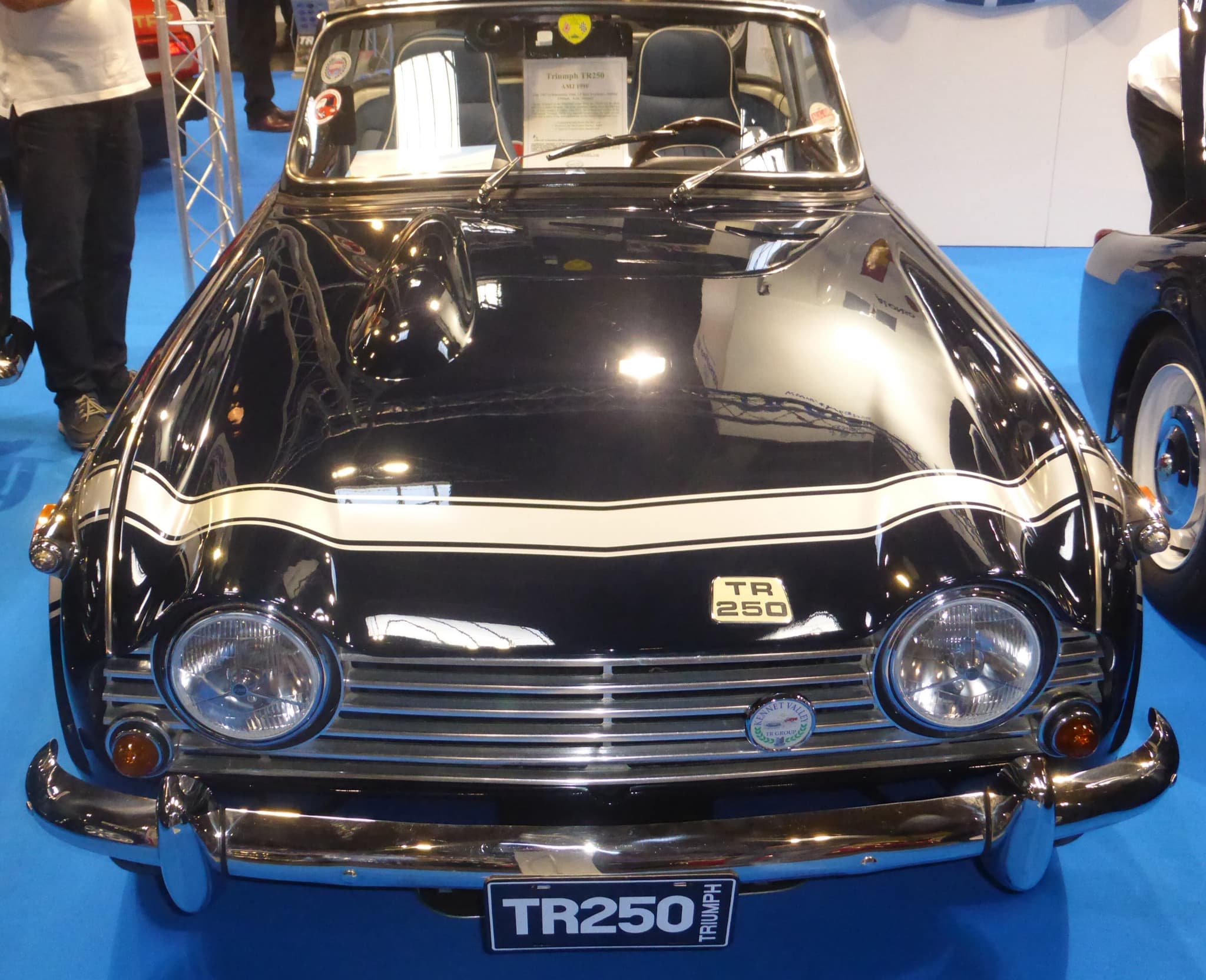
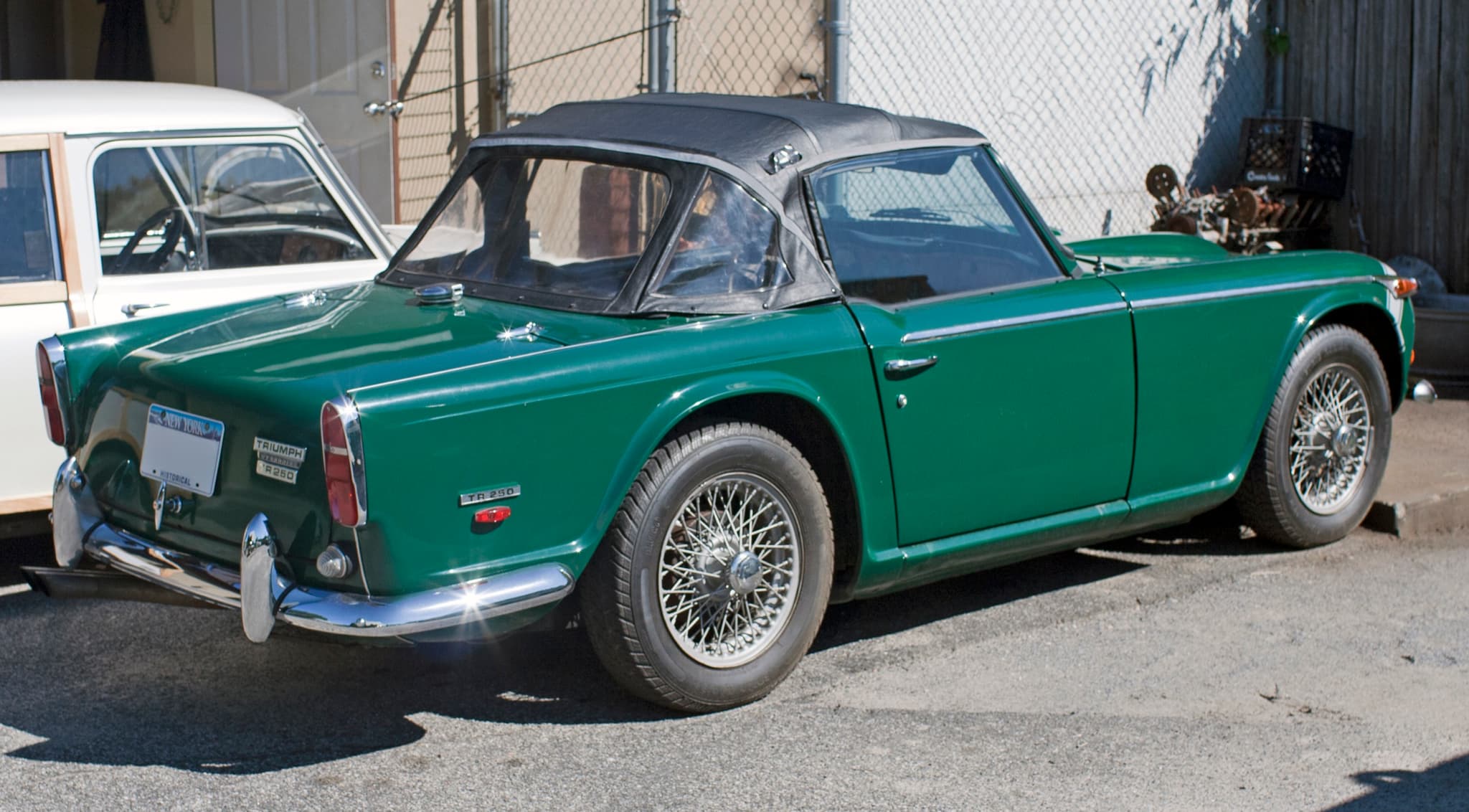
Every TR250 was meant to be recognised at a glance. The Vintage Triumph Register (VTR) says that each one left Canley with a stripe across the bonnet, pointed in the middle and swept back across the wings (fenders), and Aaron Severson credits the stripe and brighter colours to Bruce McWilliams, who ran marketing for Leyland's American company and had developed such tricks at Rover.
Under the stripe were the body, frame and six of the TR5 PI, with carburettors. The first TR250, CD1, left Canley on 11 July 1967, seven weeks before the first production TR5, and the last, CD8594L, on 19 September 1968, the day the first carburetted TR6 was built. Almost three TR250s were built for every TR5.
Instead there was the TR250, exported to North America and Canada only, with twin Stromberg carburetted 104bhp/2498cc six cylinder engine, and transverse speed stripe across the nose for recognition purposes.
Why there was a TR250
Two reasons are given, and both hold. The first is emissions. The TR Register writes that the TR5 could not be sold in North America because of the new American exhaust rules, the TR Drivers' Club points to the same tighter rules, and James Taylor writes that the Lucas system could not be made to meet them. The German TR Register's guide says that the sharp injected version could no longer be sold in the United States, "und blieb England und dem Rest der Welt vorbehalten" (in our translation, and was kept for England and the rest of the world).
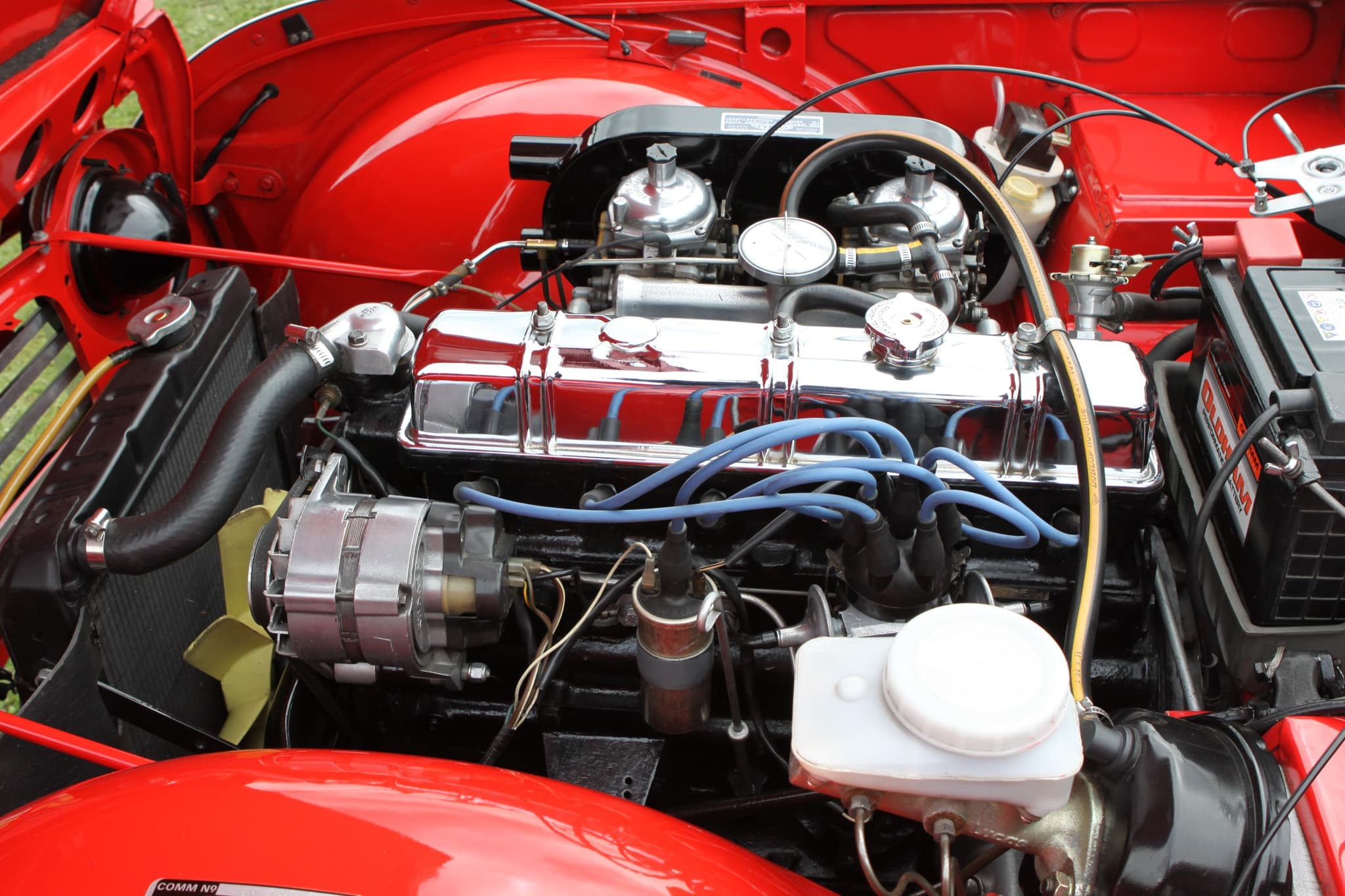
The second is cost. In a market where the distributors had already balked at paying for independent rear suspension, Severson puts the cost of injection at $400 or more on the list price, and adds that the injected engine, rich at low speeds, could have passed the rules only with an air pump. The answer was to detune the six: its compression came down, two modified Zenith-Stromberg carburettors took the place of the injection and its inlet vacuum was limited, and it passed with no extra hardware, which also cut the cost of making it. Michael Richards records that the sales force rebelled at the thought of a TR dearer than the TR4A.
Chris Harvey writes that the Americans got a car "with the old carburettors that, ironically, passed the emission tests by careful tuning", and adds that "if the TR250's jets were much smaller they'd be blanks".
Names
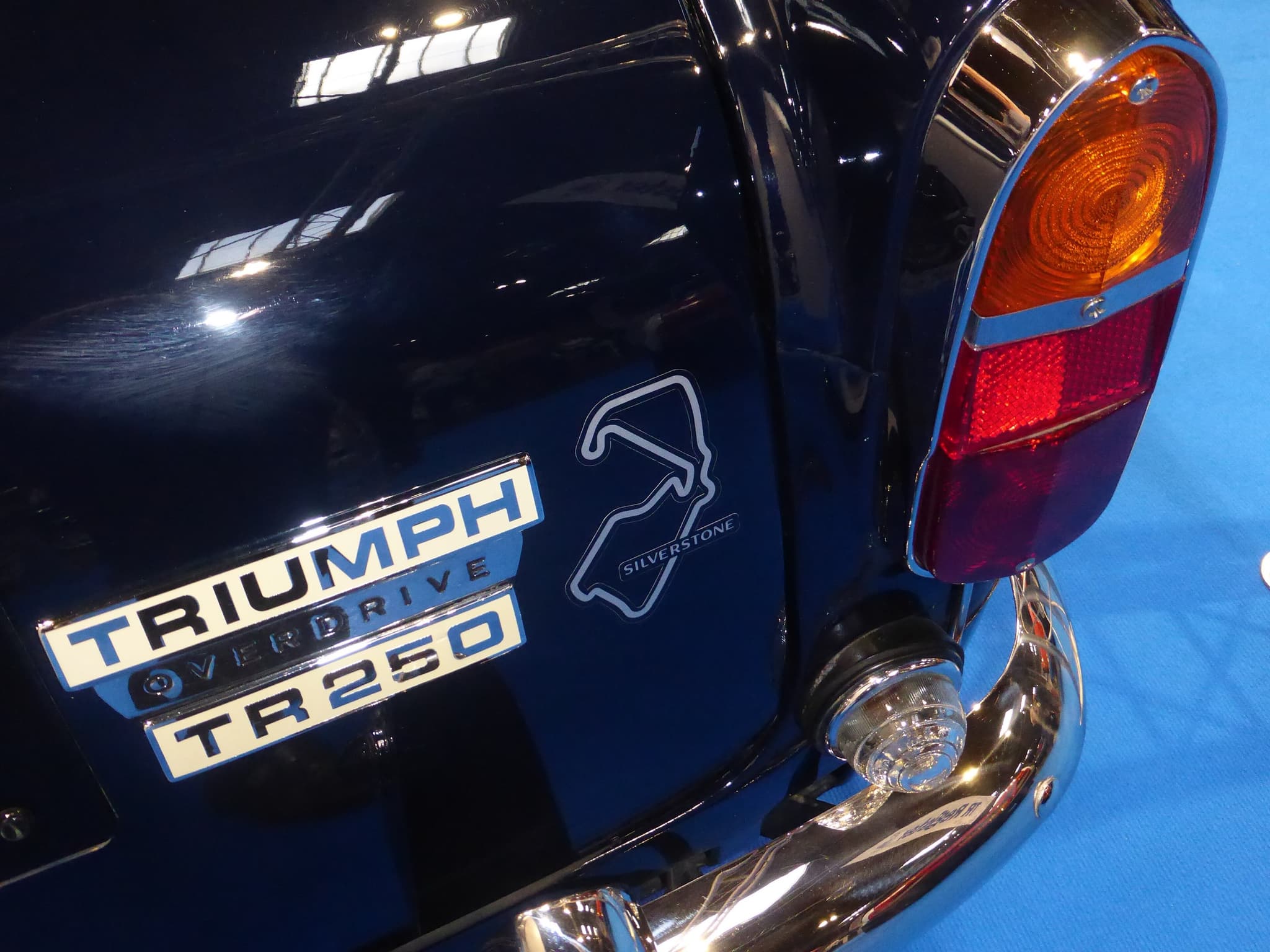
The car wore TR250 on the bonnet and on the boot lid, and a 2500 badge on each rear wing, as the TR5 did. Richards writes that Standard-Triumph chose not to give two such different cars one name. American magazines wrote it differently: Car and Driver headed its April 1968 story on the Sebring TR250K "TR-250K", and Motor Trend titled its April 1968 test "Triumph 250". The importer's newsletter once made them one car. Captioning a picture of the new TR5 the Coventry police had for patrolling the local expressways, its newsletter of July 1968 called it a "TR-5 (that's TR-250 to you)".
What changed for the US and Canadian market
The VTR's account of the TR250 is the fullest, and most of what follows rests on it. The table sets the main differences against the TR5 PI; the specification below gives the figures.
| Item | TR250 | TR5 PI |
|---|---|---|
| Fuel system | Zenith-Stromberg carburettors, mixture sealed | Lucas petrol (fuel) injection |
| Camshaft | 256°, by the German TR Register | 280° |
| Axle | The TR4A's, lower geared | Higher geared |
| Brakes | Servo standard, with a brake-failure warning lamp | Servo standard; the warning lamp on left-hand-drive cars |
| Hazard flashers | Standard | On left-hand-drive cars |
| Commission numbers | CD | CP |
Under the bonnet there was a vacuum control valve on the throttle linkage below the front carburettor, which the VTR describes as often lost or not working, and hoses striped yellow and black. Every TR250 had independent rear suspension, since the live axle some American TR4As had was no longer offered, and the front lower wishbones gained a second stud to the frame, which the VTR says cured a failure noted on the TR4A. Severson adds that the TR4's optional, still lower-geared axle could no longer be had except to special order. The tyres were wider than the TR5's, and their speed rating differs between the sources; the specification's note gives both.
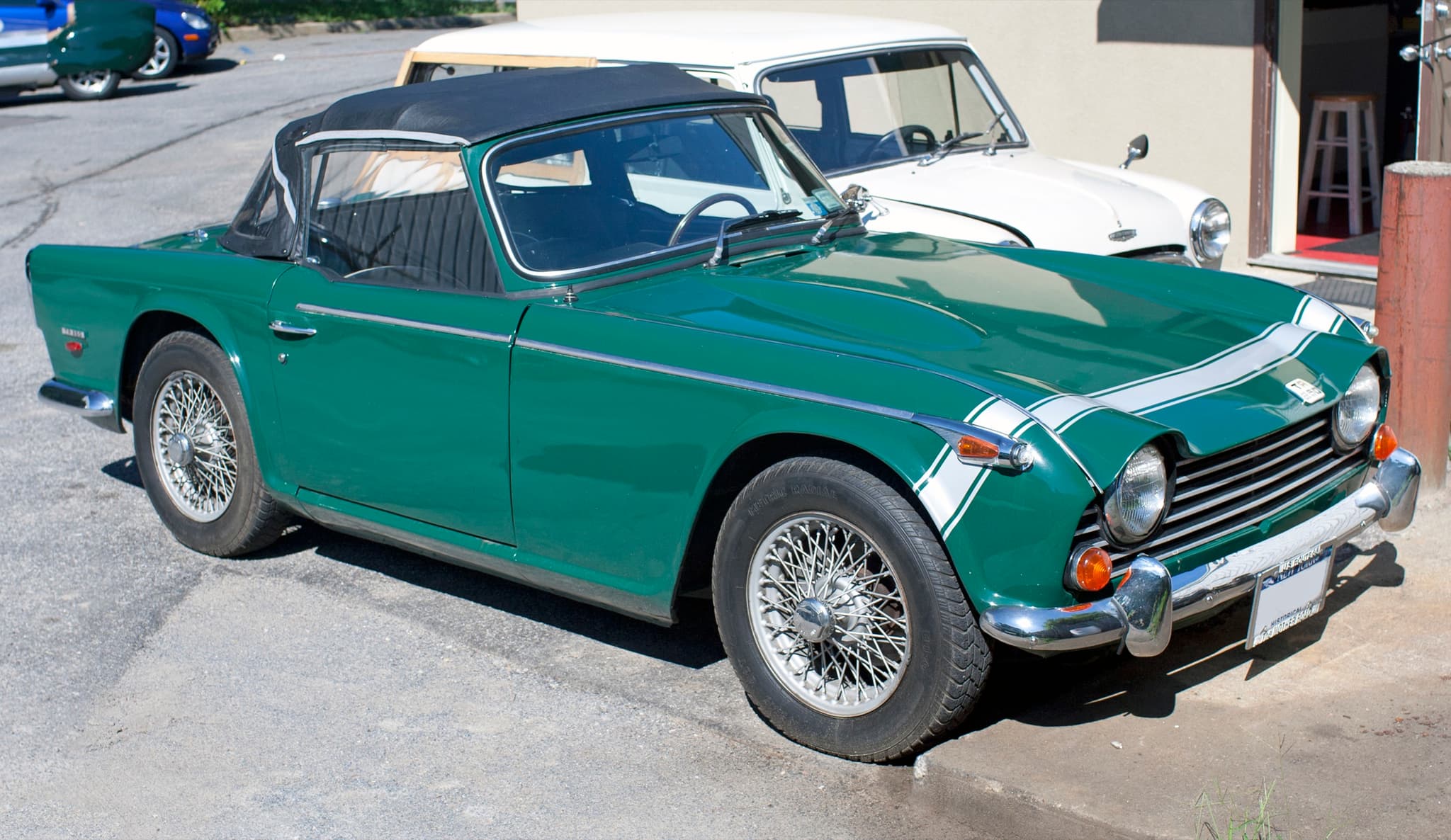
Outside, beside the stripe and badges, there were amber front lamps whose sides no longer flashed, tail lamps with vertical fins and indicator lenses red or amber by the state the car was sold in, and a magnetic "Monza" fuel cap, larger than the TR5's. British Leyland later told dealers to turn the cap through 45° so that it would not open in a collision. Its wheel covers were the same Rostyle-style ones as the TR5's, and wire wheels could be had instead.
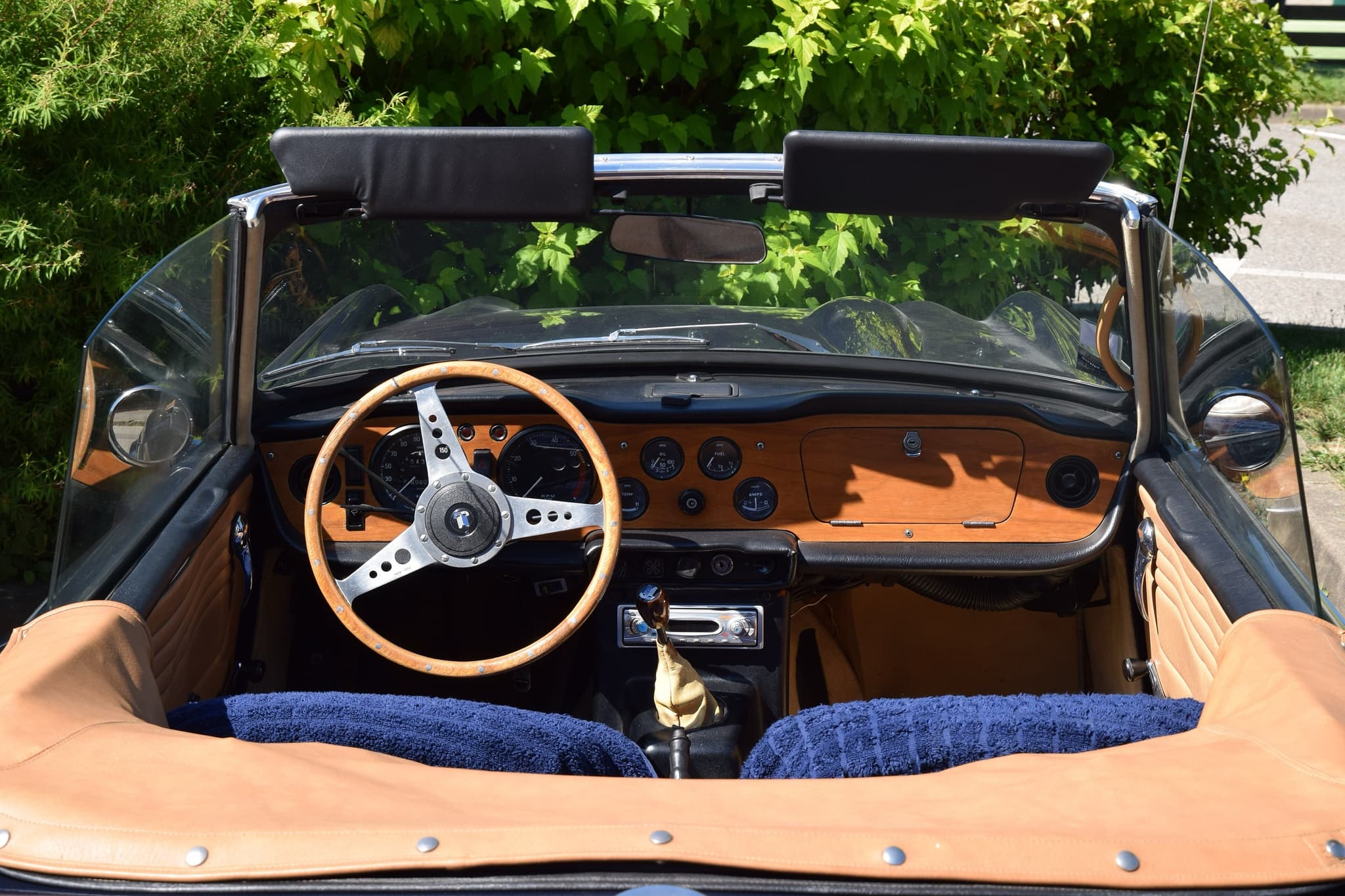
For safety the VTR lists a brake-failure warning lamp, a brace to keep the steering rack from collapsing into the cockpit and hazard flashers; Severson adds that both cars had switches revised for the federal rules that took effect on 1 January 1968. Inside, the seats had a diamond pattern in their centre panels; Ambla was standard, and leather an option on the seat facings. The dashboard kept its wood, though, the VTR says, the last 500 to 750 cars did without the book-matched veneer of the rest. Overdrive was an option, fitted at the factory or by a dealer; a glass-fibre hardtop was offered in America only, and the TR Drivers' Club says the TR250 could also have the Surrey top. Air conditioning was advertised, though, the VTR notes, no original example is known.
Tr250s were the first Triumphs to offer a Hazard flasher system.
Selling it, and living with it
The importer's newsletter reported that by February 1968 the TR-250 was "in such short supply that few dealers have more than one in stock", and Leyland's stand at the New York Auto Show, which opened at the Coliseum on 30 March, was to feature the TR-250 and a light show. Severson writes that it sold well enough, though far behind the four-cylinder TR4.
Road & Track's owner survey of 1969, as reported by Severson, found that over 40% of TR250 owners would not buy another. Severson records an early complaint:
Owners soon complained about the emissions-controlled carburetors, which were temperamental and could not be adjusted.
On the track, Kas Kastner's competition department and Group 44 ran TR250s in C Production in 1968, and Bob Tullius won often in the East; the season is on racing, and the Sebring one-off that Kastner built with Peter Brock on a TR4A chassis is the TR250K. The press reception is on road tests.source 17source 18source 4source 3source 19source 20source 21source 12
Other markets
The TR250 was built for the United States and Canada; no source read gives a Canadian difference or a Canadian price. Elsewhere the car sold was the TR5 PI, though a few TR250s were delivered in Europe and the German TR Register gives a German price for the TR250:
| Market | What differed |
|---|---|
| Britain | The TR5 PI with right-hand drive; its price rose in spring 1968 with purchase tax |
| Continental Europe | The TR5 PI with left-hand drive, and hazard and brake-failure warning lamps, which the Italian brochure lists "nei modelli a guida sinistra soltanto" (on left-hand-drive models only) |
| Belgium | Kits assembled at Malines (Mechelen), according to tr5passion.com, and numbered 1CP … LP |
| France | Mostly Belgian-assembled cars, says tr5passion.com, which gives a price of 20,000 francs |
| Germany | Prices of DM 14,290 for a TR5 PI and DM 12,650 for a TR250, by the German TR Register's figures; TR250s delivered there had extra number-plate (license-plate) lamps |
| Denmark | Extra plate lamps on TR250s delivered there, two TR3-type lamps turned upside down on the boot lid |
| Australia | Right-hand-drive TR5s, one of which Sports Car World tested in October 1968 |
| United States and Canada | The TR250 only; no TR5 went there new |
The Belgian cars have numbers and plates of their own, and tr5passion.com advises that the British Motor Museum holds no record of them; identification explains both.
Some TR250s never crossed the Atlantic. An American could take delivery in Europe: the importer's newsletter of March 1968 set out the cost, from a factory price of $2,325 with estimates for registration, shipping, duty and federal tax, $2,803 in all. The VTR says that "A few 250's did stay in Europe via the European delivery program but it was not the norm."source 14source 1source 15source 7source 18source 3source 4source 22
Specification
Production
Sources for Production, TR250
- Price new
- Several figures in print.Triumph Sports Owners Association, Triumph Sports Owners Association Newsletter, March 1968, Mar 1968 (vol. 14 no. 3)source 18; TR Register, "Triumph TR5 / TR250" (facts sheet, under "Buyers Guide")source 4; Aaron Severson, "Grandfather's Ax: The Many Evolutions of the Triumph TR4, Part 2: TR5, TR250, and TR6", Ate Up With Motor, 7 Nov 2012source 3
- Built
- Several figures in print.Drew Holliday, "Triumph TR250 Production Information" (8 pp. PDF), Vintage Triumph Registersource 1; Graham Robson (essay "15 Years of Evolution"), Triumph TR2 – TR3/3A, TR4/4A – TR5, TR250 1953–1968 Parts & Accessories Catalogue, Rimmer Bros, edn 2.1 (source code TR2512), Part 1source 2
- Built at
- One good source."built at Canley" (production table heading). Graham Robson (essay "15 Years of Evolution"), Triumph TR2 – TR3/3A, TR4/4A – TR5, TR250 1953–1968 Parts & Accessories Catalogue, Rimmer Bros, edn 2.1 (source code TR2512), Part 1source 2
| Price new | $3,175.00 Price new, TR250 Several figures in print.
|
|---|---|
| Built | 11 Jul 1967 (CD1, start) Built, TR250 Several figures in print.
|
| Built at | Canley |
Engine
Sources for Engine, TR250
- Capacity
- Good sources agree.74.7 × 95 mm. TR Register, "Triumph TR5 / TR250" (facts sheet, under "Buyers Guide")source 4; Bruno Dwinger, "Geschichte, Typenkunde und Kaufberatung: Standard-Triumph TR4, TR5/TR250 – 'die Michelotti Autos'", TR-Register Deutschland, 2009, 13 pp. (PDF)source 7
- Compression ratio
- Good sources agree.Aaron Severson, "Grandfather's Ax: The Many Evolutions of the Triumph TR4, Part 2: TR5, TR250, and TR6", Ate Up With Motor, 7 Nov 2012source 3; Bruno Dwinger, "Geschichte, Typenkunde und Kaufberatung: Standard-Triumph TR4, TR5/TR250 – 'die Michelotti Autos'", TR-Register Deutschland, 2009, 13 pp. (PDF)source 7
- Carburettors
- Several figures in print.Aaron Severson, "Grandfather's Ax: The Many Evolutions of the Triumph TR4, Part 2: TR5, TR250, and TR6", Ate Up With Motor, 7 Nov 2012source 3; TR Register, "Triumph TR5 / TR250" (facts sheet, under "Buyers Guide")source 4
| Capacity | 2498 cc |
|---|---|
| Compression ratio | 8.5:1 |
| Carburettors | two Zenith-Stromberg 175CD (175CDSE, mixture sealed) Carburettors, TR250 Several figures in print.
|
Performance
Sources for Performance, TR250
- Power
- Several figures in print.Aaron Severson, "Grandfather's Ax: The Many Evolutions of the Triumph TR4, Part 2: TR5, TR250, and TR6", Ate Up With Motor, 7 Nov 2012source 3; TR Register, "Triumph TR5 / TR250" (facts sheet, under "Buyers Guide")source 4; TR Drivers Club, "The TR5/250"source 8; Drew Holliday, "Triumph TR250 Production Information" (8 pp. PDF), Vintage Triumph Registersource 1; Motor Sport, "A–Z of Classic Sporting Cars 1950–1975", Oct 1996, p. 80source 23
- Torque
- Several figures in print.Aaron Severson, "Grandfather's Ax: The Many Evolutions of the Triumph TR4, Part 2: TR5, TR250, and TR6", Ate Up With Motor, 7 Nov 2012source 3; TR Register, "Triumph TR5 / TR250" (facts sheet, under "Buyers Guide")source 4
- Top speed
- Good sources disagree.TR Register, "Triumph TR5 / TR250" (facts sheet, under "Buyers Guide")source 4; Motor Sport, "A–Z of Classic Sporting Cars 1950–1975", Oct 1996, p. 80source 23
- 0–60 mph
- One good source.Test not named. TR Register, "Triumph TR5 / TR250" (facts sheet, under "Buyers Guide")source 4; TR Drivers Club, "The TR5/250"source 8
- Standing start
- Good sources disagree.TR Register, "Triumph TR5 / TR250" (facts sheet, under "Buyers Guide")source 4; Drew Holliday, "Triumph TR250 Production Information" (8 pp. PDF), Vintage Triumph Registersource 1
| Power | 104 bhp Power, TR250 Several figures in print.
|
|---|---|
| Torque | 143 lb ft Torque, TR250 Several figures in print.
|
| Top speed | 109 mph |
| 0–60 mph | 10.6 s |
| Standing start | 17.8 s Standing start, TR250 Good sources disagree. |
Running gear
Sources for Running gear, TR250
- Overdrive
- Several figures in print.Bruno Dwinger, "Geschichte, Typenkunde und Kaufberatung: Standard-Triumph TR4, TR5/TR250 – 'die Michelotti Autos'", TR-Register Deutschland, 2009, 13 pp. (PDF)source 7; Drew Holliday, "Triumph TR250 Production Information" (8 pp. PDF), Vintage Triumph Registersource 1
- Front brakes
- Several figures in print.Drew Holliday, "Triumph TR250 Production Information" (8 pp. PDF), Vintage Triumph Registersource 1; Aaron Severson, "Grandfather's Ax: The Many Evolutions of the Triumph TR4, Part 2: TR5, TR250, and TR6", Ate Up With Motor, 7 Nov 2012source 3
- Front suspension
- Good sources agree.The TR6's was "the first on a production TR". Aaron Severson, "Grandfather's Ax: The Many Evolutions of the Triumph TR4, Part 2: TR5, TR250, and TR6", Ate Up With Motor, 7 Nov 2012source 3; Triumph Sports Owners Association, Triumph Sports Owners Association Newsletter, January 1969, Jan 1969 (vol. 15 no. 1)source 24
- Tyres
- Good sources disagree.TR Register, "Triumph TR5 / TR250" (facts sheet, under "Buyers Guide")source 4; Drew Holliday, "Triumph TR250 Production Information" (8 pp. PDF), Vintage Triumph Registersource 1; Aaron Severson, "Grandfather's Ax: The Many Evolutions of the Triumph TR4, Part 2: TR5, TR250, and TR6", Ate Up With Motor, 7 Nov 2012source 3
- Wheels
- Several figures in print.Drew Holliday, "Triumph TR250 Production Information" (8 pp. PDF), Vintage Triumph Registersource 1; TR Register, "Triumph TR5 / TR250" (facts sheet, under "Buyers Guide")source 4
| Overdrive | Laycock A-type on 2nd, 3rd and top Overdrive, TR250 Several figures in print.
|
|---|---|
| Front brakes | servo standard; PDWA brake-failure warning Front brakes, TR250 Several figures in print.
|
| Front suspension | no anti-roll bar |
| Tyres | 185 × 15 Tyres, TR250 Good sources disagree.
|
| Wheels | 4.5 × 15 steel, Rostyle-style covers; 60-spoke wire wheels optional Wheels, TR250 Several figures in print. |
Dimensions and weight
Sources for Dimensions and weight, TR250
- Length
- One good source.Drew Holliday, "Triumph TR250 Production Information" (8 pp. PDF), Vintage Triumph Registersource 1
- Width
- One good source.Drew Holliday, "Triumph TR250 Production Information" (8 pp. PDF), Vintage Triumph Registersource 1
- Height
- One good source.Top up. Drew Holliday, "Triumph TR250 Production Information" (8 pp. PDF), Vintage Triumph Registersource 1
- Kerb weight
- Several figures in print.Drew Holliday, "Triumph TR250 Production Information" (8 pp. PDF), Vintage Triumph Registersource 1; Wikipedia (EN), "Triumph TR5", 2026source 25
- Wheelbase
- One good source.Drew Holliday, "Triumph TR250 Production Information" (8 pp. PDF), Vintage Triumph Registersource 1
- Ground clearance
- One good source.Drew Holliday, "Triumph TR250 Production Information" (8 pp. PDF), Vintage Triumph Registersource 1
- Fuel tank
- One good source.Drew Holliday, "Triumph TR250 Production Information" (8 pp. PDF), Vintage Triumph Registersource 1
| Length | 153.6 in |
|---|---|
| Width | 58 in |
| Height | 50 in |
| Kerb weight | 2277 lb |
| Wheelbase | 88 in |
| Ground clearance | 6 in |
| Fuel tank | 13.5 US gal |
Production
Production: how far the sources agree
- 8484, "exported to North America and Canada only"
- Good sources agree.
8484"exported to North America and Canada only"
TR Register, "Triumph TR5 / TR250" (facts sheet, under "Buyers Guide")source 4; Drew Holliday, "Triumph TR250 Production Information" (8 pp. PDF), Vintage Triumph Registersource 1; TR Drivers Club, "The TR5/250"source 8; Graham Robson (essay "15 Years of Evolution"), Triumph TR2 – TR3/3A, TR4/4A – TR5, TR250 1953–1968 Parts & Accessories Catalogue, Rimmer Bros, edn 2.1 (source code TR2512), Part 1source 2; Fred M. H. Gregory, "TR8 V-8: A mighty Triumph" (road test), with the sidebar "A String of Triumphs", Motor Trend, Jun 1980source 26
Sources
Sources are given as plain text; their addresses are on the sources page.
- Primarymade at the time, by the maker or by people who were there
- Referenceserious later work: clubs, specialists, magazines, books
- Databaseresults and listings, entry by entry
- Uncheckedencyclopaedias and enthusiast sites: cited beside a good source, named in the sentence, or marked Unchecked
- Drew Holliday, "Triumph TR250 Production Information" (8 pp. PDF), Vintage Triumph Register, p. 1, CD1 and CD8594L; p. 3, the stripe; p. 3, badges; pp. 2–5; p. 1, CKD kits and European delivery; p. 4, plate lamps; p. 1, span list; p. 2; options; p. 7; pp. 2-3; p. 1. Reference
- Graham Robson (essay "15 Years of Evolution"), Triumph TR2 – TR3/3A, TR4/4A – TR5, TR250 1953–1968 Parts & Accessories Catalogue, Rimmer Bros, edn 2.1 (source code TR2512), Part 1, pp. 6–7; p. 7, commission numbers (read by the TR4 agent); p. 6, production table (read by the TR4 agent). Reference
- Aaron Severson, "Grandfather's Ax: The Many Evolutions of the Triumph TR4, Part 2: TR5, TR250, and TR6", Ate Up With Motor, 7 Nov 2012, "Triumph TR5 PI and TR250", McWilliams; "The carbureted six"; notes on sources, the period tests; "The carbureted six"; "Triumph TR5 PI and TR250"; "Triumph TR5 PI and TR250", owners and sales; notes on sources, Sports Car World; view-all page, TR5 and TR250 sections. Reference
- TR Register, "Triumph TR5 / TR250" (facts sheet, under "Buyers Guide"), history; production; Basic Price TR250; markets; facts sheet, prices; facts sheet, engine details; facts sheet, TR250; facts sheet, performance table; facts sheet, production. Reference
- Graham Robson (foreword), Triumph TR6 1969–1976 Parts & Accessories Catalogue, Rimmer Bros, edn 2.2 (source code TR600313), p. 5, CC25003L. Reference
- Chris Harvey, TR for Triumph, Oxford Illustrated Press, 1983, ISBN 0-902280-94-5, full-text passages on the US engine; full-text passage on the cylinder heads. Reference
- Bruno Dwinger, "Geschichte, Typenkunde und Kaufberatung: Standard-Triumph TR4, TR5/TR250 – 'die Michelotti Autos'", TR-Register Deutschland, 2009, 13 pp. (PDF), p. 5, the US version; p. 5, camshafts; p. 5; pp. 12–13, German prices; technical data, TR250; p. 11. Reference
- TR Drivers Club, "The TR5/250", history; the Surrey top; TR5/250 page; TR5/250 page, performance; TR5/250 page, production. Reference
- Michael Richards, Triumph TR4, 5, 6, Haynes, 1990, full-text passage on the sales force; full-text passage on the badges. Reference
- James Taylor, Triumph TR, Windrow & Greene, Classics in Colour 9, 1994, full-text passage on emissions. Reference
- Triumph Sports Owners Association, Triumph Sports Owners Association Newsletter, July 1968, Jul 1968 (vol. 14 no. 7), p. 3, the Coventry police caption. Primary
- Leon Mandel, "TR-250K: Salvation of an Empire", Car and Driver, Apr 1968 (vol. 13 no. 10), the title; pp. 2–4, the TR4A chassis. Primary
- Moss Motoring, "Driven – 1968 Triumph TR250", 28 Aug 2015, "fewer made than any other TR"; the wheel covers. Reference
- Standard-Triumph, Nuova Triumph TR5 PI (fold-out sales brochure), Italy, Oct 1967, ref. 387/1067/IT, data panel, warning lamps. Primary
- Frédéric Reydellet (racing history), tr5passion.com (group): "En bref / Summary", "Identification", "Lucas injection", "Options", "Technical spec", "Colours", "TR5 Ginevra", "Racing history", TR5 Passion, Technical specification page (_r65), alternator; Identification page (_r61); Summary page (_r58). Reference
- Steve Gronau with David Webb (buyer's guide), "TR5/250" (history; buyer's guide), Vintage Triumph Register, modified 12 Dec 2023, buyer's guide, striped hoses. Reference
- Triumph Sports Owners Association, Triumph Sports Owners Association Newsletter, April 1968, Apr 1968 (vol. 14 no. 4), p. 4, sales and supply. Primary
- Triumph Sports Owners Association, Triumph Sports Owners Association Newsletter, March 1968, Mar 1968 (vol. 14 no. 3), p. 3, the New York Auto Show; p. 4, the price panel; overseas-delivery panel; Mar 1968, price list. Primary
- Triumph Sports Owners Association, Triumph Sports Owners Association Newsletter, September 1968, Sep 1968 (vol. 14 no. 9), p. 2. Primary
- Triumph Sports Owners Association, Triumph Sports Owners Association Newsletter, December 1968, Dec 1968 (masthead "Volume 14, Number 11"), p. 3. Primary
- racingsportscars.com, Sebring 12 Hours 1968, results, No. 47. Database
- Moss Motoring, "Triumph in America", 1 Mar 2001, TR5 and TR250 lines. Reference
- Motor Sport, "A–Z of Classic Sporting Cars 1950–1975", Oct 1996, p. 80, Oct 1996 p. 80, TR5 entry. Reference
- Triumph Sports Owners Association, Triumph Sports Owners Association Newsletter, January 1969, Jan 1969 (vol. 15 no. 1), Jan 1969 (read by the TR6 agent). Primary
- Wikipedia (EN), "Triumph TR5", 2026, TR250 table. Unchecked
- Fred M. H. Gregory, "TR8 V-8: A mighty Triumph" (road test), with the sidebar "A String of Triumphs", Motor Trend, Jun 1980, Jun 1980, sidebar "A String of Triumphs" (read by the TR8 agent). Primary