Triumph TR5 History
From a TR4A taken off the line in February 1965 to the day in September 1968 when the TR6 replaced it: how the TR5 got its six and its injection, why America got the TR250 instead, and what became of them.
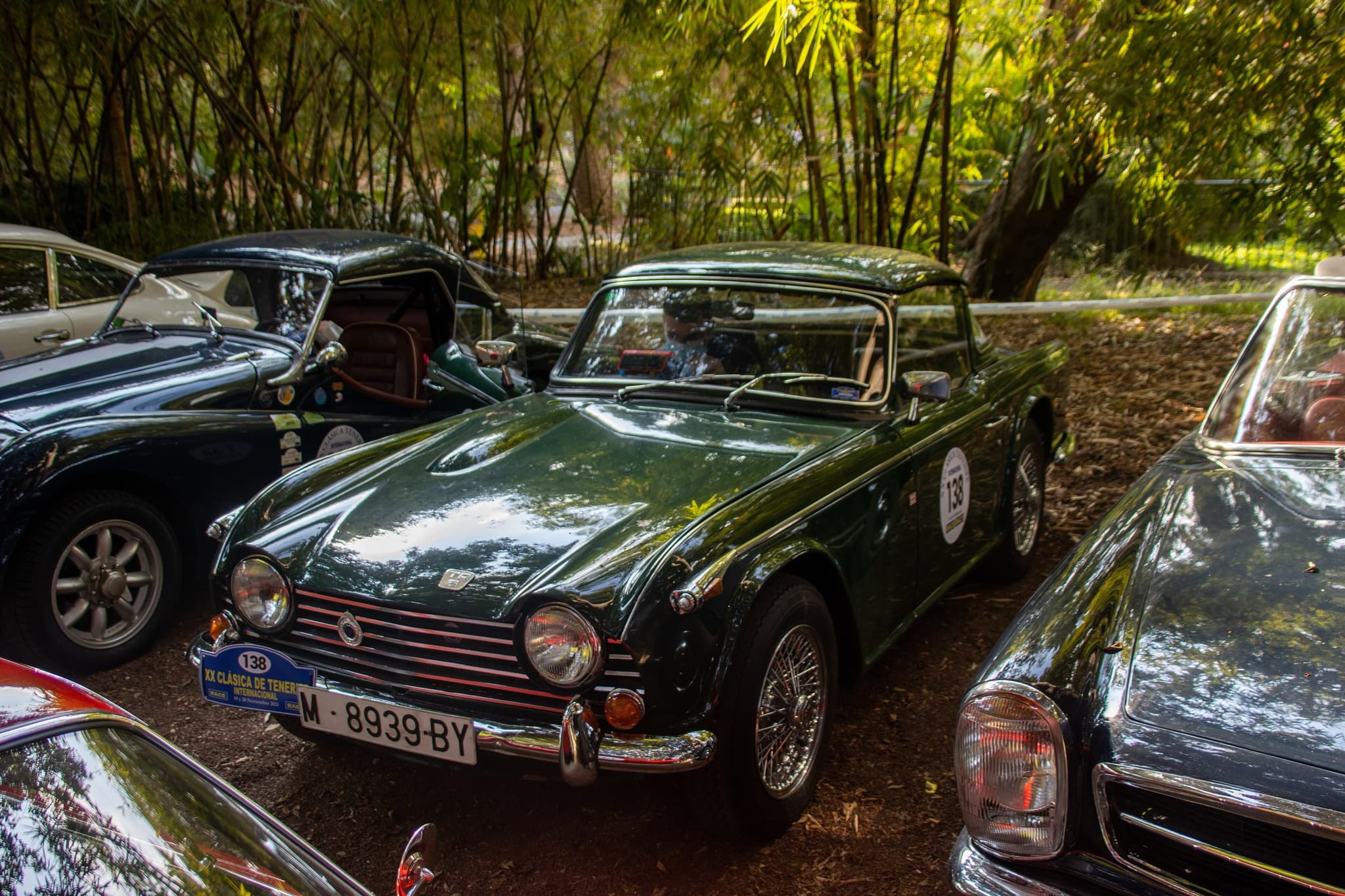
About the pictureA TR5 PI photographed in 2017, standing in for a period picture.
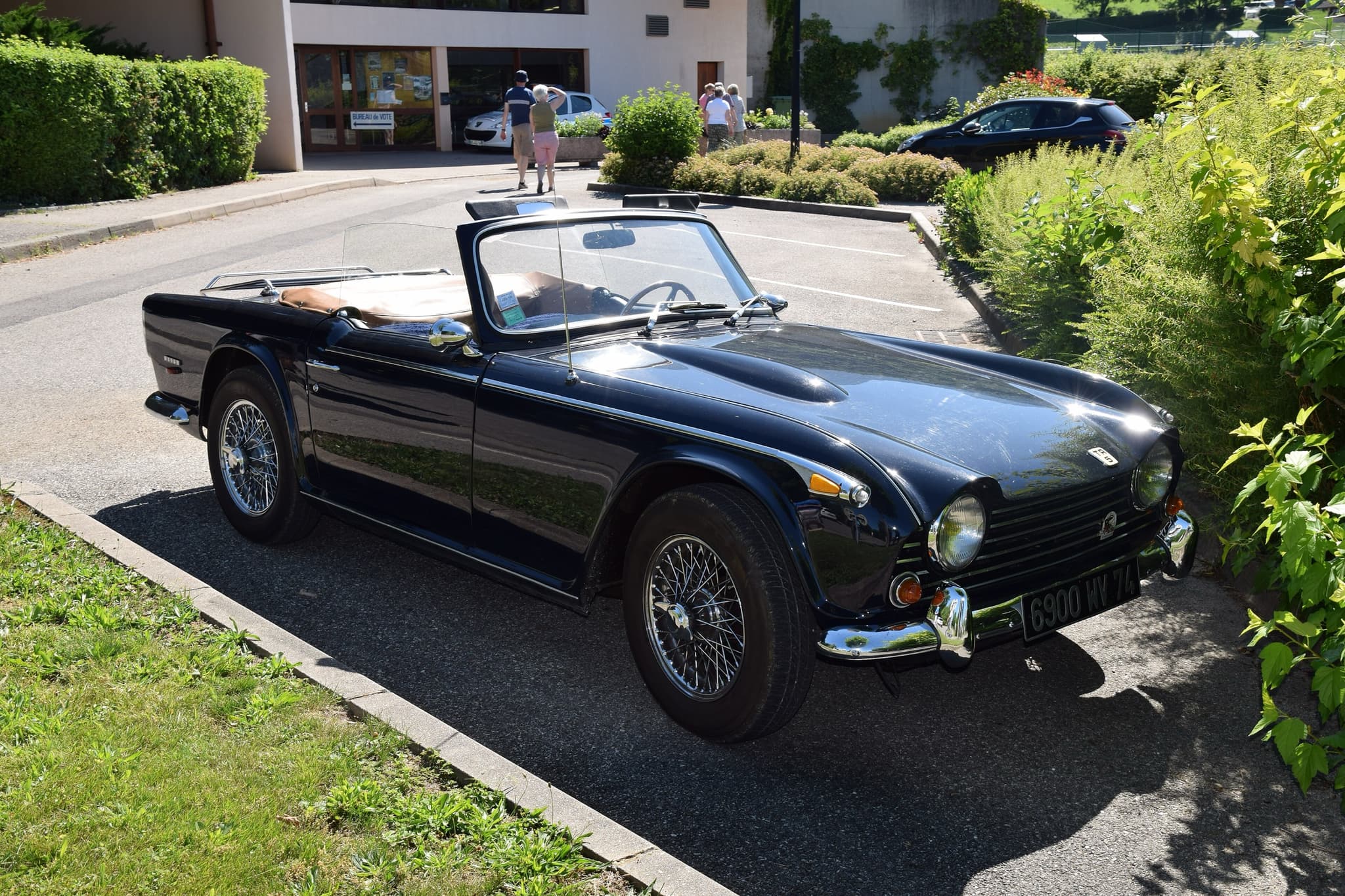
On 19 September 1968 the line at Canley, in Coventry, built the last TR5 PI, CP3101, and the last TR250, CD8594L. The same day it built the first carburetted TR6, CC25003L. Standard-Triumph had announced the TR5 less than a year before, on 3 October 1967, and the first TR250 had been built in July 1967.
The car had a longer story, which began with a six-cylinder TR prototype on test in 1962.source 1source 2source 3source 4source 5source 6
Before the TR5: the TR4A and the case for six cylinders
The TR4A, built from January 1965, put independent rear suspension (semi-trailing arms and coil springs) under the body Giovanni Michelotti had styled for the TR4. In North America it was also sold with a live axle; the TR250 dropped that choice, and every TR250 had independent rear suspension.
By Aaron Severson's account the TR4A had grown heavier than the TR3A, 86 kg (190 lb) by the factory's reckoning, for only 9 more gross horsepower. The four-cylinder engine could be tuned, and in racing tune it made far more power, but at the cost of its pulling power low down and its economy. It could have been bored out. Or Triumph could use the newer six of the Vitesse and the 2000 saloon (sedan). By then the old four was used only by the TR and some Morgans, and American emissions rules were coming.
The six won, though as it stood it gave away power and torque to the four. Standard-Triumph redesigned the block for a stroke 19 mm (0.75 in) longer on the same bore, so that one engine would serve the six-cylinder TR and the saloons to come. The German TR Register's guide says that the short-stroke engine became "ein echter Langhuber" (in our translation, a true long-stroke engine). Revington TR traces the six back to the Standard Vanguard's 2-litre six.
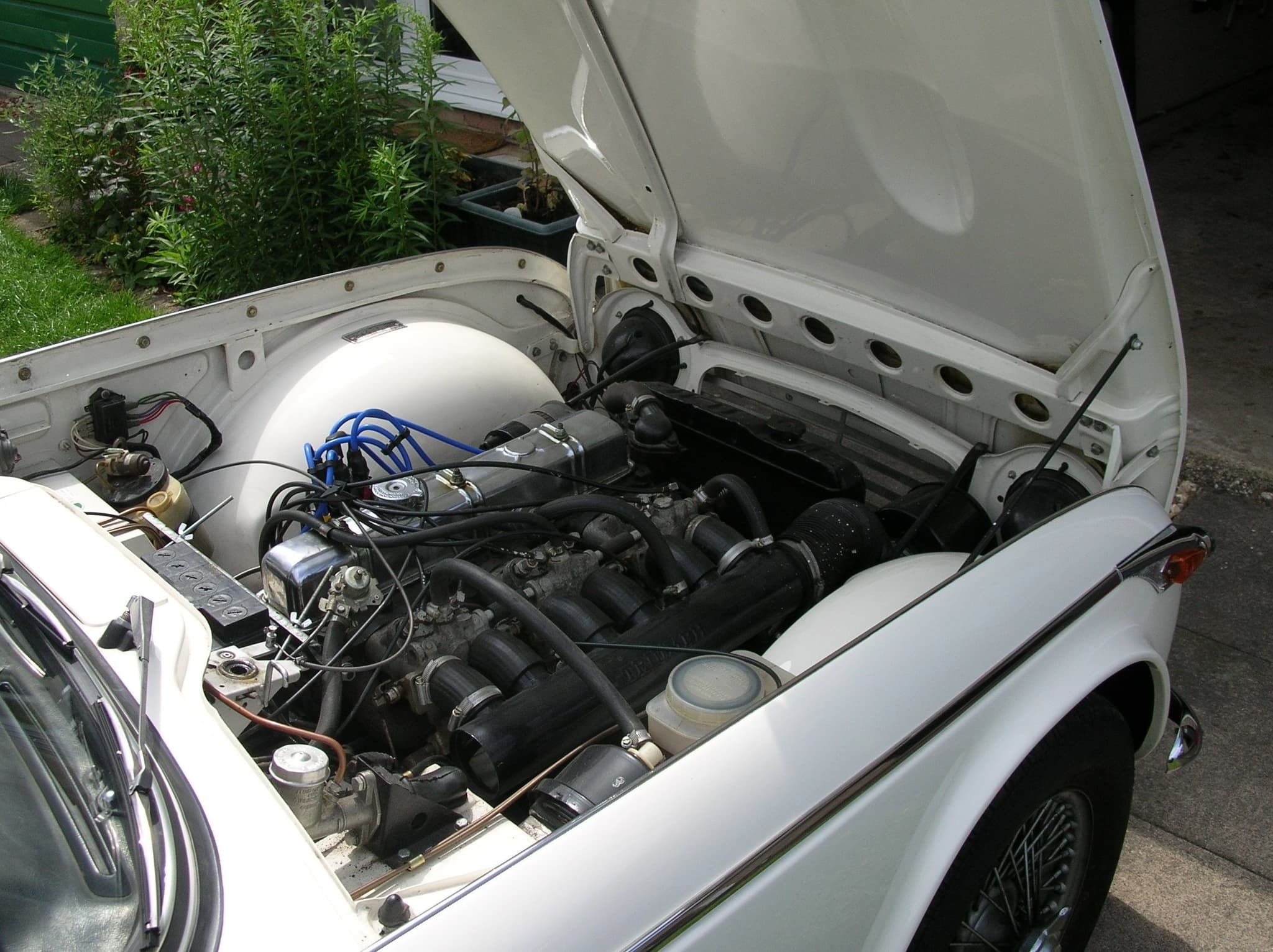
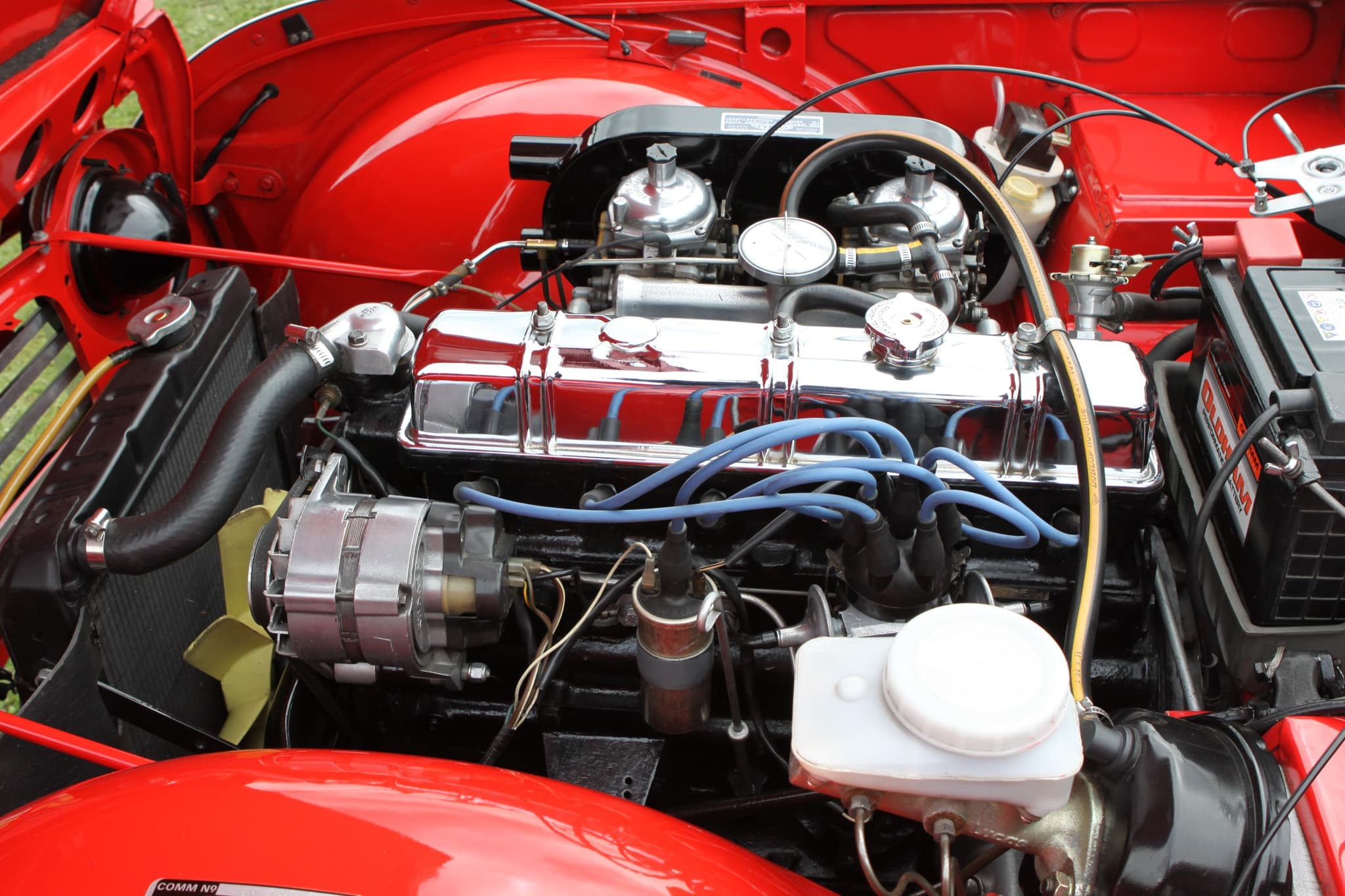
For the injected car the engine took higher compression and a hotter camshaft, and Lucas petrol (fuel) injection in place of the saloon's carburettors. Triumph's rally 2000s, Severson writes, had shown injection to be the better match for the hotter camshaft.source 2source 7source 1source 8source 9
The prototypes, 1962–67
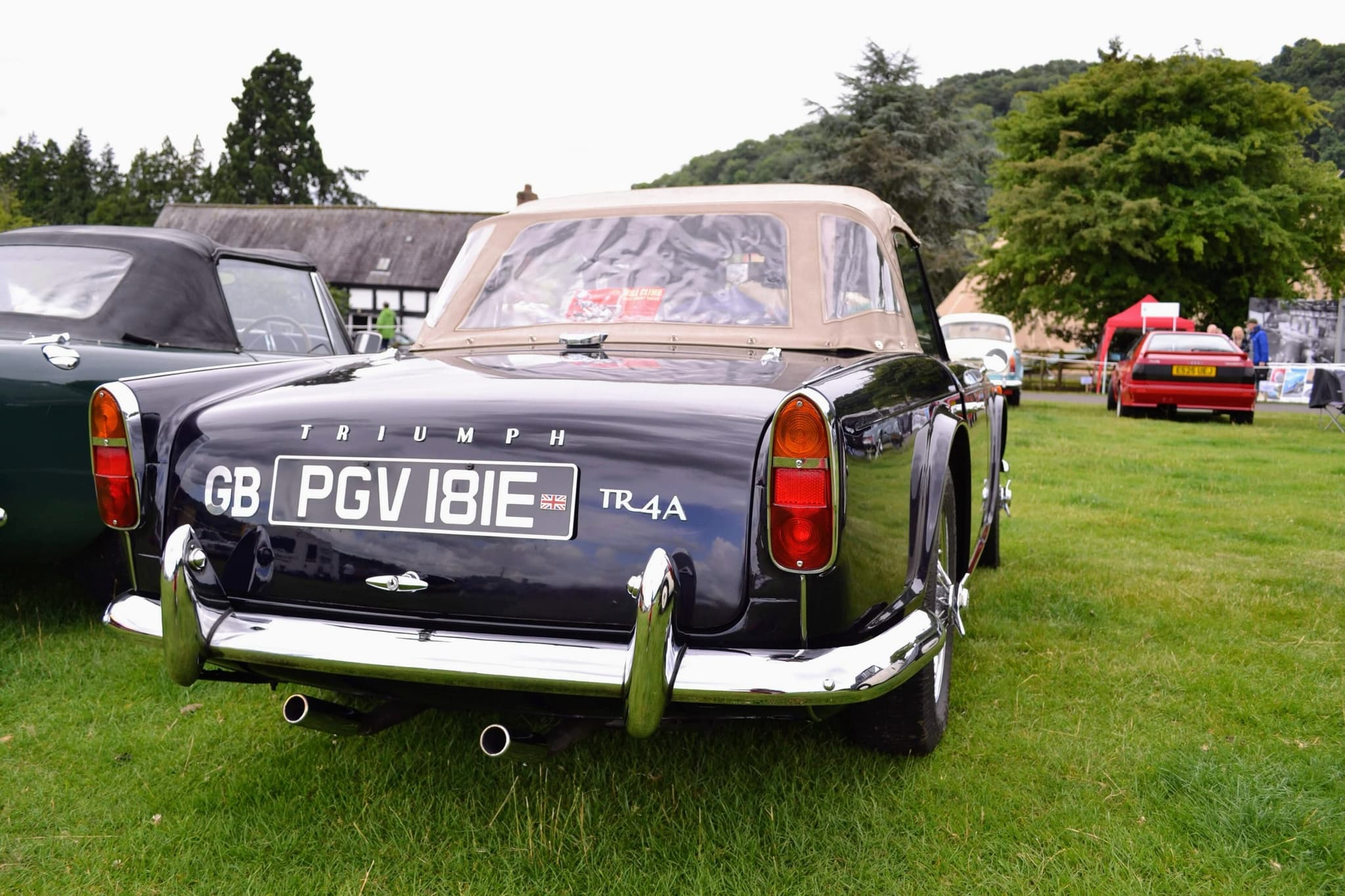
A six-cylinder TR began testing in 1962, five years before the TR5 or the TR250 was ready for production, according to Michael Richards. The project that led to them began in February 1965 and was code-named Wasp. "Various attempts were made to develop a TR4B as the 'Wasp' project," Chris Harvey writes, but the car that went into production kept the old body.
Its first prototype, X747, was built in February 1965, before the TR4A went on sale. Revington TR records that it was a TR4A taken from the production line with its chassis altered for the six, that it was registered to Lucas for injection development, and that Lucas kept it until 1972. Richards lists the rest. X748, registered GKV 310D, did not follow until February 1966; X753, X754 and X755 were registered in 1967 as JDU 745E, JVC 505E and LKV 40F; and X760 and X761 were also built in 1967. Michelotti's TR5 Ginevra, the one-off he showed at Geneva in 1968, was built on X760.
The injection came from Lucas: "The only British fuel injection system which could be used was that manufactured by Lucas," Richards writes, and Graham Robson lists fuel injection for the TR5 among the innovations completed while Harry Webster ran Standard-Triumph's engineering.
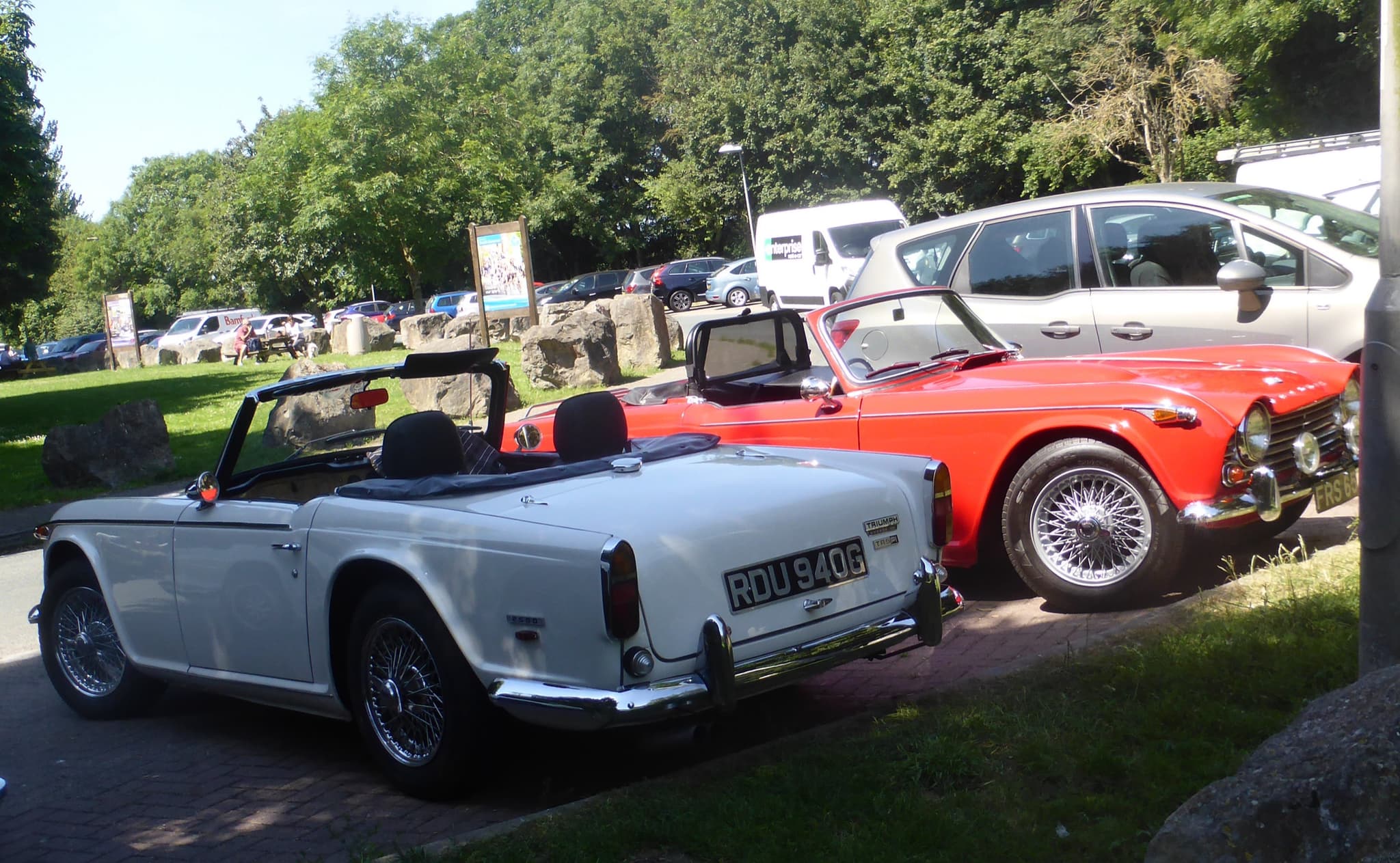
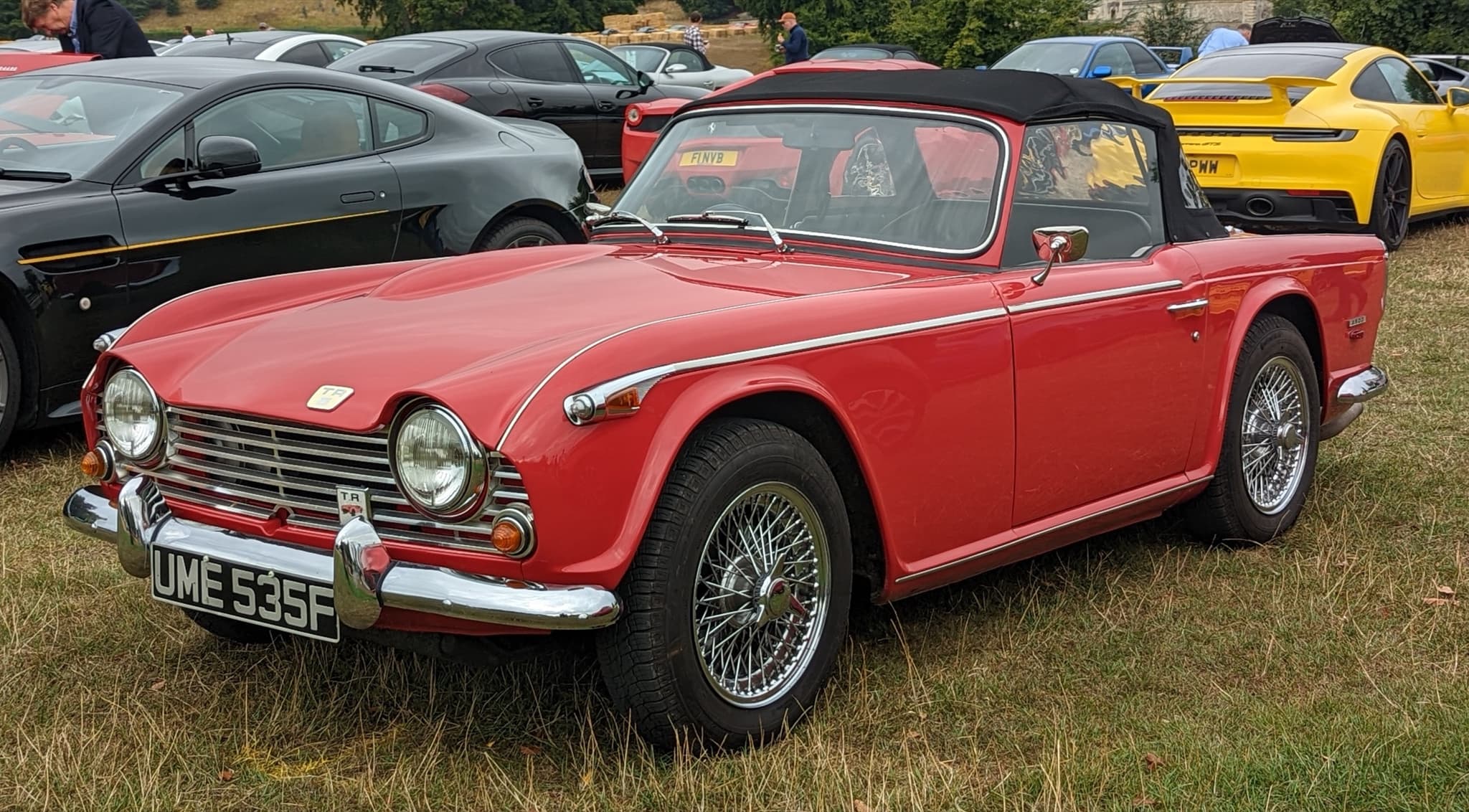
Richards also records the debate over names: whether cars with "so very different" engines should carry the same name. "Standard-Triumph thought not." The injected car was badged TR5 on the bonnet and TR5 PI on the boot lid, the carburetted car TR250 on both, and each wore a 2500 badge on its rear wings (fenders).source 6source 9source 7source 8source 10source 5source 4source 11
Two versions, 1966–67
Standard-Triumph hoped the injected six would bring refinement and power and meet the American emissions rules at the same time. In Severson's telling, "the sticking point once again was cost". American distributors had already balked at the price of independent rear suspension, and injection would have added at least $400 to the list price. The injected engine also ran rich, "particularly at low speeds", and would have needed an air-injection pump to pass the federal rules. With lower compression, two modified Zenith-Stromberg carburettors and a limit on inlet vacuum, the six passed without extra hardware, and the American organisation, Severson adds, was uneasy about the warranty implications of an unfamiliar injection system, rightly as it turned out.
Richards puts the pressure on price in the salesmen's terms:
Faced with the possibility of making the 'Wasp' much more expensive, in the USA, than the TR4A, the sales force rebelled.
The clubs tell it as a matter of emissions alone. The TR Register, the TR Drivers' Club and the German TR Register's guide all give the tighter American exhaust rules as the reason, and James Taylor's history agrees. The TR5 PI was kept for Britain and the rest of the world, and the TR250 was made for the United States and Canada; why there was a TR250 weighs the two reasons.source 7source 12source 13source 8source 6source 14
Production and launch, 1967–68
In the Vintage Triumph Register's list CD1, the first TR250, is dated 11 July 1967 and CP2, the first production TR5, 29 August; CP1 was a prototype, by tr5passion.com's account. The TR4A had ended that July, in 1967; the date of July 1964 in Wikipedia's article on the TR5 is a slip.
In October 1967 the car stood on Standard-Triumph's stand at the London Motor Show:
Pathé's commentator caught the point in a phrase: the new engine "does away with carburettors and uses a fuel injection system". The cars themselves came slowly. Motor Sport, waiting for a test car, reported in March 1968 that series production had only begun properly in the New Year, and its own test appeared in August; road tests follows the press through the car's life.
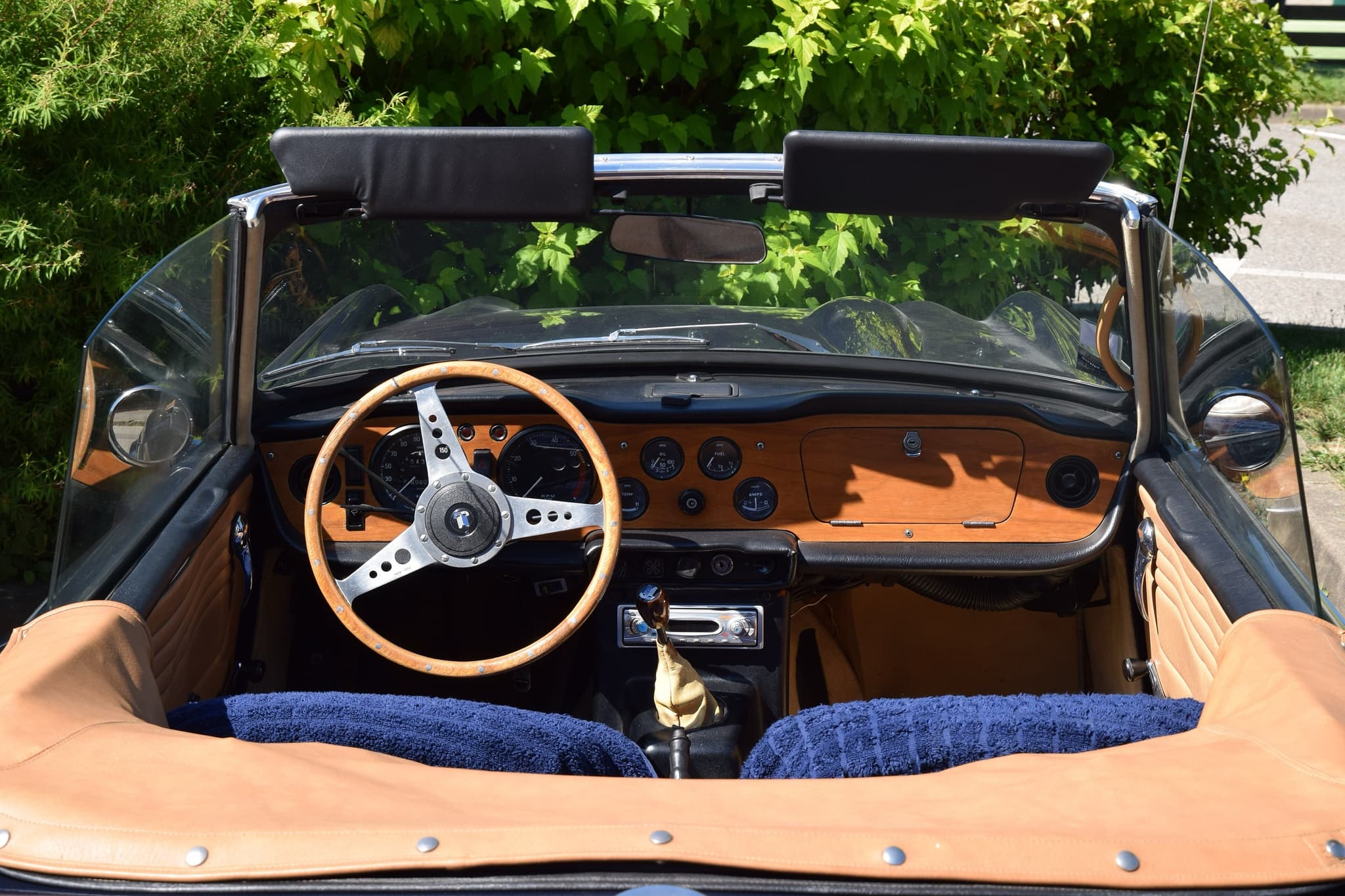
From 1 January 1968 cars for the United States had to meet new federal safety rules, and the switchgear of both cars was revised to comply. That spring the British price rose, after the Budget raised purchase tax on new cars, and the specifications give the prices. Around the engine, the brakes, rear springs, axle, tyres, electrics and trim all changed from the TR4A; TR5 vs TR6 lists them.source 1source 2source 5source 4source 15source 16source 7source 17source 18
The TR250 in America
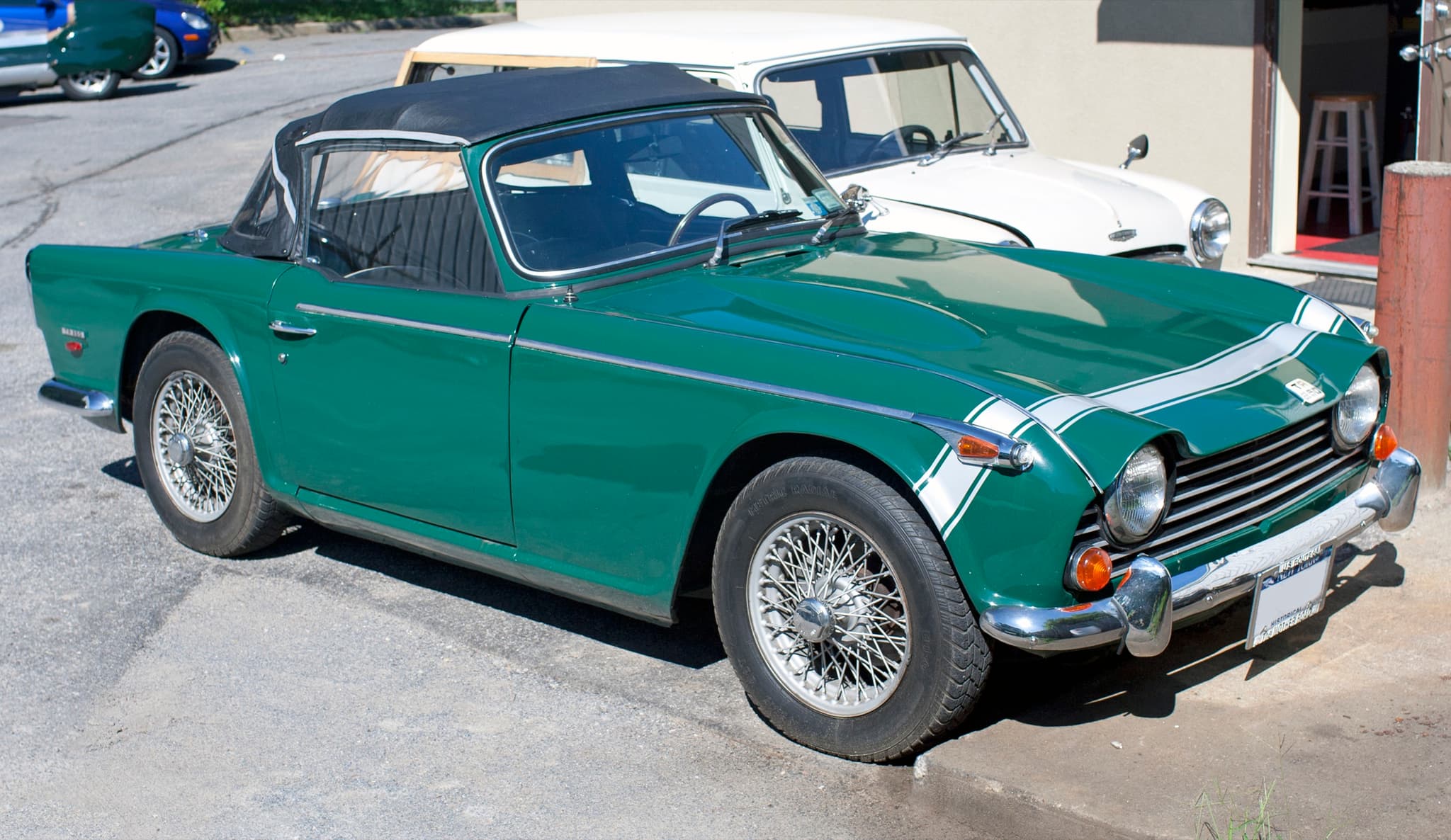
North America never had the TR5 new: the TR Register says that none went there, and Moss Motoring that it was never officially sold in the United States. What the American dealers had was the TR250, and it sold, in Severson's words, "reasonably briskly in the U.S. … but was well off the pace of the four-cylinder TR4". For Graham Robson it completed a change in Triumph's fortunes there:
In only five or six years, therefore, Leyland had transformed the fortunes of their North American sales operation, changing it from selling just one car—the aging TR3A, which was really dying on its feet in 1961—to one with no fewer than three fresh and modern models, the Spitfire, GT6 and TR250.
It was soon scarce: in the spring of 1968 the importer's newsletter reported that few dealers had more than one to sell. It also raced. Kas Kastner's competition department prepared Jim Dittemore's TR250 in the West and Group 44 ran Bob Tullius's in the East, in the Sports Car Club of America's C Production class. In March the two shared the TR250K, a one-off built for the Sebring 12 Hours. By the importer's count in September 1968 Tullius had six wins in the Northeast Division and three outside it, and in November he was third in C Production at the American Road Race of Champions. The season is told race by race on racing.source 12source 19source 7source 20source 21source 22source 23source 24source 25
Markets beyond Britain and America
Left-hand-drive TR5s went to continental Europe, and the factory's Italian brochure of October 1967 gave them hazard and brake-failure warning lamps that the right-hand-drive cars did not have. Some export cars left Canley as kits, which tr5passion.com says were assembled at Malines (Mechelen) in Belgium, and it adds that most French TR5s were among them; it gives a French price of 20,000 francs. The German TR Register gives German list prices of DM 14,290 for the TR5 PI and DM 12,650 for the TR250, against DM 12,750 for the TR4A. Right-hand-drive TR5s were also sold in Australia, where Sports Car World tested one in October 1968.
A few TR250s stayed in Europe, bought through the European delivery programme. Each market's differences are on the TR250 page, under other markets.source 26source 1source 5source 8source 7
Rivals in 1967–68
The obvious rival arrived at the same show. Bill Boddy, Motor Sport's editor, wrote in his show report of 1967 that the TR5 "will be a direct competitor of the 3-litre carburetted 145-b.h.p. M.G.-C". Both were six-cylinder developments of existing cars, announced at Motor Show time, and the magazine meant to test them together. It could not borrow a TR5, so in March 1968 it tested the MGC alone, and wrote: "Not only were comparisons being drawn with the TR5, but also with the MG.-B, which continues in production, and the Austin-Healey 3000, which doesn't." tr5passion.com names the same field: the MGC and the Austin-Healey 3000.
The MGC that Motor Sport tested was rated at 145 bhp at 5,250 rpm, the basis not stated, and cost £1,239 as tested with £127 of extras. By spring 1968, Severson writes, the TR5 cost over £100 more than a six-cylinder MGC. Rating the TR5 on a net basis, below Triumph's own figure (the specifications give both), he did not think the MGC close:
The rival MGC, marginally more powerful on paper, was no match at all for the Triumph.
The TR5's own figures are in the specifications.
No source read sets the TR250 beside its American rivals in 1967–68. The nearest is Popular Science's "The $3,000 Roadsters" of August 1969, which set the TR250's successor, the TR6, against the Datsun 2000, the Fiat 124 Spider, the MGB and the MGC. On the track the TR250 met Porsches, Datsuns and a Toyota in C Production, and at the season's championship race at Riverside in November 1968 Tullius was placed third behind two Porsches, ahead of a Toyota 2000 and the Datsuns (racing).source 27source 16source 7source 5source 28source 23
The British rivals 3
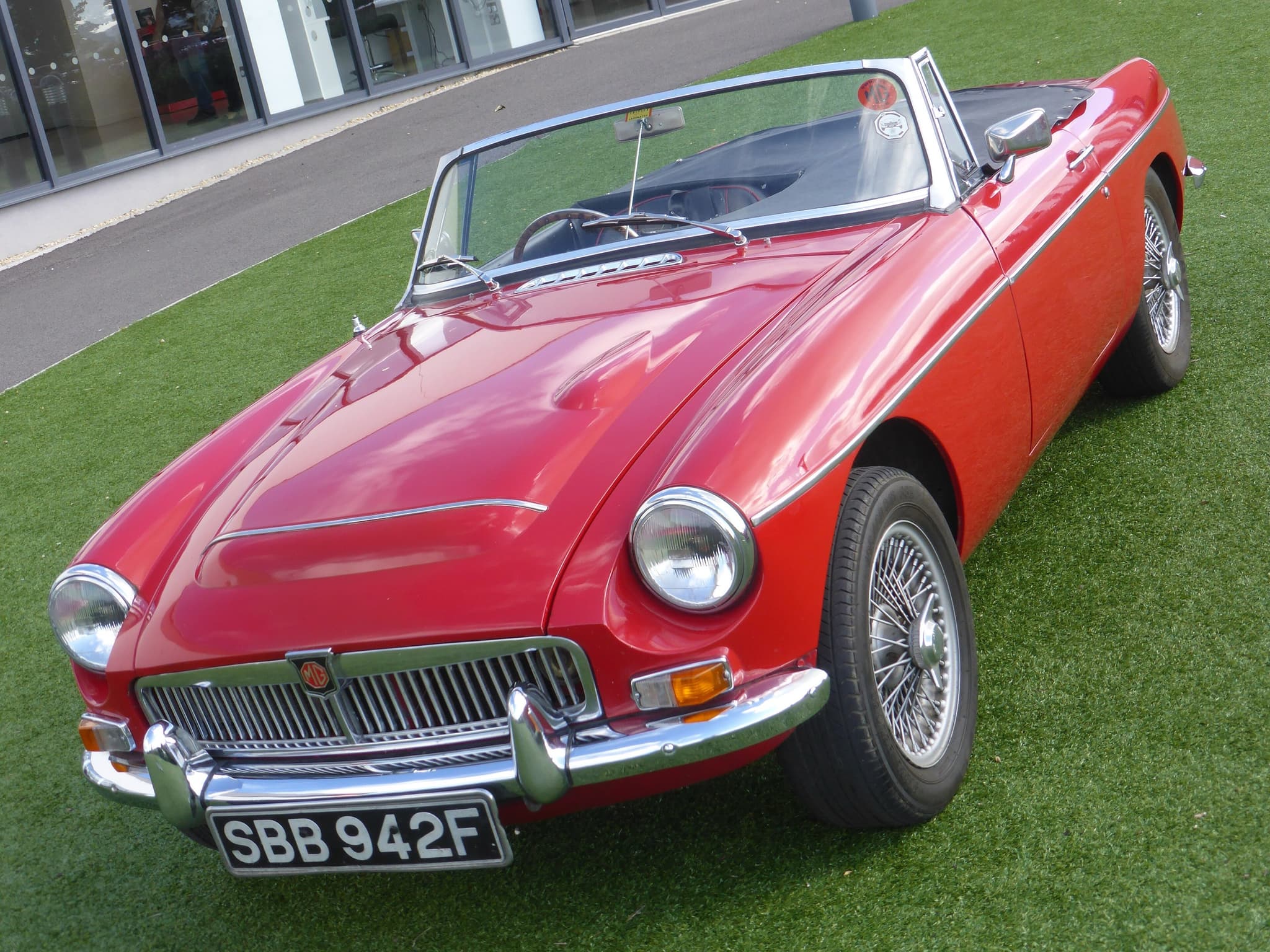
1 The MGC, *Motor Sport*'s choice of rival in 1967, here a roadster at the Haynes Motor Museum Breakfast Club, Sparkford, on 2 July 2017.
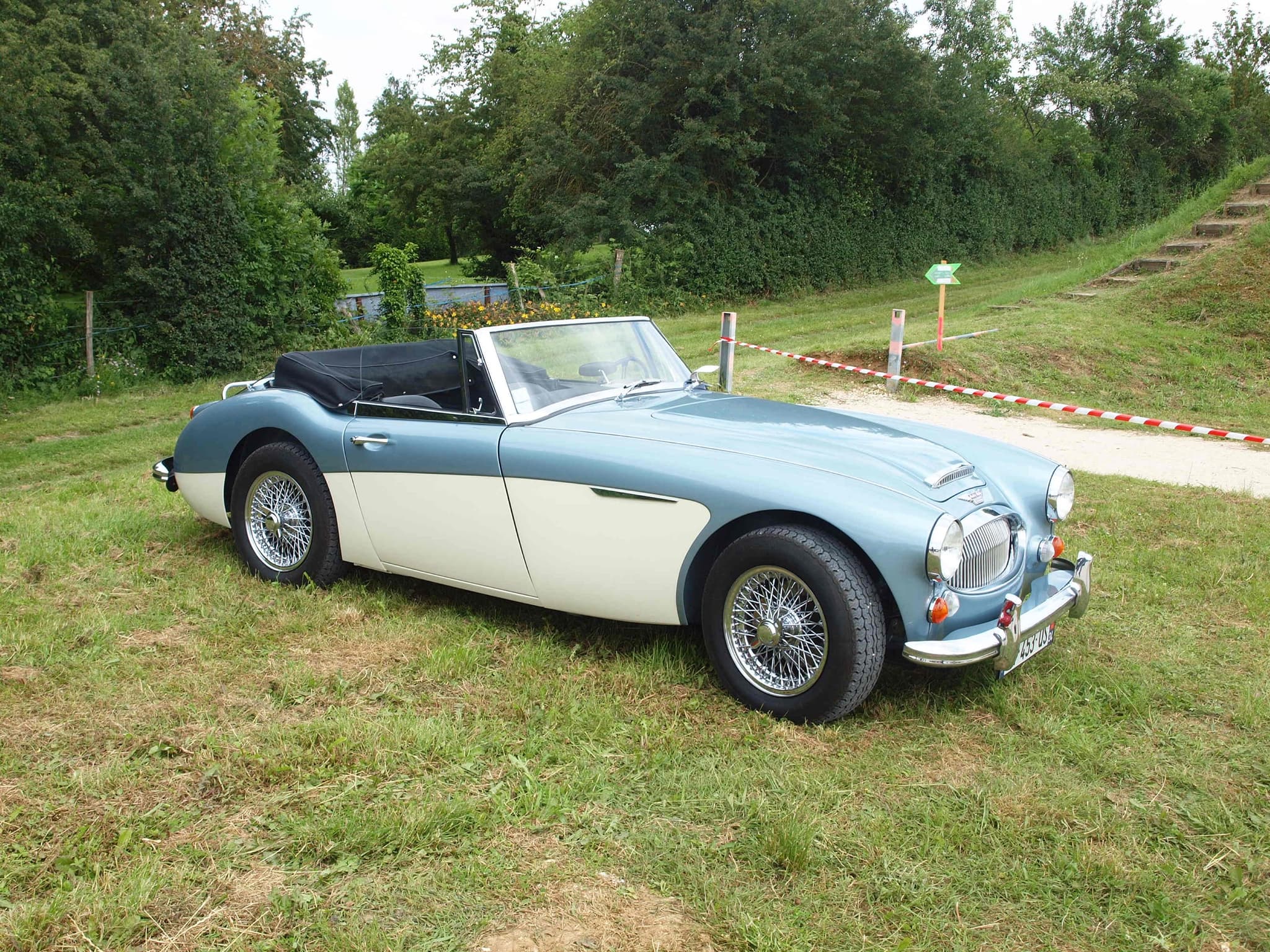
2 An Austin-Healey 3000 Mk III, the car going out of production as the TR5 arrived, with left-hand drive, at a gathering in Villemanoche, Yonne, France, on 17 June 2018.
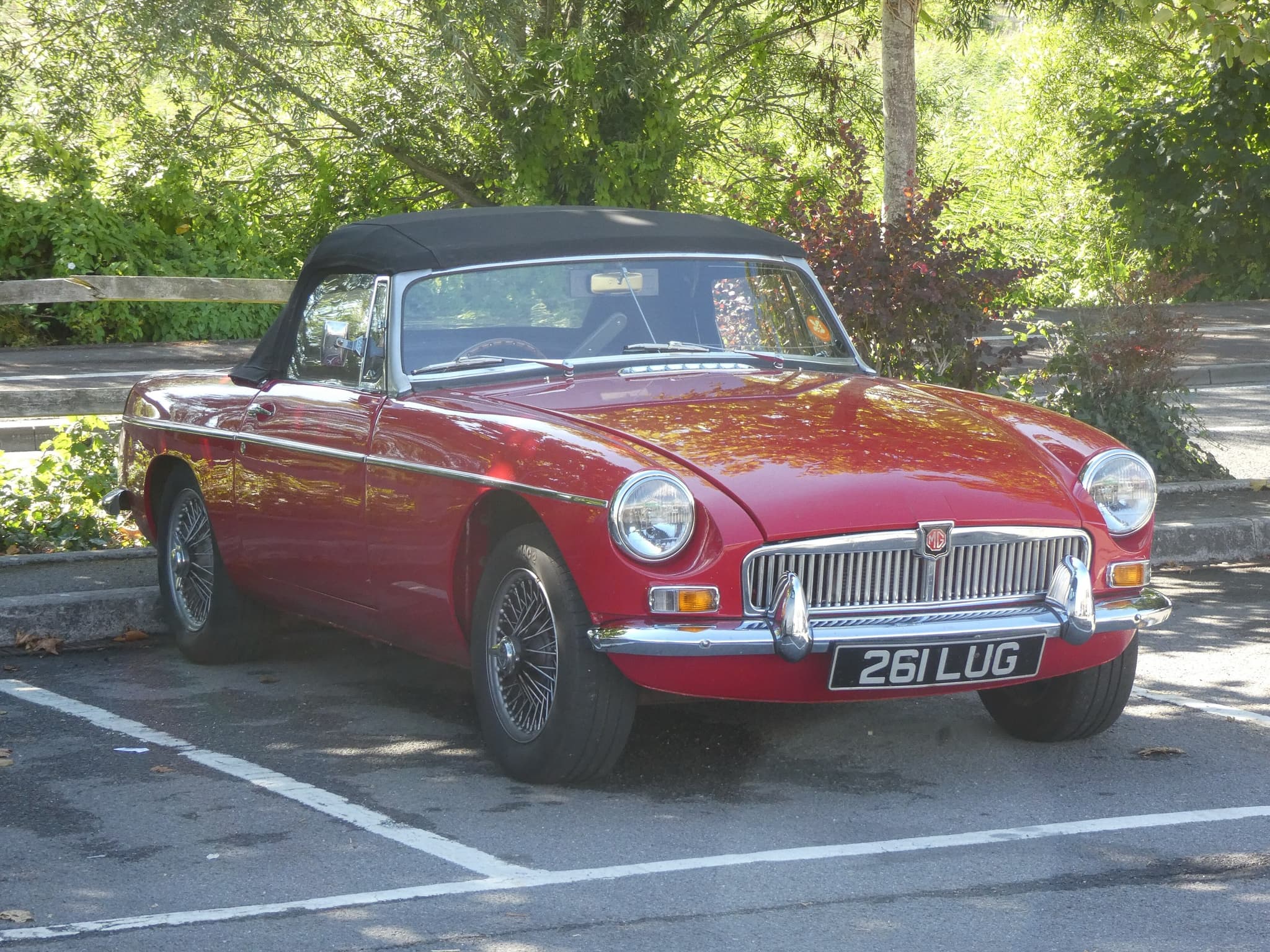
3 An early MGB roadster, the MG that continued beside the MGC, photographed in Dorset on 6 August 2020.
Picture credits (3)
- 1 Andrew Bone, CC BY 2.0
- 2 François GOGLINS, CC BY-SA 4.0
- 3 Andrew Bone, CC BY 2.0
The end: the TR6, 1968
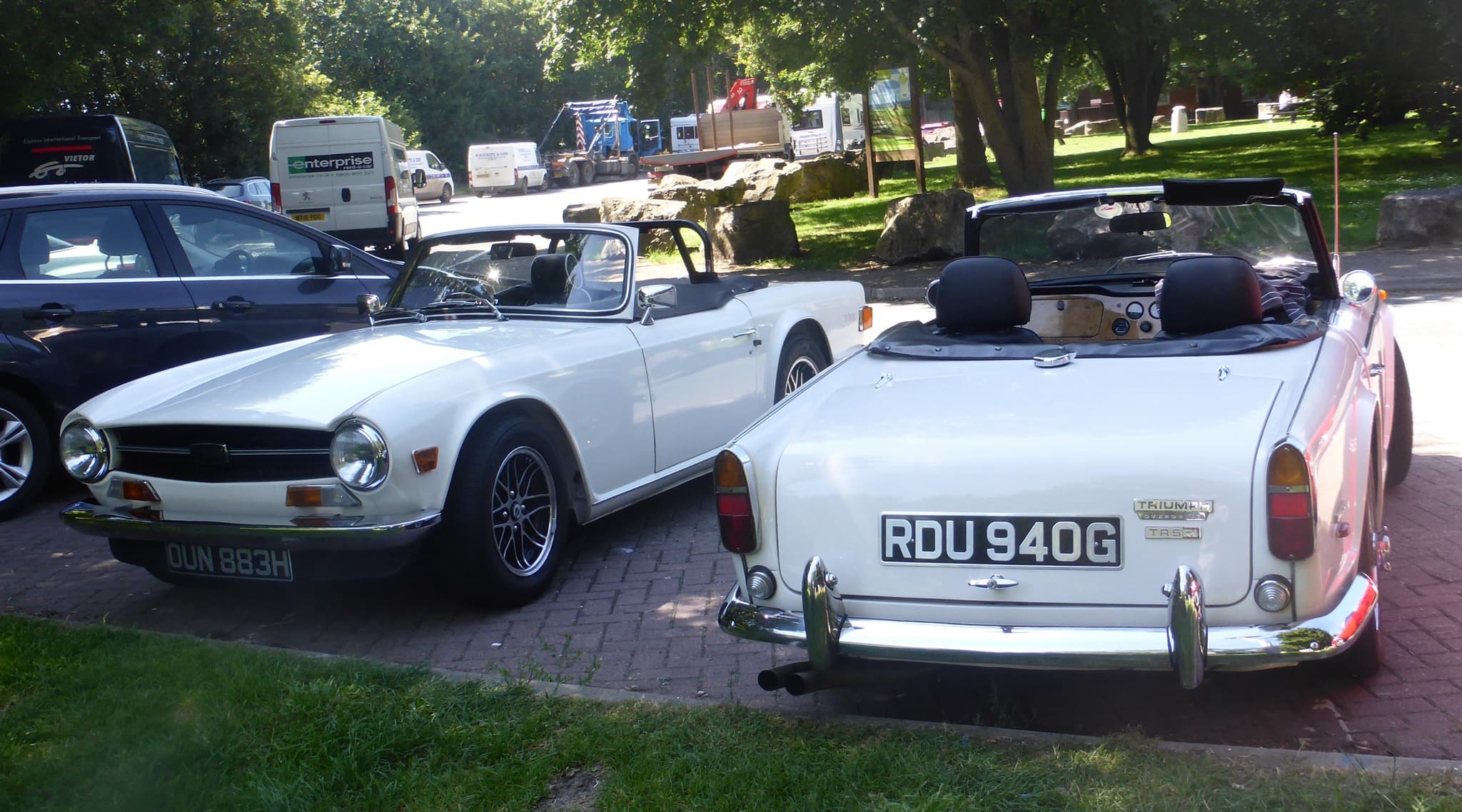
The TR5 was overtaken almost at once. In mid-1967, before it went on sale, Standard-Triumph decided that the body, the TR4's of 1961, needed updating quickly; by Severson's account Bruce McWilliams, who ran marketing for Leyland's American company, had argued in strong terms that it looked dated. Michelotti was busy, so the work went to Karmann, whose stylist, Severson writes, was Gerhard Giesecke. Michelotti showed a one-off of his own on a TR5 chassis at Geneva in March 1968, the TR5 Ginevra, which tr5passion.com says he presented as the future TR6.
Karmann gave it a new front and rear; behind them it kept the TR5's doors, windscreen (windshield) frame, floors, sills (rocker panels) and bulkhead, and beneath them its frame, engines and running gear. The TR6 was built from 19 September 1968, the TR5's last day, and announced in January 1969.
Strictly a one season wonder as the re-styled TR6 took over before the end of 1968.
Afterlife
The injected six outlived the car it was made for. It went on in the TR6 PI, until the last of those was built early in 1975, and from late 1968 in milder tune in the Triumph 2.5 PI saloon, which, Severson writes, outsold the TR5 by more than three to one.
How the cars raced when new is told on racing. Owners today have the TR Register and the TR Drivers' Club in Britain, the Vintage Triumph Register in America and the TR-Register Deutschland; in France tr5passion.com, which says it is not a club, keeps a registry of TR5s by country.source 7source 31source 32source 2source 33source 12source 13source 34source 5
Sources
Sources are given as plain text; their addresses are on the sources page.
- Primarymade at the time, by the maker or by people who were there
- Referenceserious later work: clubs, specialists, magazines, books
- Databaseresults and listings, entry by entry
- Uncheckedencyclopaedias and enthusiast sites: cited beside a good source, named in the sentence, or marked Unchecked
- Drew Holliday, "Triumph TR250 Production Information" (8 pp. PDF), Vintage Triumph Register, p. 1, first and last cars; p. 1, independent rear suspension standard; p. 1, span list; p. 1, CKD kits; European delivery; p. 1, last cars. Reference
- Graham Robson (essay "15 Years of Evolution"), Triumph TR2 – TR3/3A, TR4/4A – TR5, TR250 1953–1968 Parts & Accessories Catalogue, Rimmer Bros, edn 2.1 (source code TR2512), Part 1, p. 7, commission numbers; p. 7, TR4A commission numbers; p. 7; p. 6, production table. Reference
- Graham Robson (foreword), Triumph TR6 1969–1976 Parts & Accessories Catalogue, Rimmer Bros, edn 2.2 (source code TR600313), p. 5, CC25003L. Reference
- Doug Nye ("D. C. N."), "Road Test Report on a Sports Car: The Fuel-Injection Triumph TR5 PI", Motor Sport, Aug 1968, p. 26, p. 26, para. 1; p. 26, the badges. Primary
- Frédéric Reydellet (racing history), tr5passion.com (group): "En bref / Summary", "Identification", "Lucas injection", "Options", "Technical spec", "Colours", "TR5 Ginevra", "Racing history", TR5 Passion, Summary page (_r58); TR5 Ginevra page (_r60); Identification page (_r61), CP1 and CP2; Identification page (_r61), Malines; Summary page (_r58), France; Summary page (_r58), the TR6; home page. Reference
- Michael Richards, Triumph TR4, 5, 6, Haynes, 1990, full-text passages on the Wasp prototypes; full-text passages on the Wasp prototypes, the names and Lucas; full-text passage on the sales force. Reference
- Aaron Severson, "Grandfather's Ax: The Many Evolutions of the Triumph TR4, Part 2: TR5, TR250, and TR6", Ate Up With Motor, 7 Nov 2012, "Wasp: six into TR4"; "The carbureted six"; "Triumph TR5 PI and TR250", prices and the US rules; "Triumph TR5 PI and TR250"; notes on sources, Sports Car World; "A new bottle: the Triumph TR6"; "Triumph TR5 PI and TR250"; the 2.5 PI. Reference
- Bruno Dwinger, "Geschichte, Typenkunde und Kaufberatung: Standard-Triumph TR4, TR5/TR250 – 'die Michelotti Autos'", TR-Register Deutschland, 2009, 13 pp. (PDF), p. 4, the six; p. 4, "Wasp"; p. 5, the US version; pp. 12–13, German prices. Reference
- Revington TR, "TR250/5 Technical Specification Change Points", the six-cylinder engine and the Vanguard; para. 1, X747. Reference
- Chris Harvey, TR for Triumph, Oxford Illustrated Press, 1983, ISBN 0-902280-94-5, full-text passage on the Wasp project. Reference
- Graham Robson, "Harry Webster – My Technical Mentor", Moss Motoring (Moss Motors), 12 Jun 2019, list of innovations. Reference
- TR Register, "Triumph TR5 / TR250" (facts sheet, under "Buyers Guide"), history; markets; "one season wonder"; the club. Reference
- TR Drivers Club, "The TR5/250", history; the club. Reference
- James Taylor, Triumph TR, Windrow & Greene, Classics in Colour 9, 1994, full-text passage on emissions. Reference
- Motor Sport, "A selection of new models" (Earls Court show), Nov 1967, p. 39, p. 39, Triumph. Primary
- Motor Sport, "New M.G.-C Sports Car", Mar 1968, p. 44, p. 44, test cars; p. 44. Primary
- Motor Sport, "Matters of Moment", May 1968, p. 14, p. 14, the Budget. Primary
- Wikipedia (EN), "Triumph TR5", 2026, introduction: the TR4A's end. Unchecked
- Moss Motoring, "Triumph in America", 1 Mar 2001, TR5 and TR250 lines. Reference
- Graham Robson, "One Design, Many Derivatives", Moss Motoring, 26 Oct 2022, the TR250 lines. Reference
- Triumph Sports Owners Association, Triumph Sports Owners Association Newsletter, April 1968, Apr 1968 (vol. 14 no. 4), p. 4, sales. Primary
- Triumph Sports Owners Association, Triumph Sports Owners Association Newsletter, September 1968, Sep 1968 (vol. 14 no. 9), p. 2, Tullius's wins. Primary
- Triumph Sports Owners Association, Triumph Sports Owners Association Newsletter, December 1968, Dec 1968 (masthead "Volume 14, Number 11"), p. 3, the ARRC. Primary
- racingsportscars.com, "Triumph TR250 – All Results", 1968 entries. Database
- racingsportscars.com, Sebring 12 Hours 1968, results, No. 47. Database
- Standard-Triumph, Nuova Triumph TR5 PI (fold-out sales brochure), Italy, Oct 1967, ref. 387/1067/IT, data panel, warning lamps. Primary
- Bill Boddy, "The editor's annual showtime soliloquy", Motor Sport, Nov 1967, p. 24, p. 24. Primary
- Jan P. Norbye and Jim Dunne, "The $3,000 Roadsters", Popular Science, vol. 195 no. 2, Aug 1969, pp. 96–101, pp. 96–101. Primary
- Revington TR, "Technical Specification Change Points" (TR6), Karmann; what the TR6 kept. Reference
- "Johnny Oversteer", "Almost Famous – Triumph TR5 Ginevra", Moss Motoring, 25 Mar 2015, the Ginevra at Geneva. Reference
- Bill Boddy, "Road Impressions of: The Triumph 2.5 PI", Motor Sport, Apr 1969, p. 54, p. 54. Primary
- Bruno Dwinger, "Geschichte, Typenkunde und Kaufberatung: British Leyland Triumph TR 6PI und TR 6 (Vergaser) – Die Karmann Autos", TR-Register Deutschland, c. 2010, 13 pp. (PDF), the last TR6 PI. Reference
- Paul Towle and Rex Holford (update) and Mark Elbers (update), "TR7 & TR8 Identification & Production Data Explained", TR Drivers Club, 1987, updated (© 2016), TR8 production table. Reference
- Steve Gronau with David Webb (buyer's guide), "TR5/250" (history; buyer's guide), Vintage Triumph Register, modified 12 Dec 2023, the club. Reference