Triumph TR5 Images
Pictures of the TR5 PI and the TR250 taken long after they were new: the cockpit, the cars outside, the badges that tell them apart, the injected engine, the hardtop, and the two one-offs of 1968.
The TR5s and TR250s here appear as they were when photographed, some with later wheels, lamps or steering wheels, which the captions point out. The date in a caption is the photograph's. Colours are as the camera saw them; the specifications list the paints by name.source 1source 2
The interior
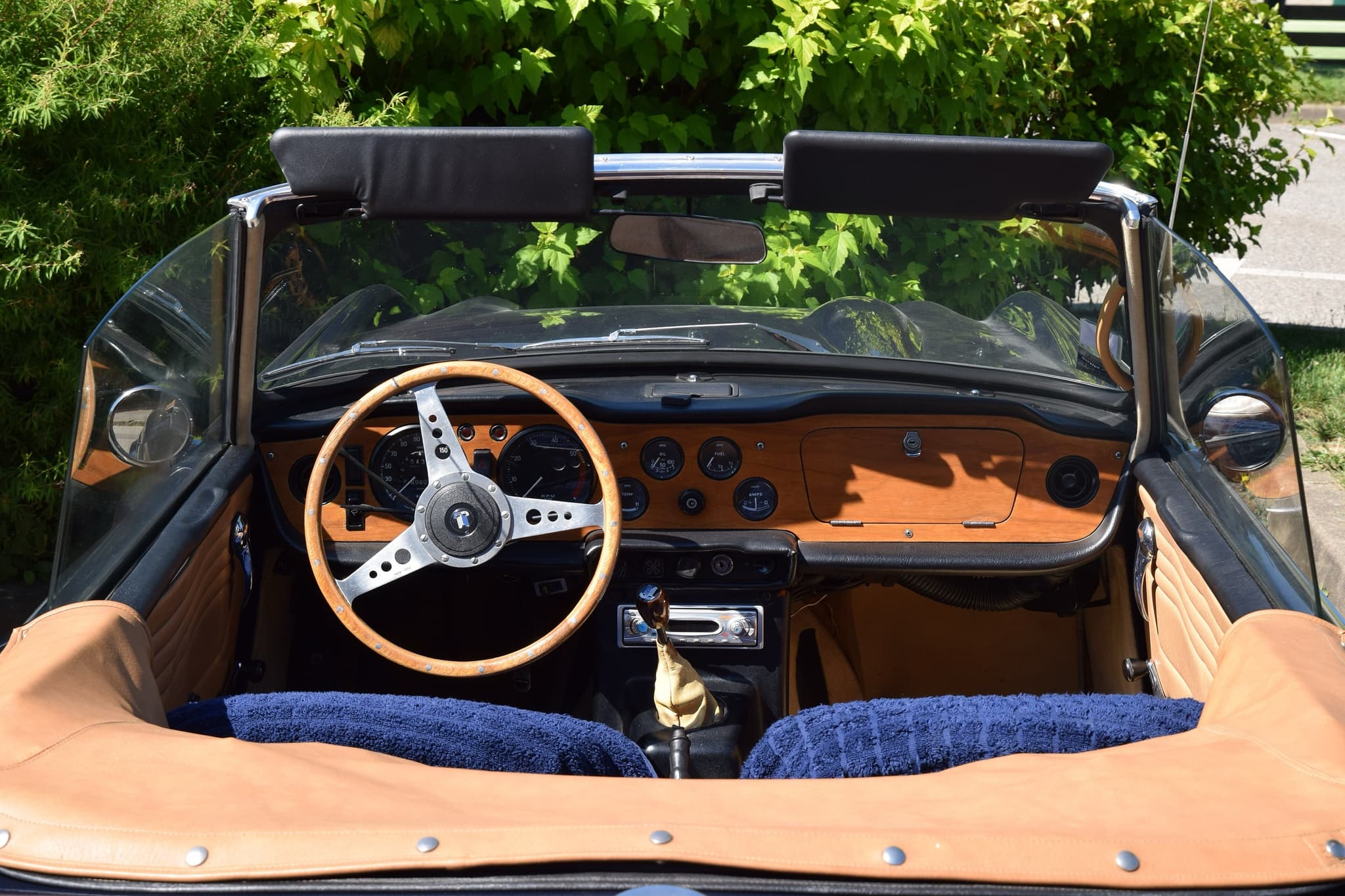
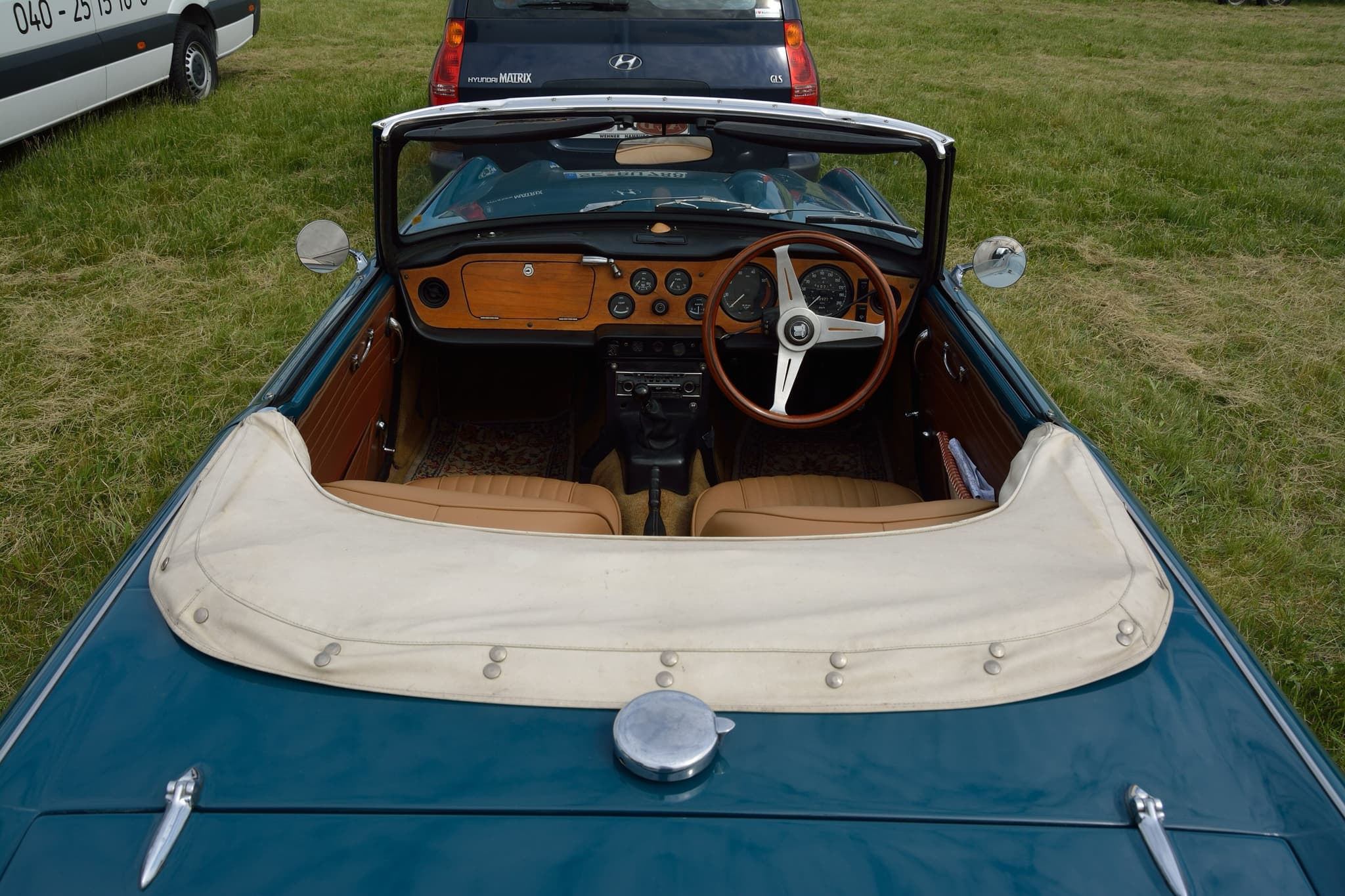
In the cockpit the dashboard was wood with a matt finish, and the speedometer and rev counter were 12½ cm across, by the factory's brochure. A knob on the console worked the injection's cold start, and the switches were revised for the American safety rules of 1968; the brochure gives the three-spoke wheel a leather rim.source 3source 4source 1source 5
The TR5 PI outside
The TR5 PI looks like a TR4A until you know where to look. Its grille was revised and lost the starting-handle hole, though the notch in the valance stayed; indicator repeaters stand out from the side flashes; and at the back there are reversing lamps below the tail lamps and both exhaust pipes leave on the left. The bonnet (hood) kept the TR4A's bulge, which, Aaron Severson writes, the injected engine did not need.source 4source 5source 6
TR5 PI 8
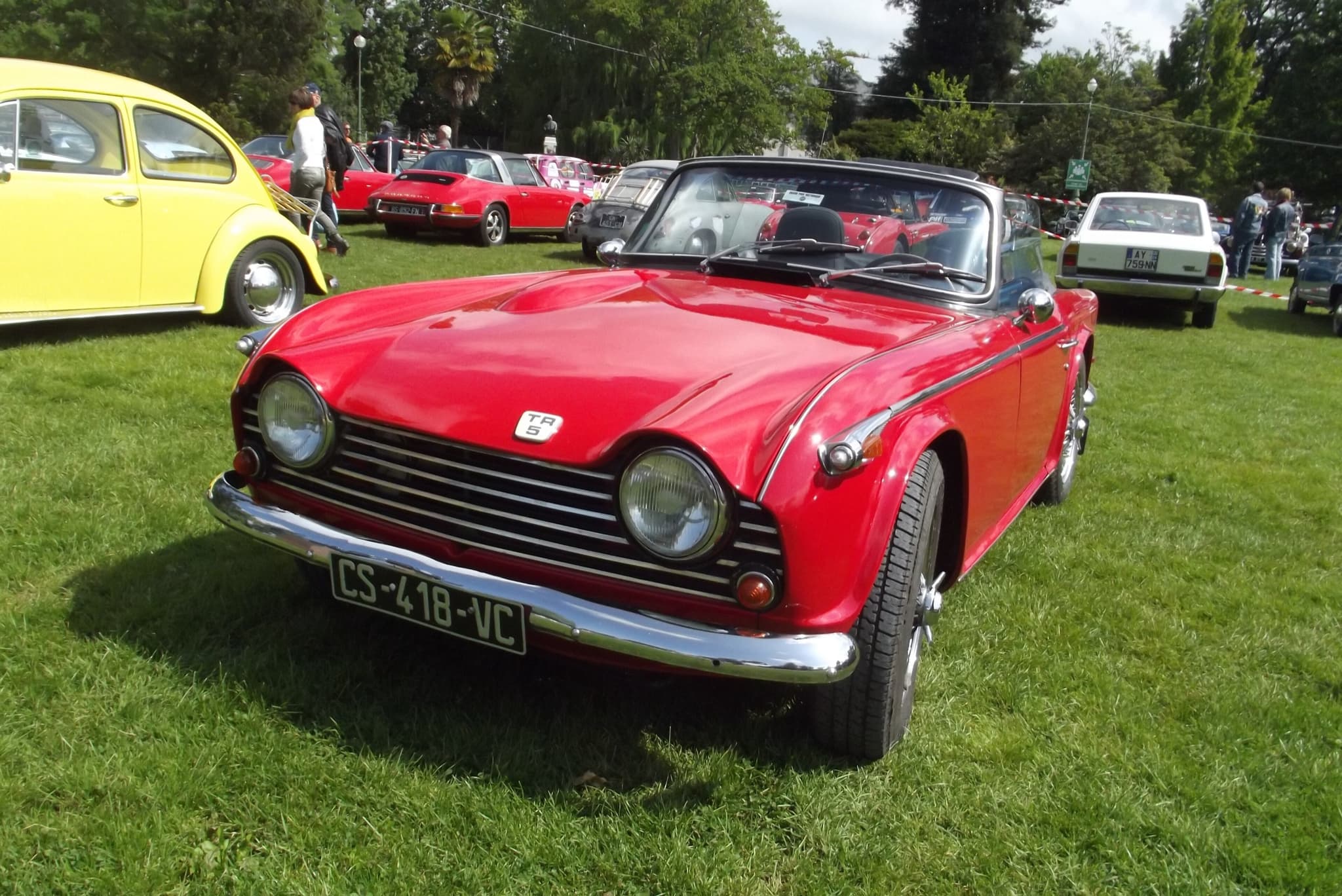
1 Eared spinners on the wire wheels of a red TR5 PI, its black hood (soft top) raised, at Pau, France, on 23 May 2015.
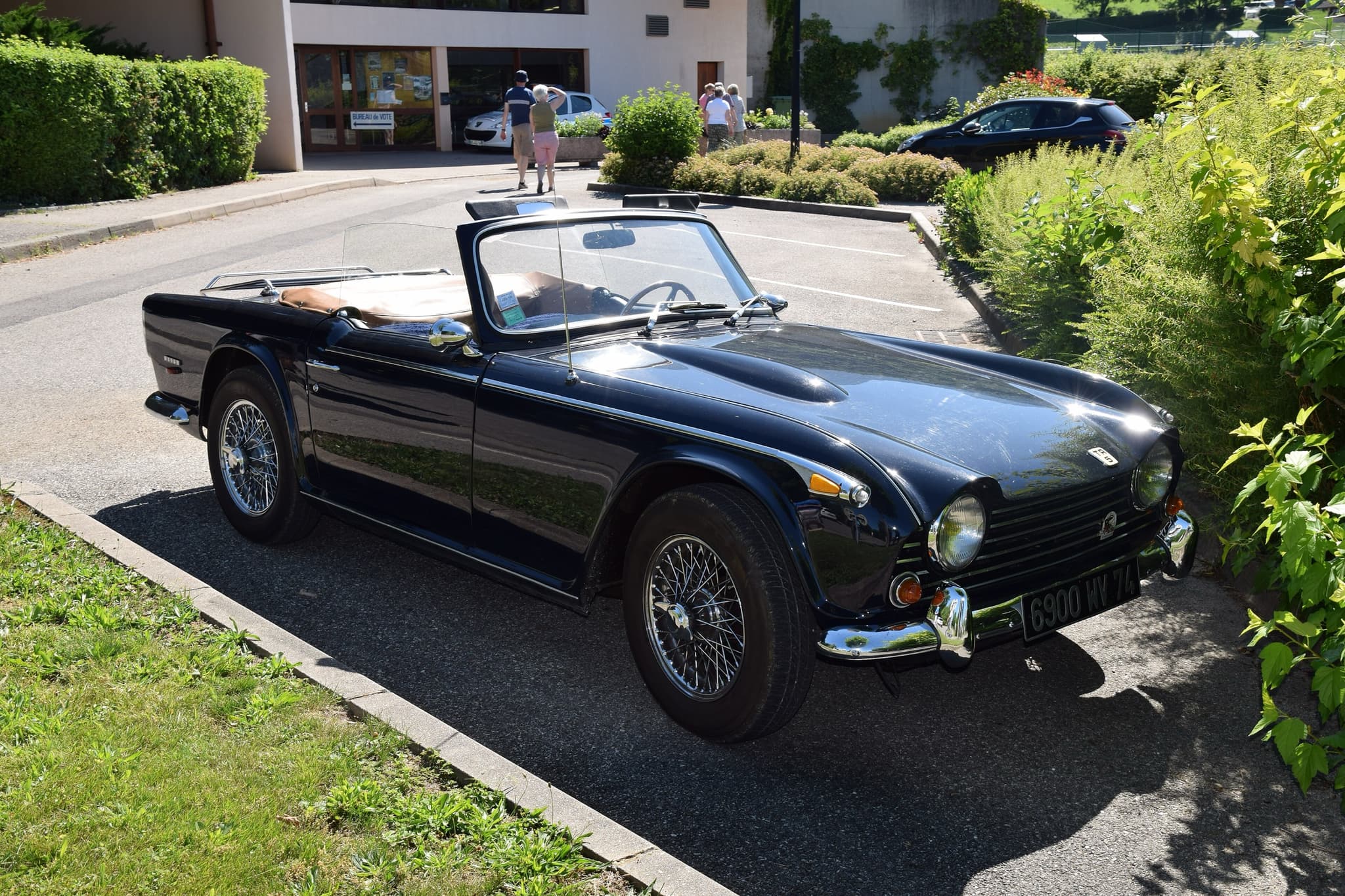
2 A left-hand-drive TR5 PI on wire wheels, its hood folded, at Menthon-Saint-Bernard, Haute-Savoie, on 18 June 2017.
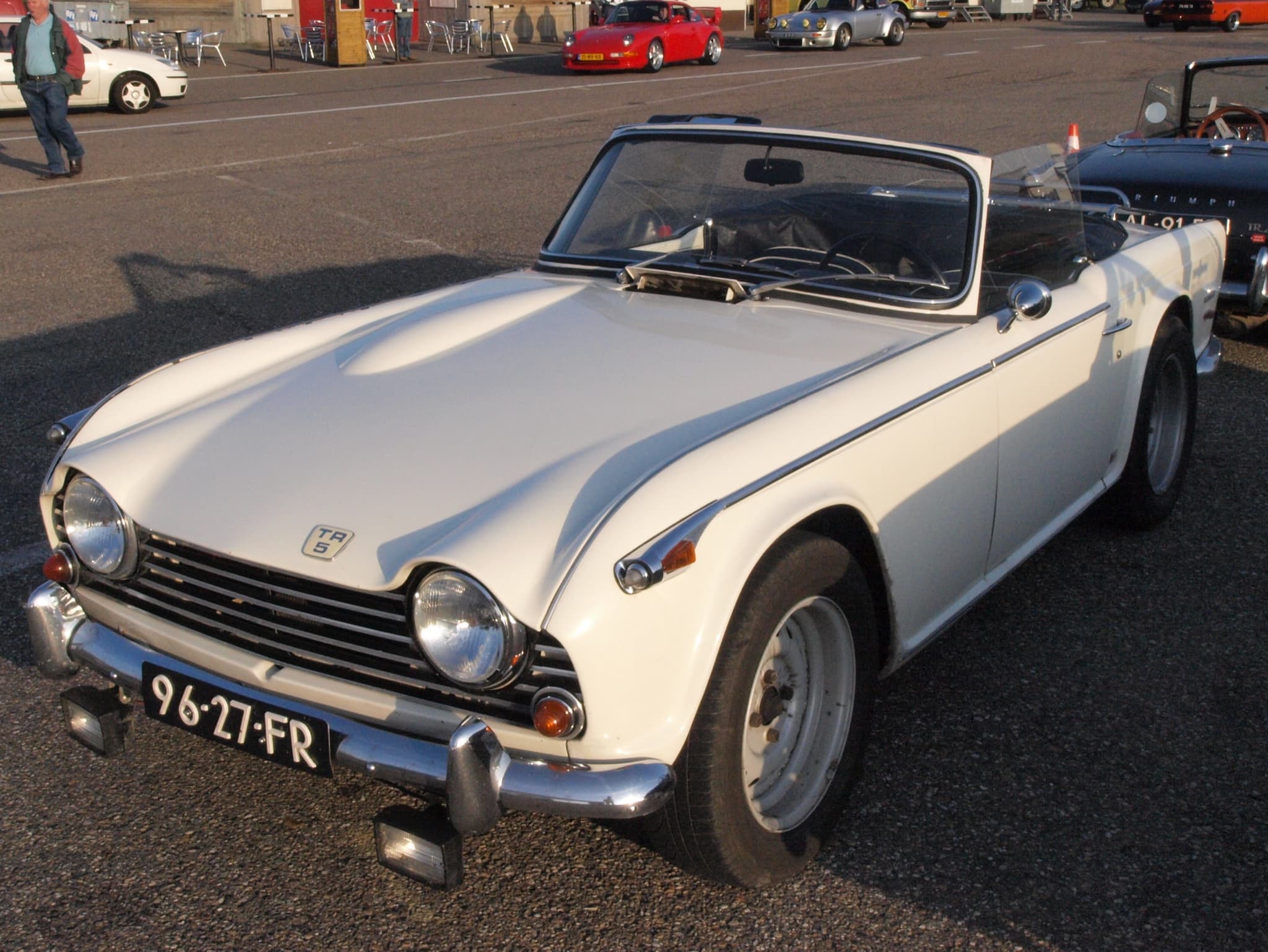
3 White, on steel wheels without their trims, and with left-hand drive: a TR5 PI at the Nationaal Oldtimer Festival, Zandvoort, the Netherlands, on 27 September 2009.
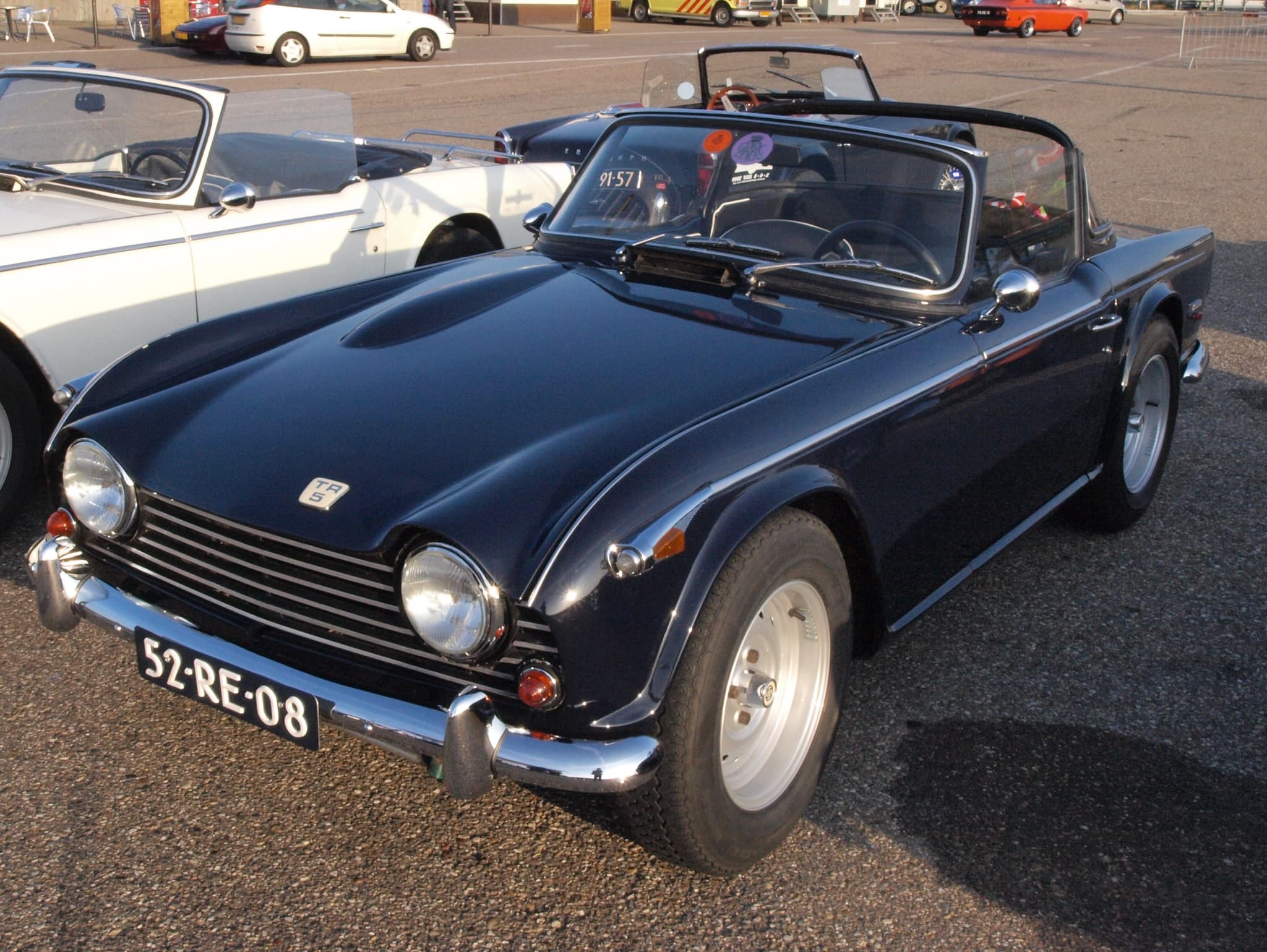
4 Another left-hand-drive TR5 PI, its hood folded, in the evening sun at the same Zandvoort festival on 27 September 2009.
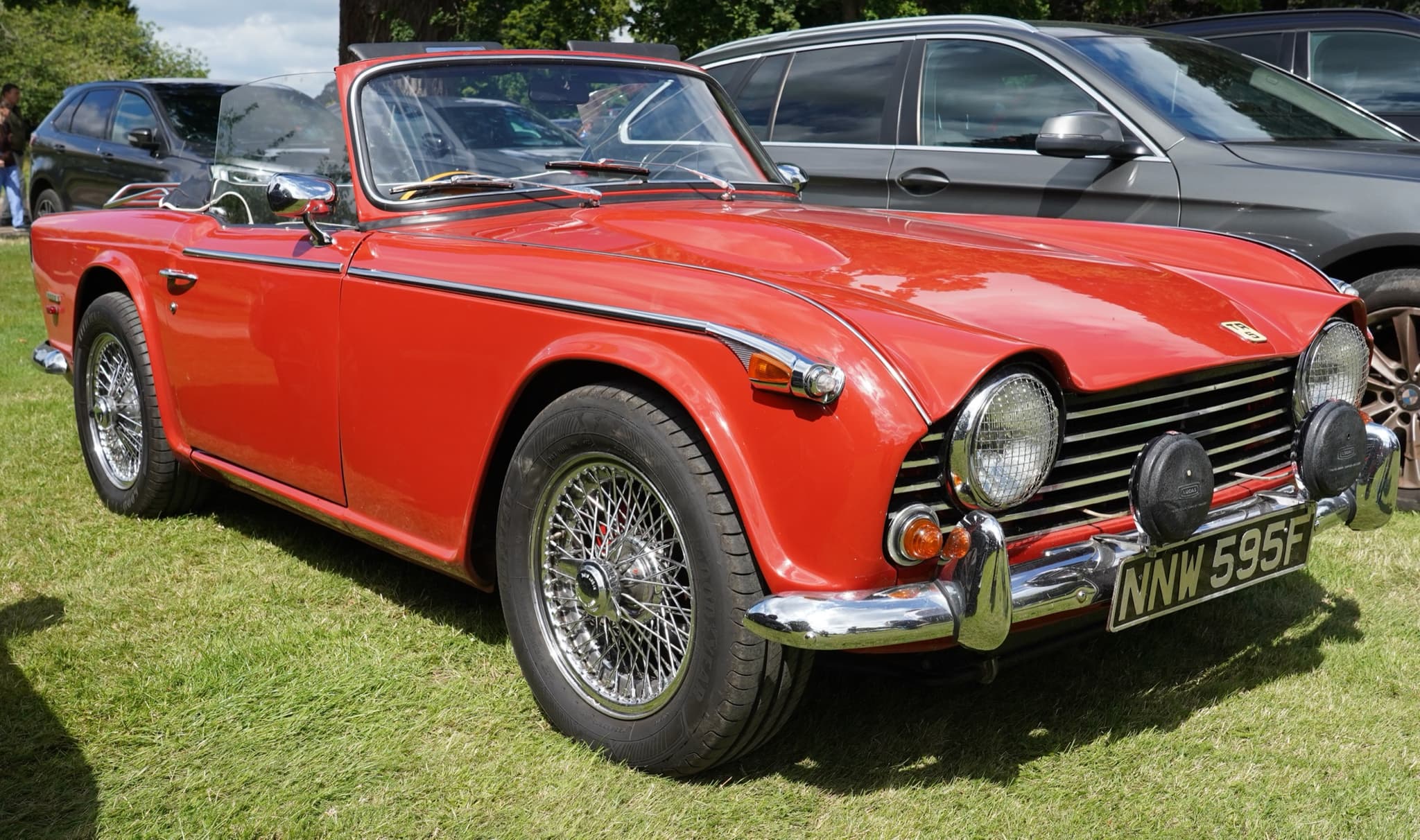
5 Wire wheels and two added spot lamps on a red TR5 PI, at a Rotary Club rally in the grounds of Culford School, Suffolk, in the summer of 2024.
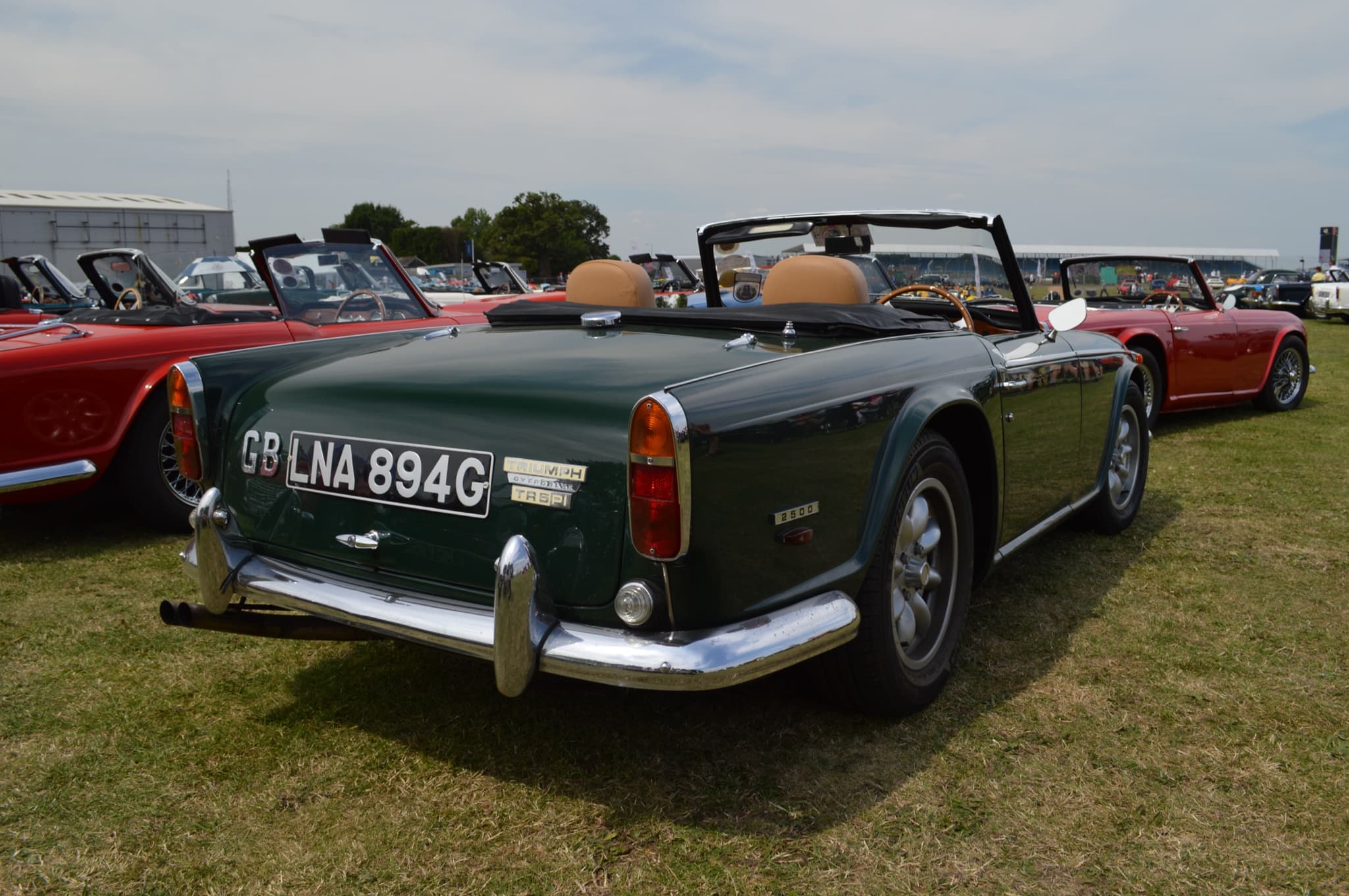
6 Twin tailpipes on the left of a dark green TR5 PI with alloy wheels of a later pattern, seen from behind at the Silverstone Classic on 26 July 2014.
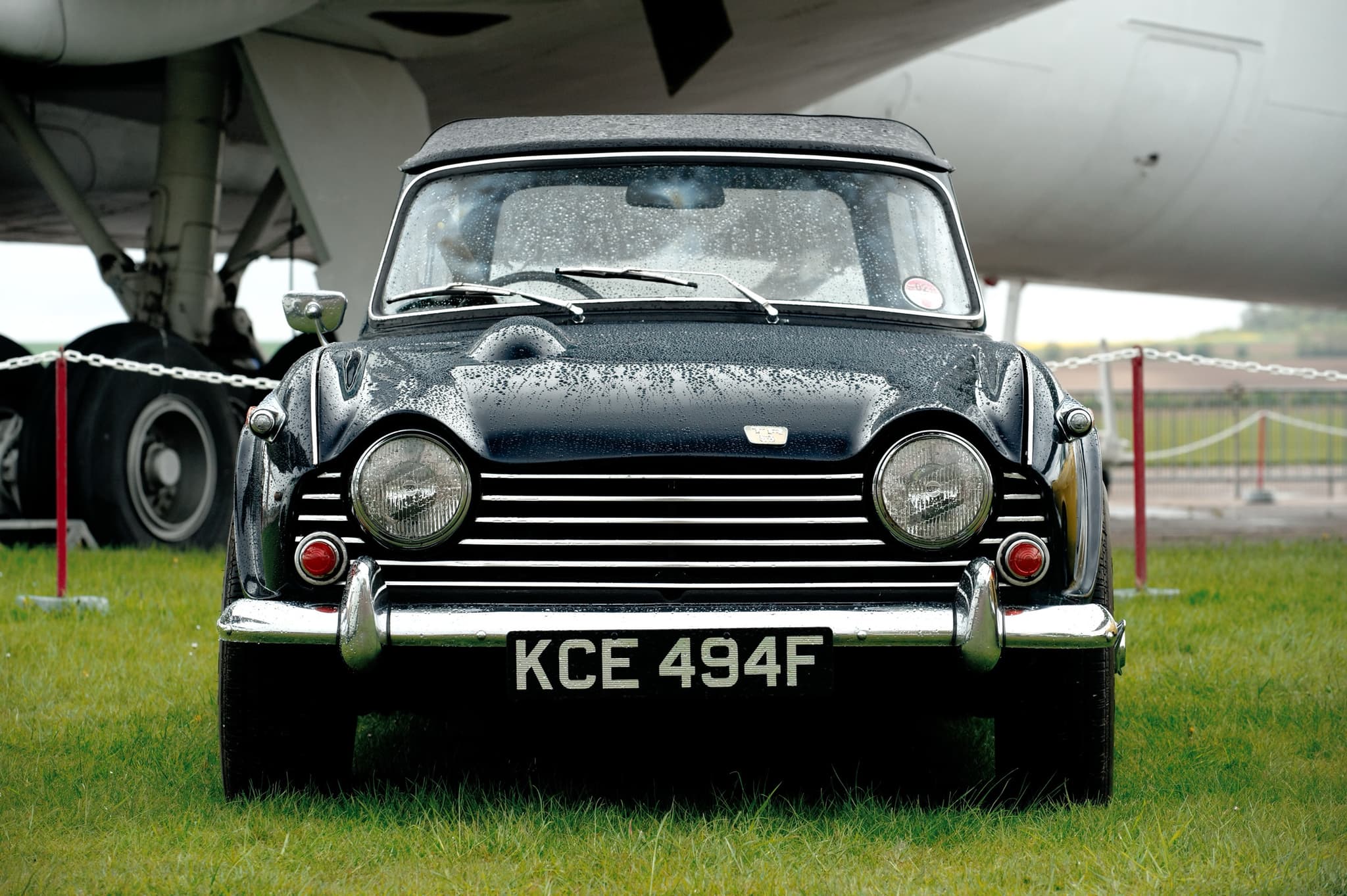
7 A TR5 PI with its hood up, beaded with rain, parked beneath the wing of an airliner at a museum, on 2 May 2010.
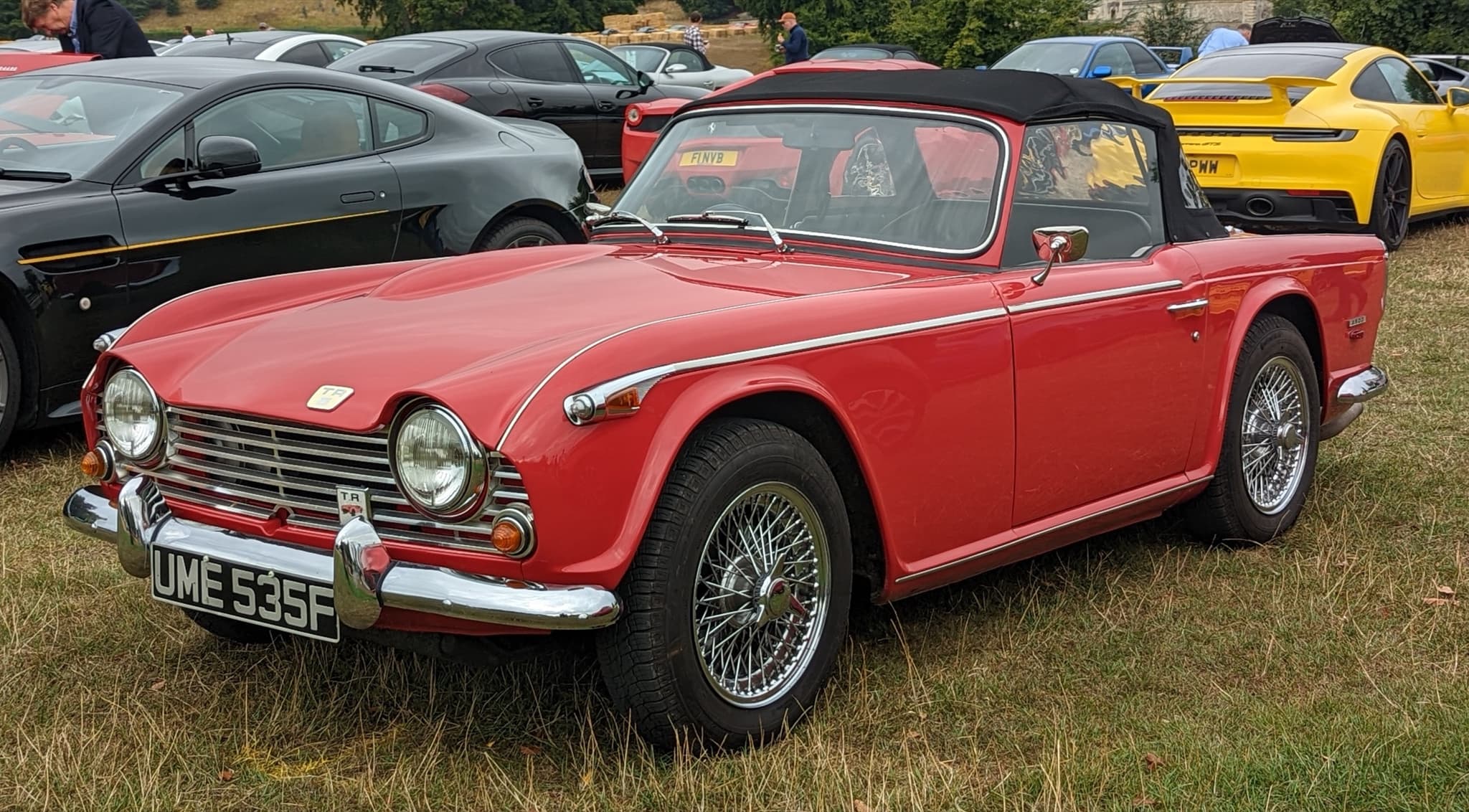
8 A TR5 PI on wire wheels among modern cars at Salon Privé, Blenheim Palace, on 4 September 2022.
Picture credits (8)
- 1 Handelsgeselschaft, CC BY-SA 4.0
- 2 Hugh Llewelyn, CC BY-SA 2.0
- 3 AlfvanBeem, CC0
- 4 AlfvanBeem, CC0
- 5 Steve Knight, CC BY 2.0
- 6 Draco2008, CC BY 2.0
- 7 pyntofmyld, CC BY 2.0
- 8 Calreyn88, CC BY-SA 4.0
The badges
The badges are the quickest check. On a TR5 PI the bonnet badge is a stacked TR5, the boot (trunk) lid's badge reads TR5 PI, and each rear wing (fender) has a 2500 badge. Identification explains why badges alone prove nothing.source 7source 4source 5
Badges 3
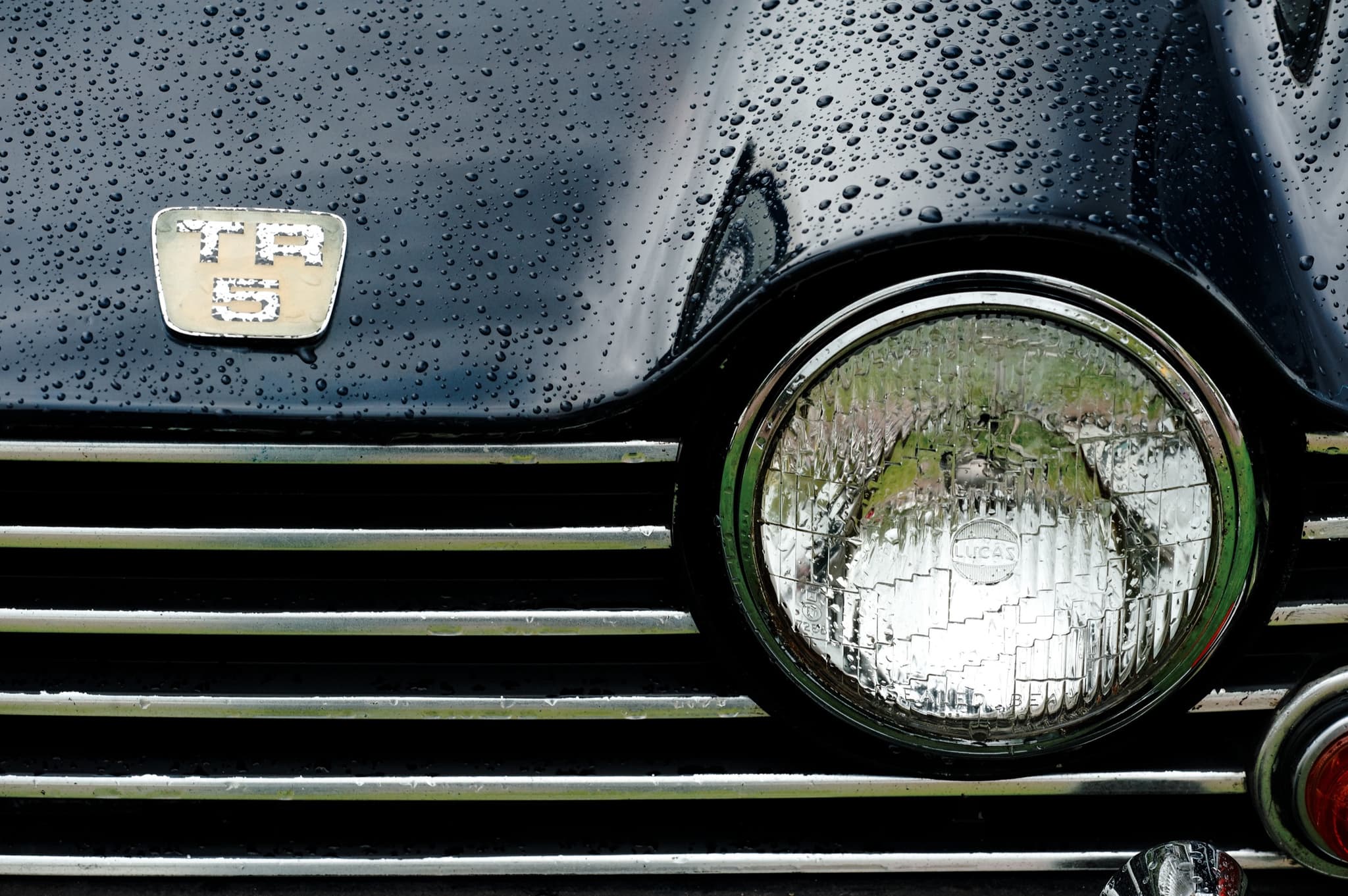
9 The stacked TR 5 badge on the nose, its chrome worn, after rain on 2 May 2010.
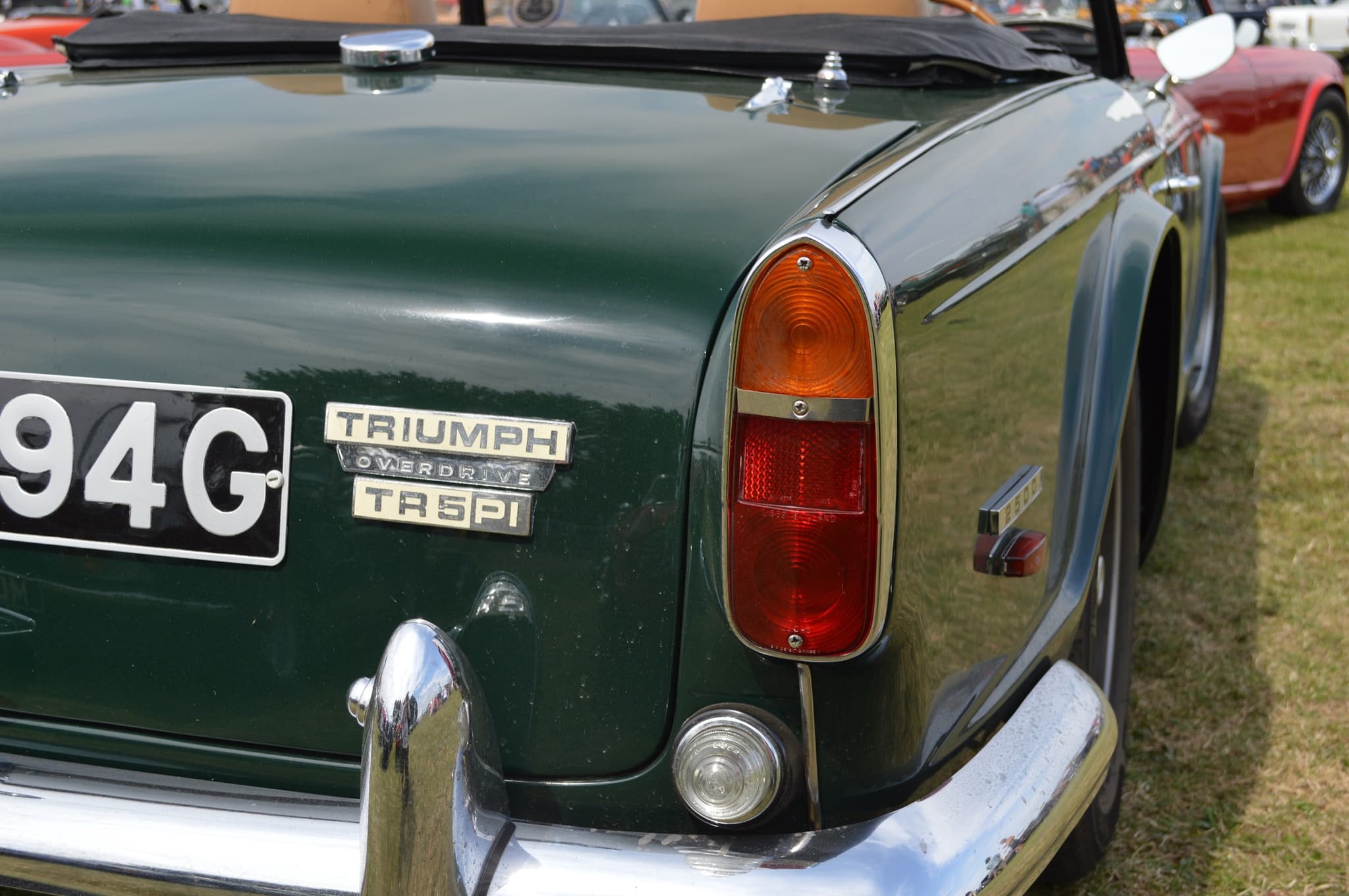
10 TRIUMPH, OVERDRIVE and TR5 PI on a boot lid, beside the tail and reversing lamps, at the Silverstone Classic on 26 July 2014.
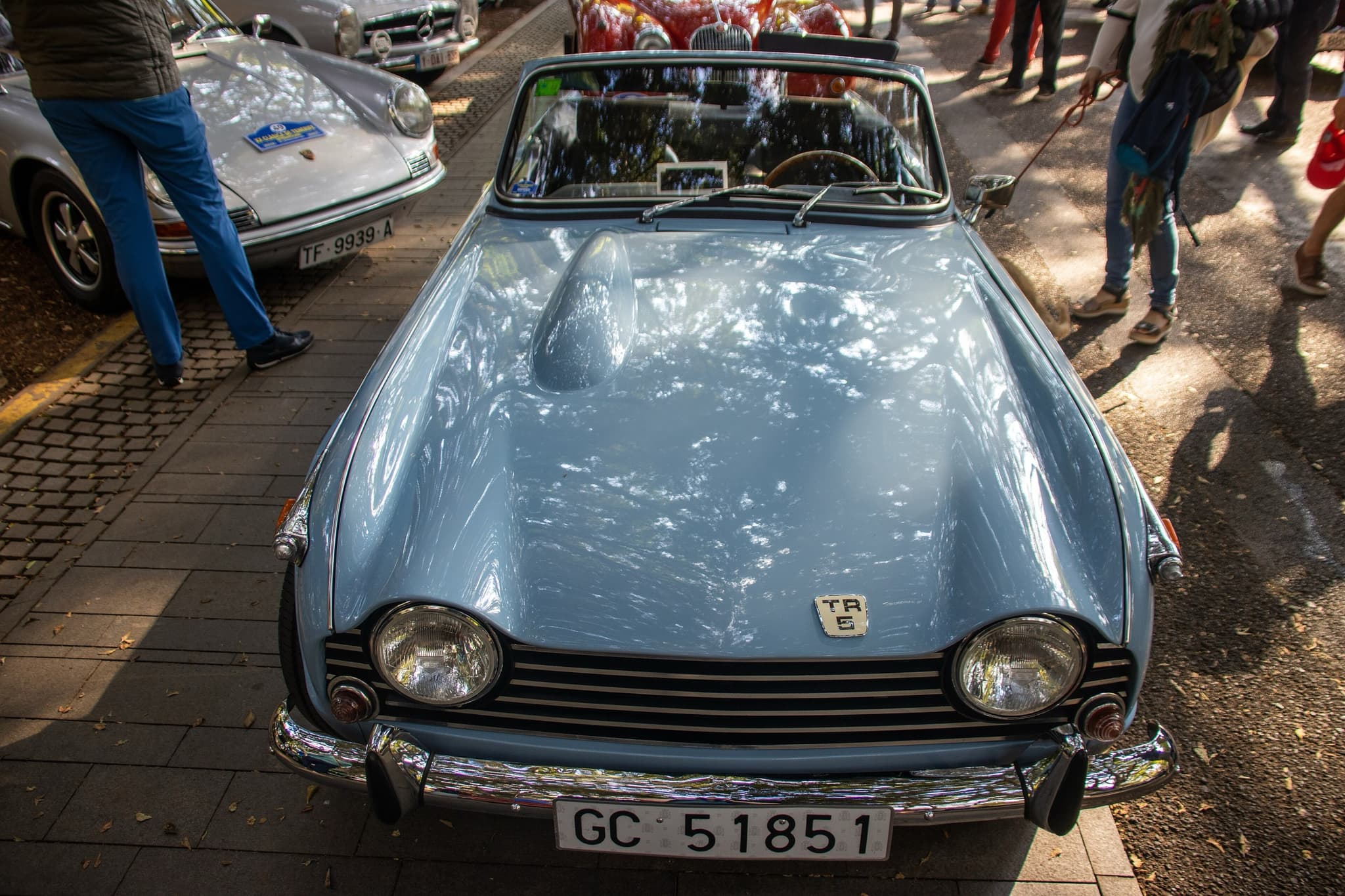
11 The nose badge from above: a small TR 5 over the grille, below the bonnet's bulge, at the Clásica de Tenerife on 19 November 2021.
Picture credits (3)
- 9 pyntofmyld, CC BY 2.0
- 10 Draco2008, CC BY 2.0
- 11 Mike Peel, CC BY-SA 4.0
The engine bay
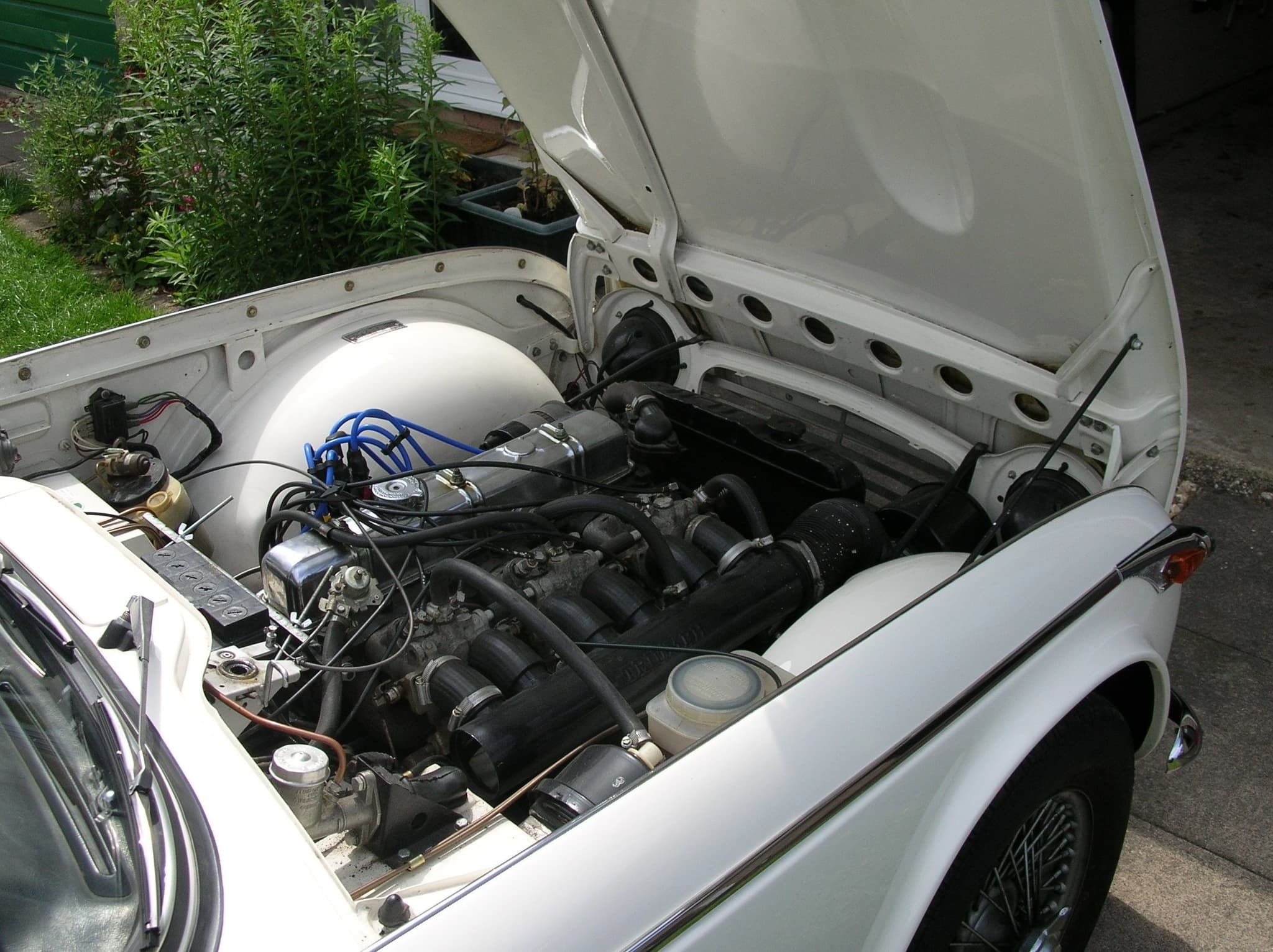
Open the bonnet and the injection is plain: there are no carburettors, and the plenum runs the length of the engine. The metering unit sits low on the left of the engine, out of this picture.source 4
The hardtop
The hardtop came in two parts, a fixed rear section with a glass window and a roof panel that lifted out, and the factory sold a folding canopy, the Surrey top, to fill the roof when the panel was off. Not every roof panel in a photograph is the canopy.source 3source 2
Hardtops 4
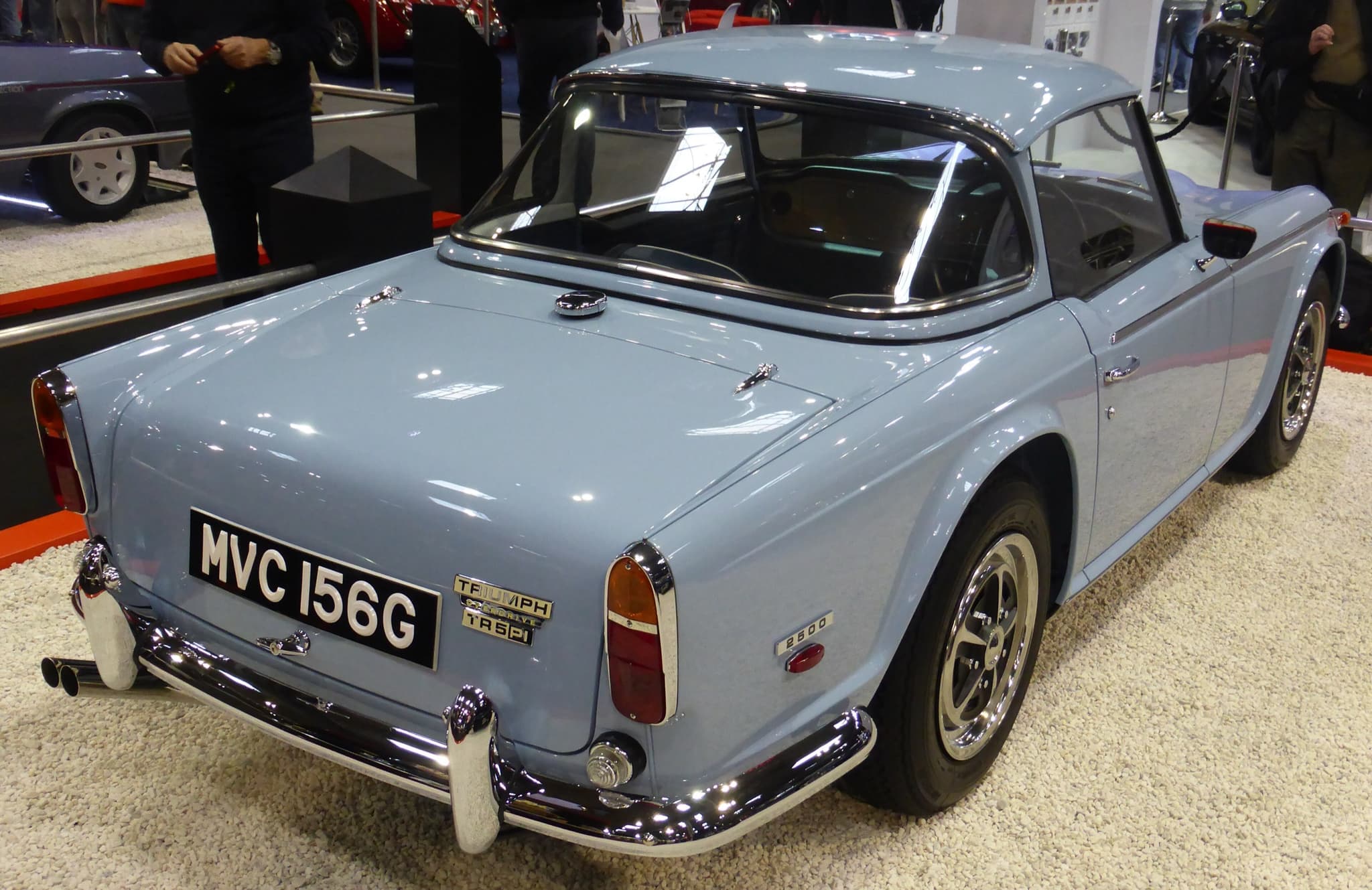
12 A TR5 PI's hardtop from behind, the glass window in its fixed rear section, at the Classic Motor Show, NEC Birmingham, on 9 November 2018.
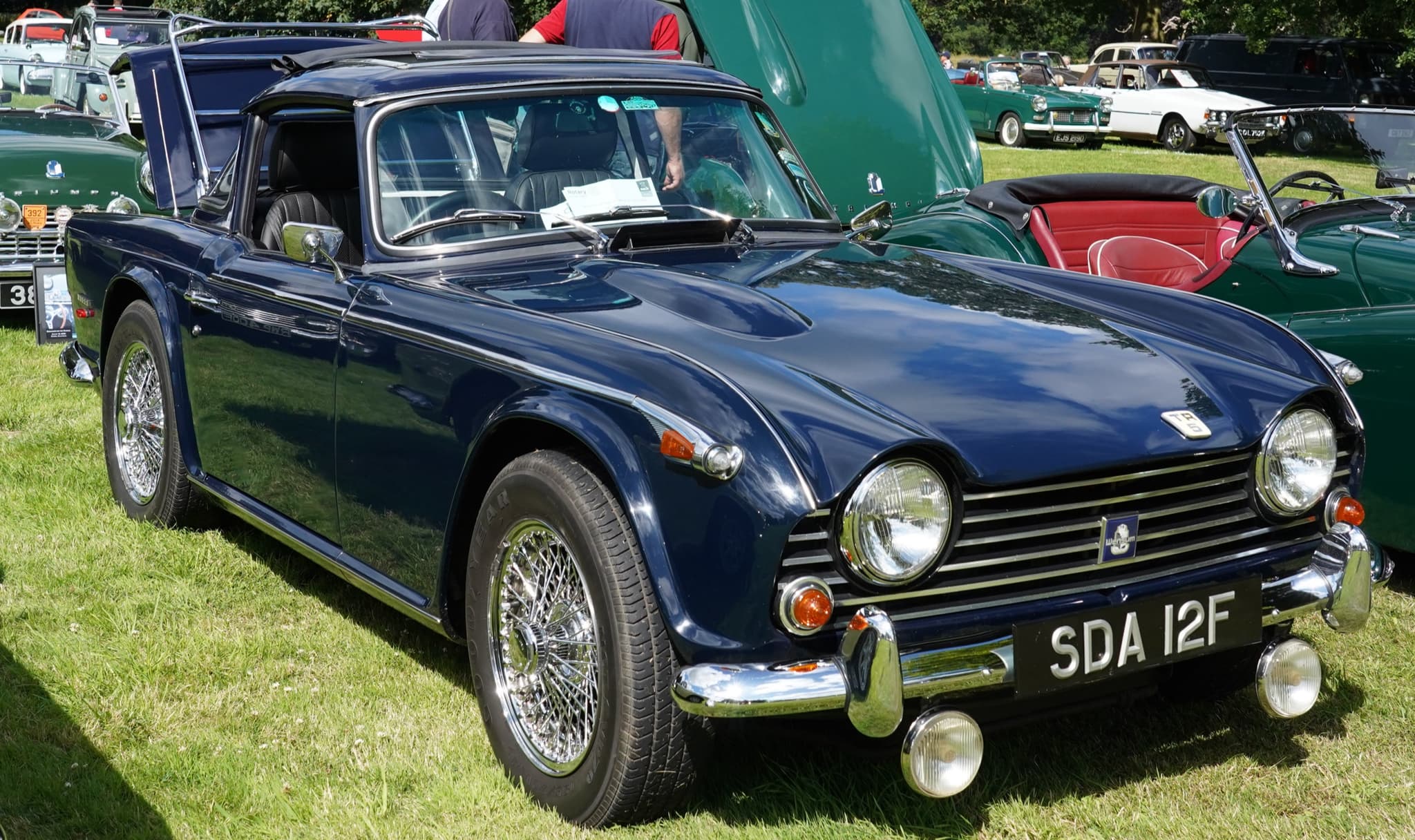
13 A black fabric roof panel in a TR5 PI's hardtop, perhaps the Surrey canopy, at Culford School, Suffolk, in the summer of 2024.
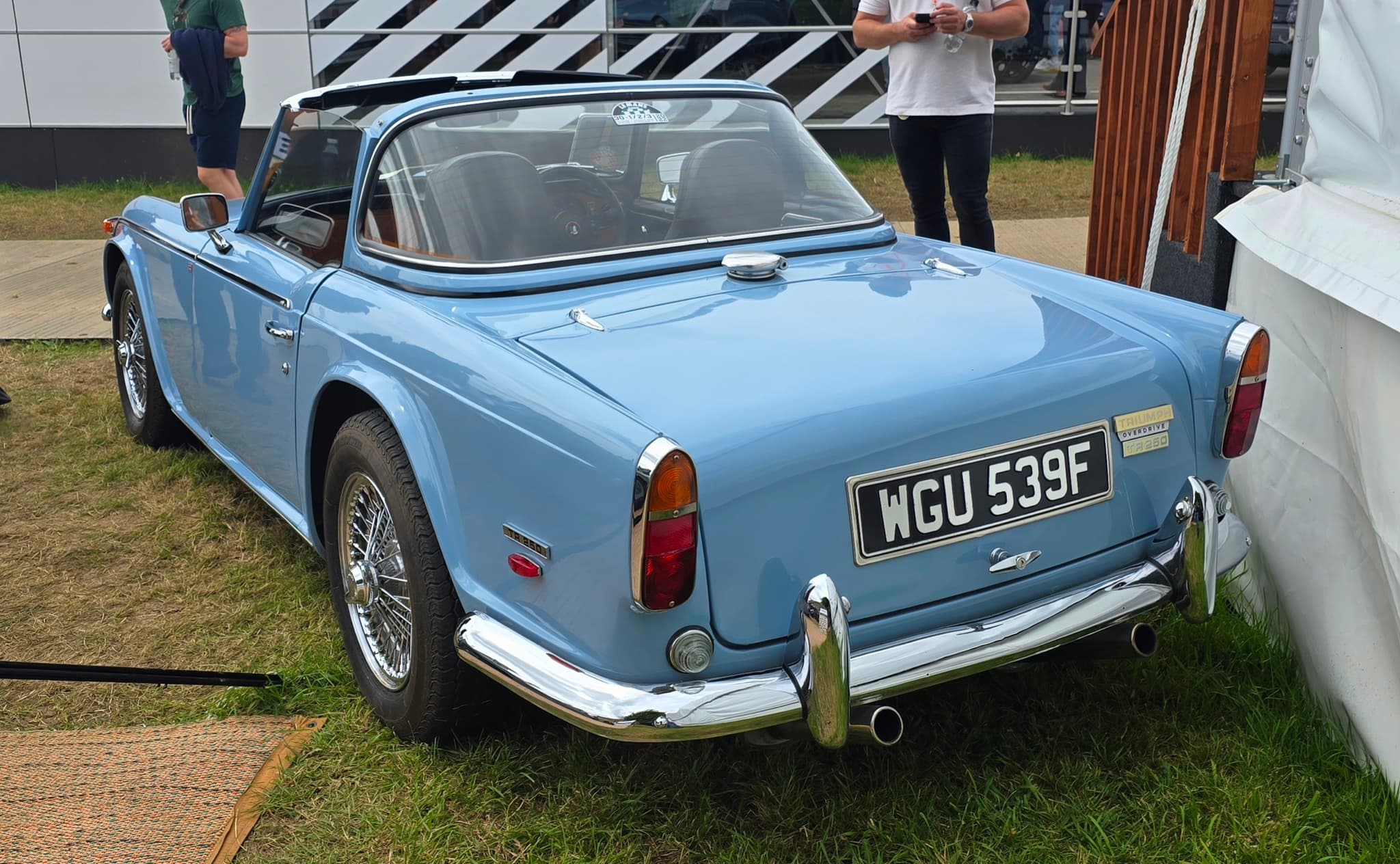
14 Roof panel out, only the fixed rear section with its wrap-round window left, on a car badged TR250 and converted to right-hand drive, at the Goodwood Festival of Speed on 14 July 2024.
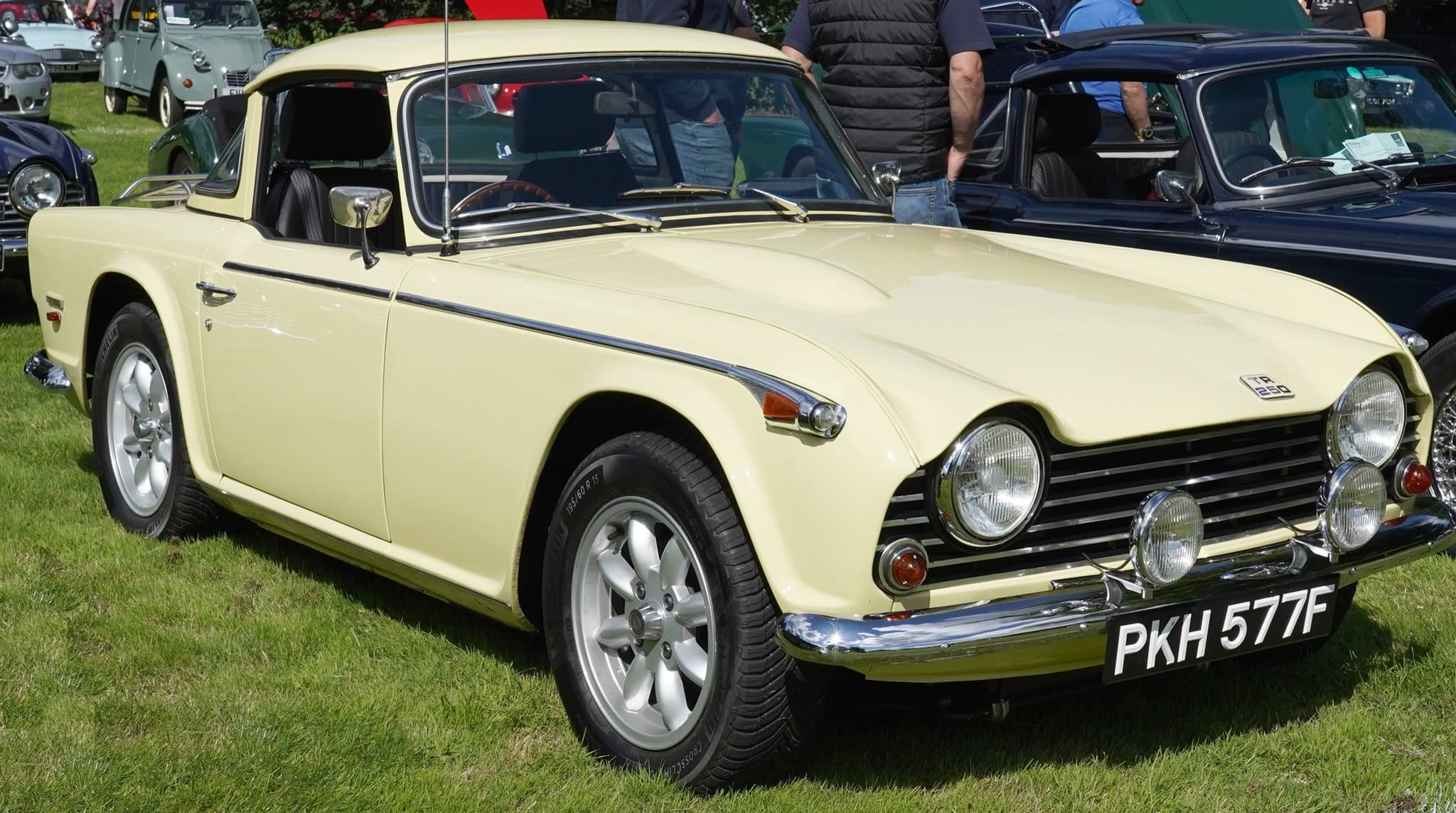
15 A hardtop in place on a car badged TR 250, with right-hand drive and no stripe, at Culford School in the summer of 2024; its wheels and lamps are later.
Picture credits (4)
- 12 andreboeni, CC BY 2.0
- 13 Steve Knight, CC BY 2.0
- 14 Calreyn88, CC BY-SA 4.0
- 15 Steve Knight, CC BY 2.0
The TR250
A TR250 shows itself by its badges and by its stripe. The stripe was the idea, by Severson's account, of Bruce McWilliams, who ran Leyland's marketing in America; the Vintage Triumph Register describes it as silver, pointed in the middle of the bonnet and angled back across the wings, though not every car shows it in silver. Every TR250 was built with left-hand drive, so one with the wheel on the right has been converted.source 1source 5source 8
TR250 4
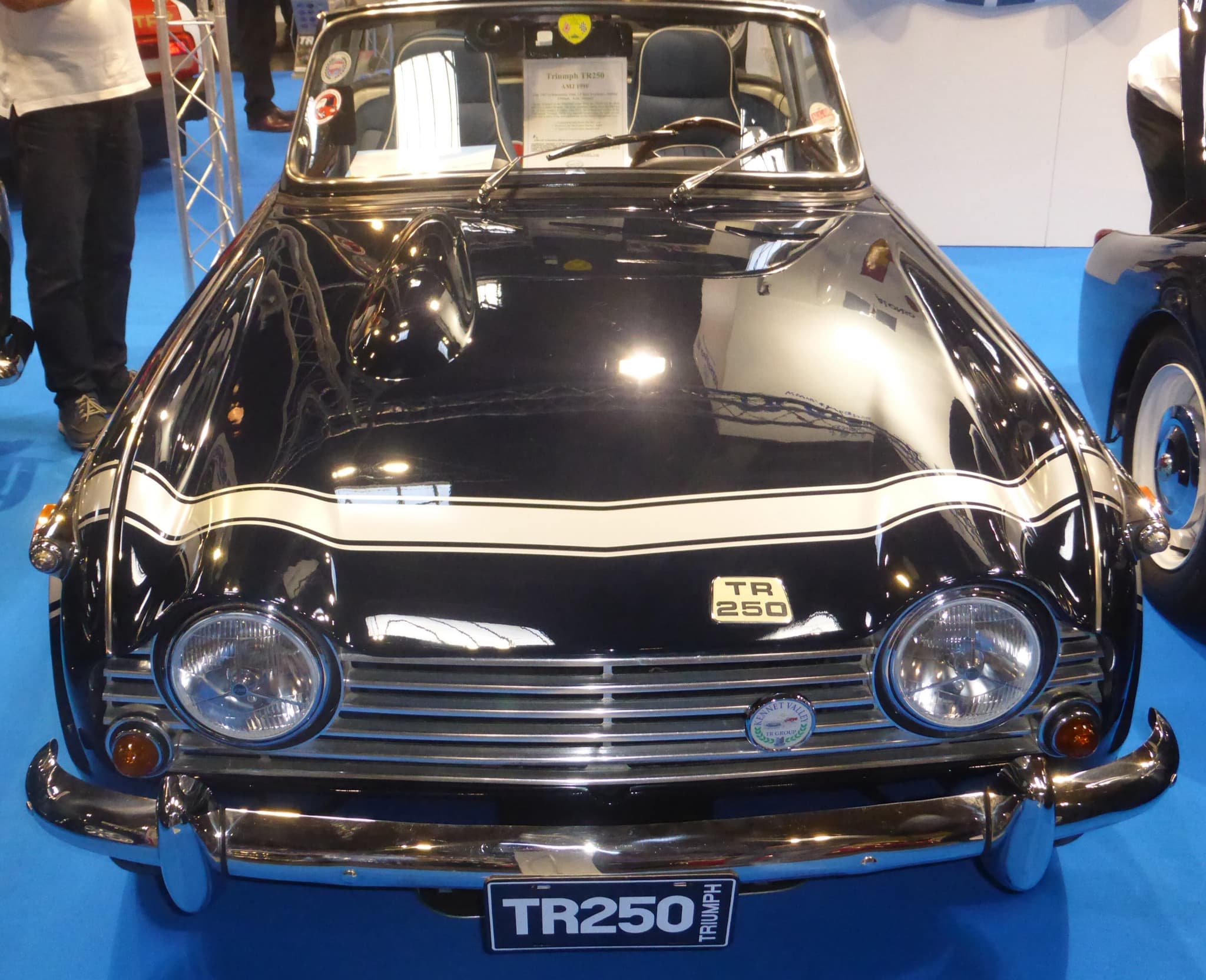
16 Black paint, a silver stripe with black pinstripes and a TR 250 badge: a TR250's nose at the Classic Motor Show, NEC Birmingham, on 10 November 2017.
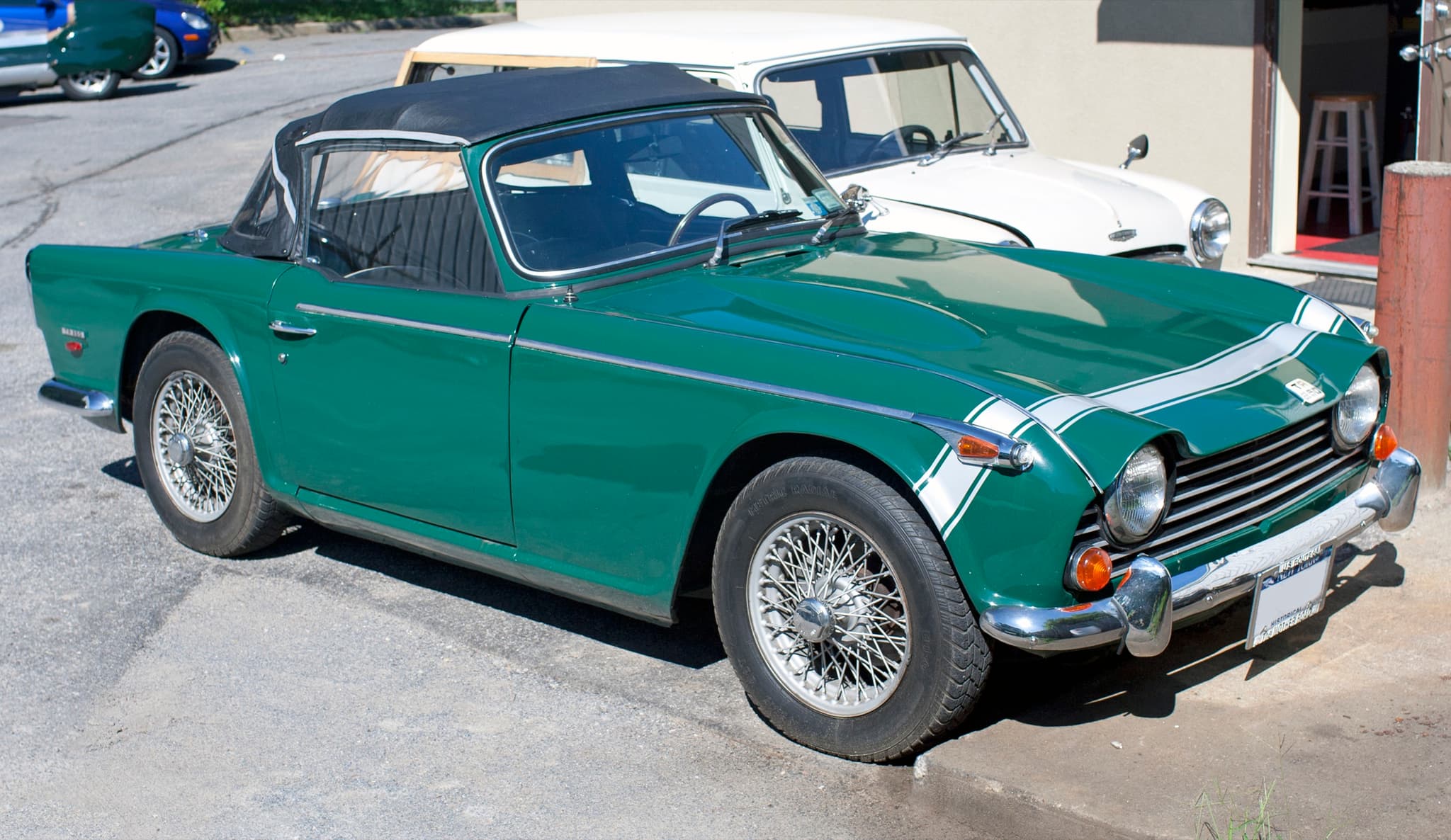
17 A left-hand-drive TR250 with wire wheels and its hood up, photographed on 21 July 2012; its stripe is white with a fine green line.
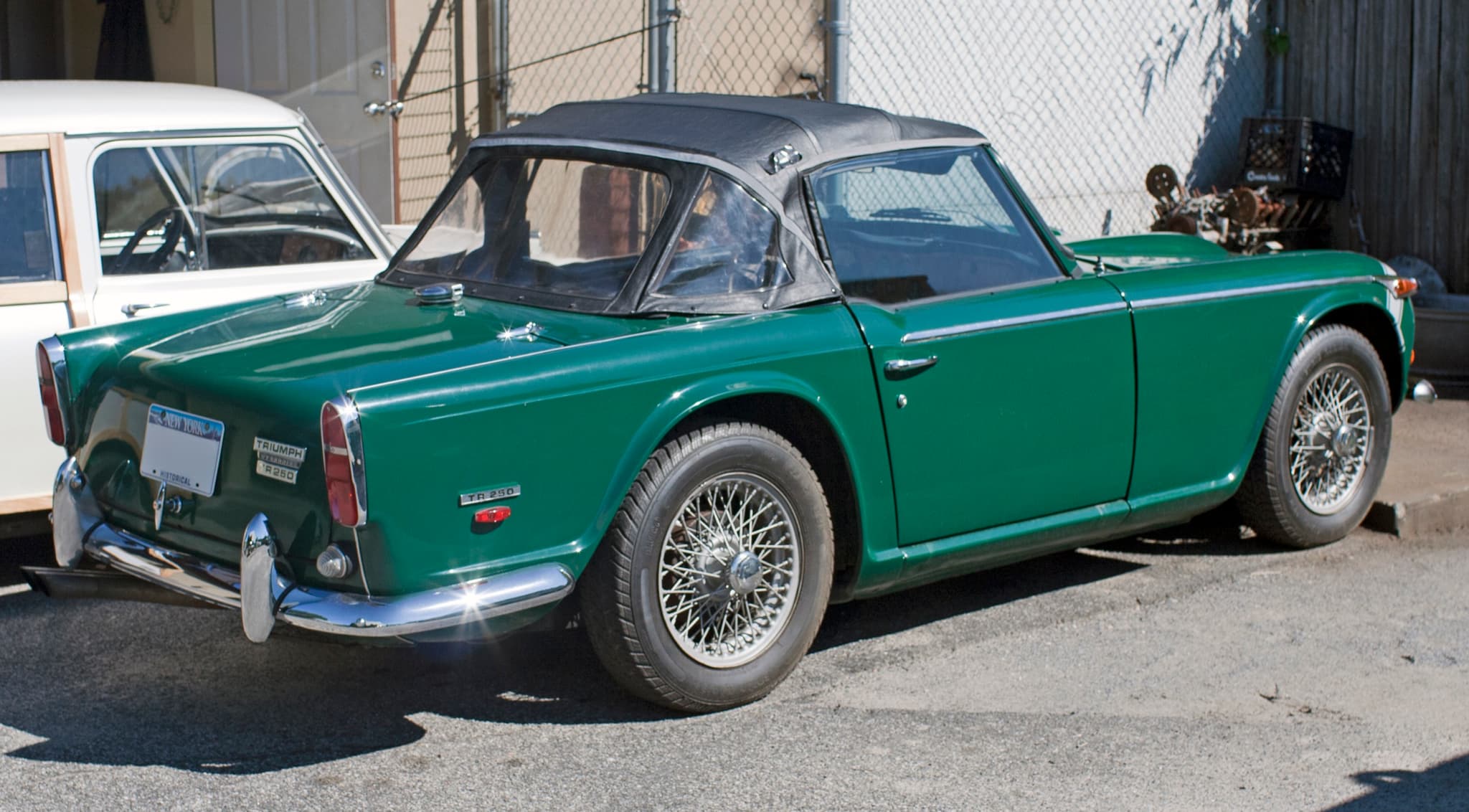
18 A TR250's tail: TRIUMPH, OVERDRIVE and TR 250 on the boot lid and TR 250 on the rear wing, on 21 July 2012.
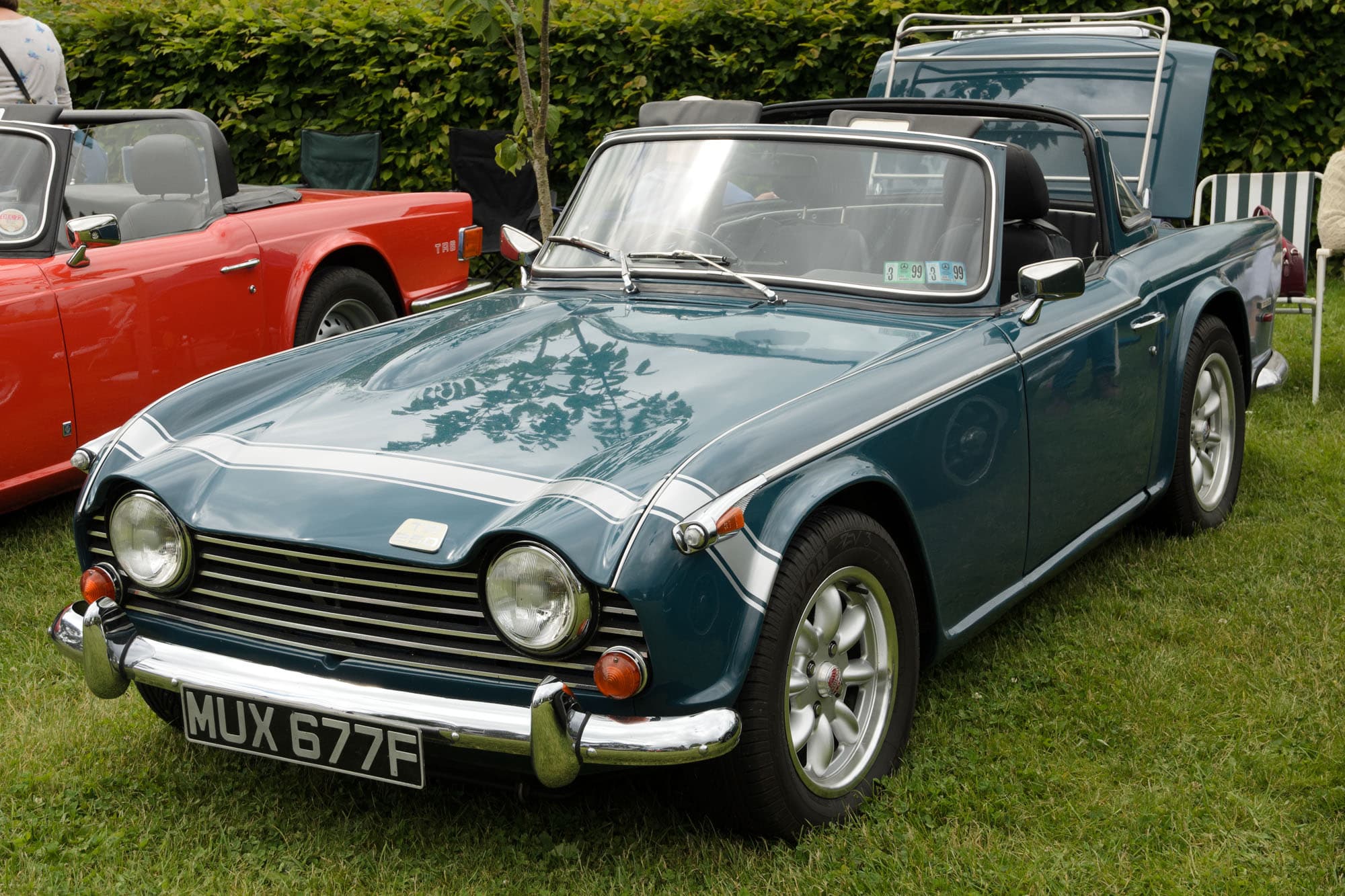
19 The boot lid up, luggage rack and all, on a dark teal TR250 converted to right-hand drive, at Trentham Gardens, Staffordshire, on 21 June 2015; the alloy wheels are later.
Picture credits (4)
- 16 andreboeni, CC BY 2.0
- 17 Mr.choppers, CC BY-SA 3.0
- 18 Mr.choppers, CC BY-SA 3.0
- 19 SG2012, CC BY 2.0
The one-offs
Two cars of 1968 had bodies of their own: Giovanni Michelotti's TR5 Ginevra, built for the Geneva show on a TR5 chassis, and the TR250K, built by Kas Kastner and Peter Brock for the Sebring 12 Hours. Both survive, and each picture here shows the car itself.source 2source 9source 10
One-offs 2
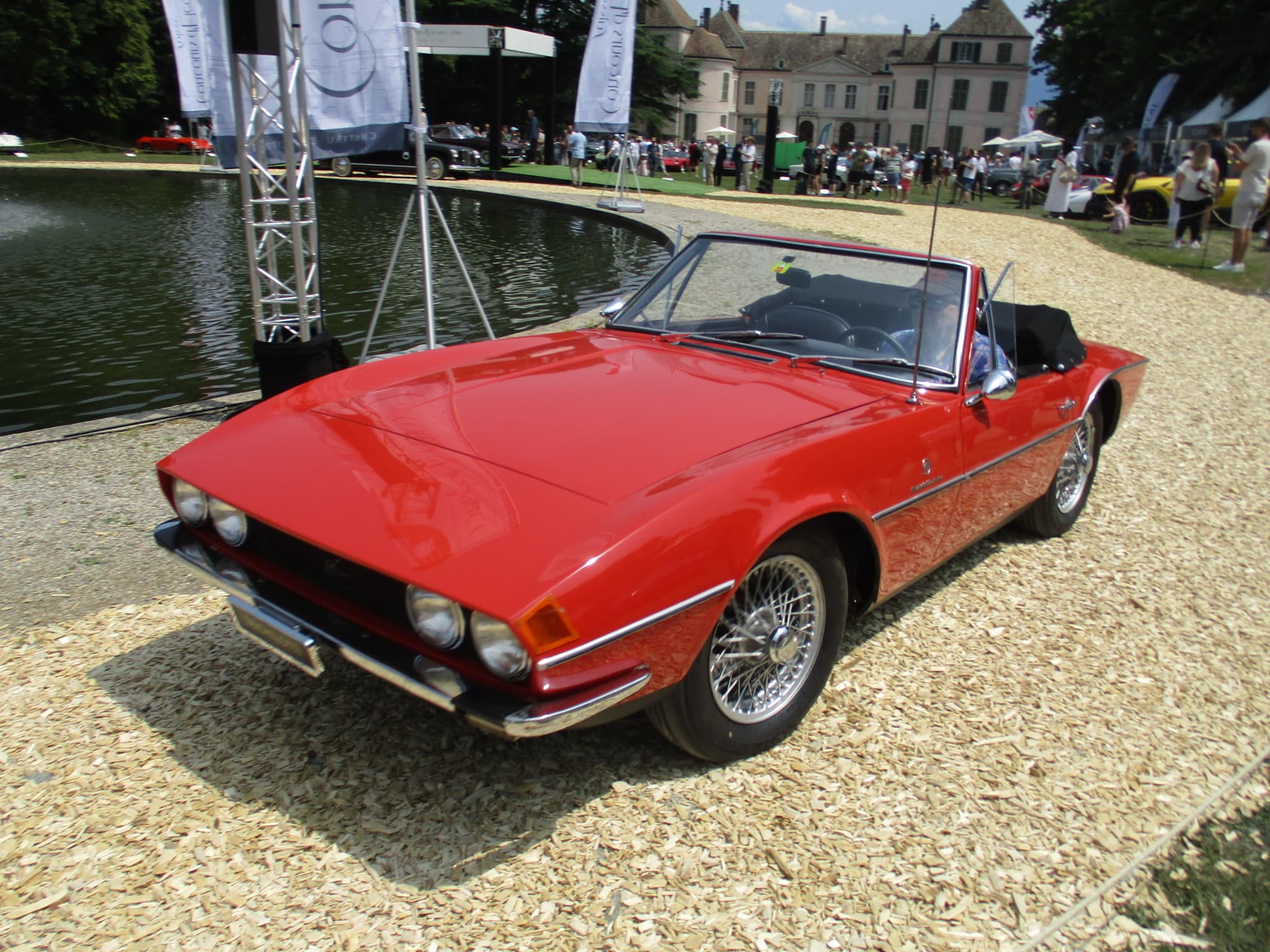
20 The TR5 Ginevra, the one-off Michelotti built for Geneva in 1968, with its wire wheels and its black hood folded, at a concours in Switzerland on 17 June 2023.
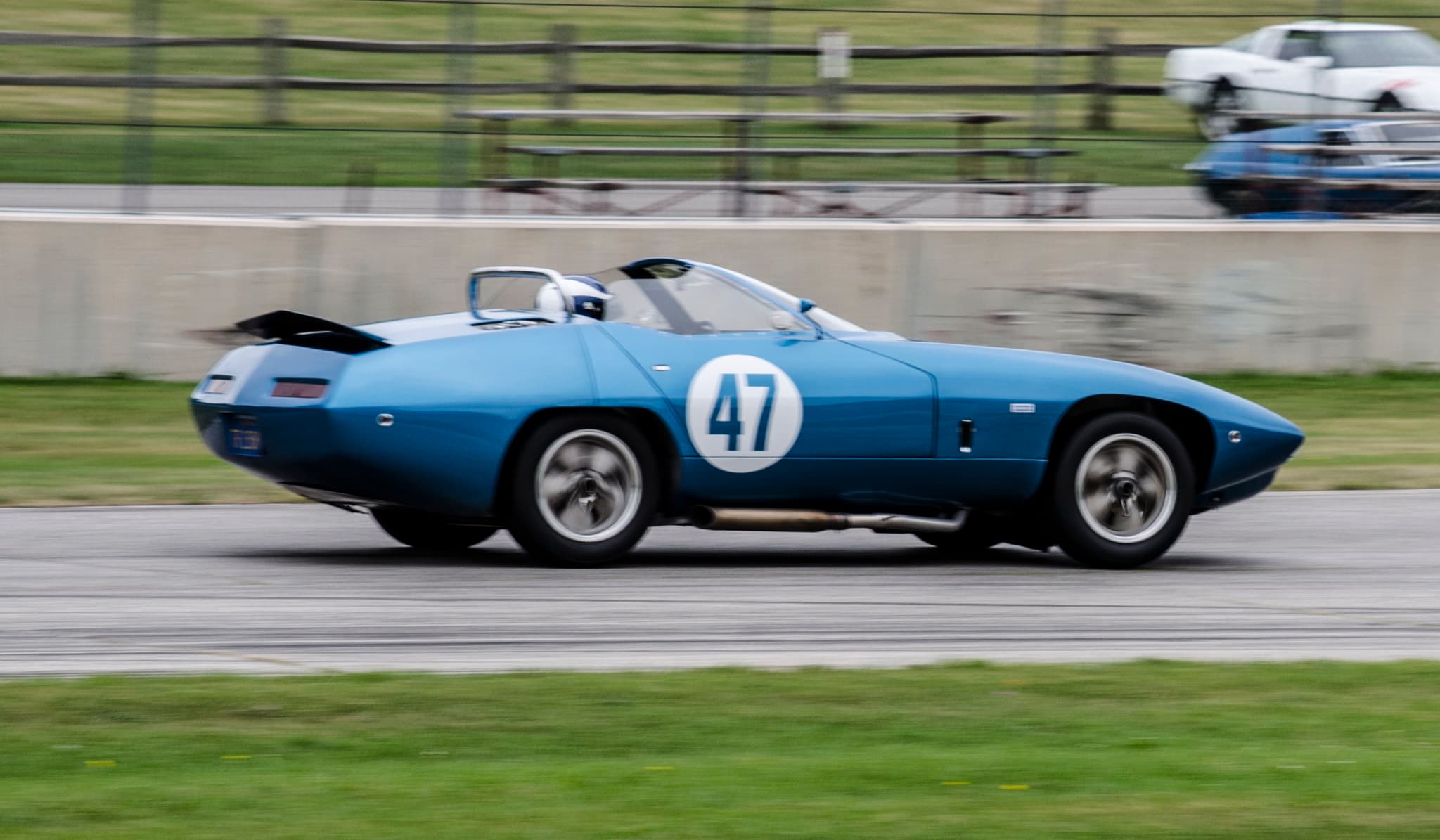
21 The TR250K, Kastner and Brock's Sebring car of 1968, at speed on 8 September 2013.
Picture credits (2)
- 20 Arnaud 25, CC BY-SA 4.0
- 21 Lodahln, CC BY-SA 2.0
The factory's brochure
Standard-Triumph's Italian brochure of October 1967 has a beach photograph of a TR5 PI, drawings of the hardtop and its Surrey canopy, and a diagram of the injection.source 3
Sources
Sources are given as plain text; their addresses are on the sources page.
- Primarymade at the time, by the maker or by people who were there
- Referenceserious later work: clubs, specialists, magazines, books
- Drew Holliday, "Triumph TR250 Production Information" (8 pp. PDF), Vintage Triumph Register, pp. 5–6, colours; p. 5, the dash; pp. 2–4, the stripe, lamps and badges. Reference
- Frédéric Reydellet (racing history), tr5passion.com (group): "En bref / Summary", "Identification", "Lucas injection", "Options", "Technical spec", "Colours", "TR5 Ginevra", "Racing history", TR5 Passion, Colours page (_r59); Options page (_r64); TR5 Ginevra page (_r60). Reference
- Standard-Triumph, Nuova Triumph TR5 PI (fold-out sales brochure), Italy, Oct 1967, ref. 387/1067/IT, data panel, instruments and steering wheel; page image, "Tetto rigido unico"; the archive.org record. Primary
- Doug Nye ("D. C. N."), "Road Test Report on a Sports Car: The Fuel-Injection Triumph TR5 PI", Motor Sport, Aug 1968, p. 26, p. 26, the dash and the cold-start control; p. 26, the changes from the TR4A; p. 26, the badges; p. 26, the specification paragraph. Primary
- Aaron Severson, "Grandfather's Ax: The Many Evolutions of the Triumph TR4, Part 2: TR5, TR250, and TR6", Ate Up With Motor, 7 Nov 2012, "Triumph TR5 PI and TR250", the switchgear; "Triumph TR5 PI and TR250"; "Triumph TR5 PI and TR250", the bonnet; "Triumph TR5 PI and TR250", McWilliams. Reference
- Bruno Dwinger, "Geschichte, Typenkunde und Kaufberatung: Standard-Triumph TR4, TR5/TR250 – 'die Michelotti Autos'", TR-Register Deutschland, 2009, 13 pp. (PDF), pp. 5–6, the differences. Reference
- Michael Richards, Triumph TR4, 5, 6, Haynes, 1990, full-text passage on the badges. Reference
- TR Register, "Buyer Beware: TR6" (2 pp. PDF leaflet), p. 2, US cars. Reference
- Leon Mandel, "TR-250K: Salvation of an Empire", Car and Driver, Apr 1968 (vol. 13 no. 10), pp. 2–4. Primary
- Peter Brock, "The Triumph That Could Have Been", Moss Motoring, 17 Jan 2020, the car today. Reference