Triumph TR5 Review
What the press made of the TR5 PI and the TR250 in 1967–69: a launch with no test cars, a British welcome for the injected engine, a cooler American reception for its carburetted twin, and an index of every period test known.
About the pictureA TR5 PI photographed in 2024, standing in for the press cars of 1967–68.
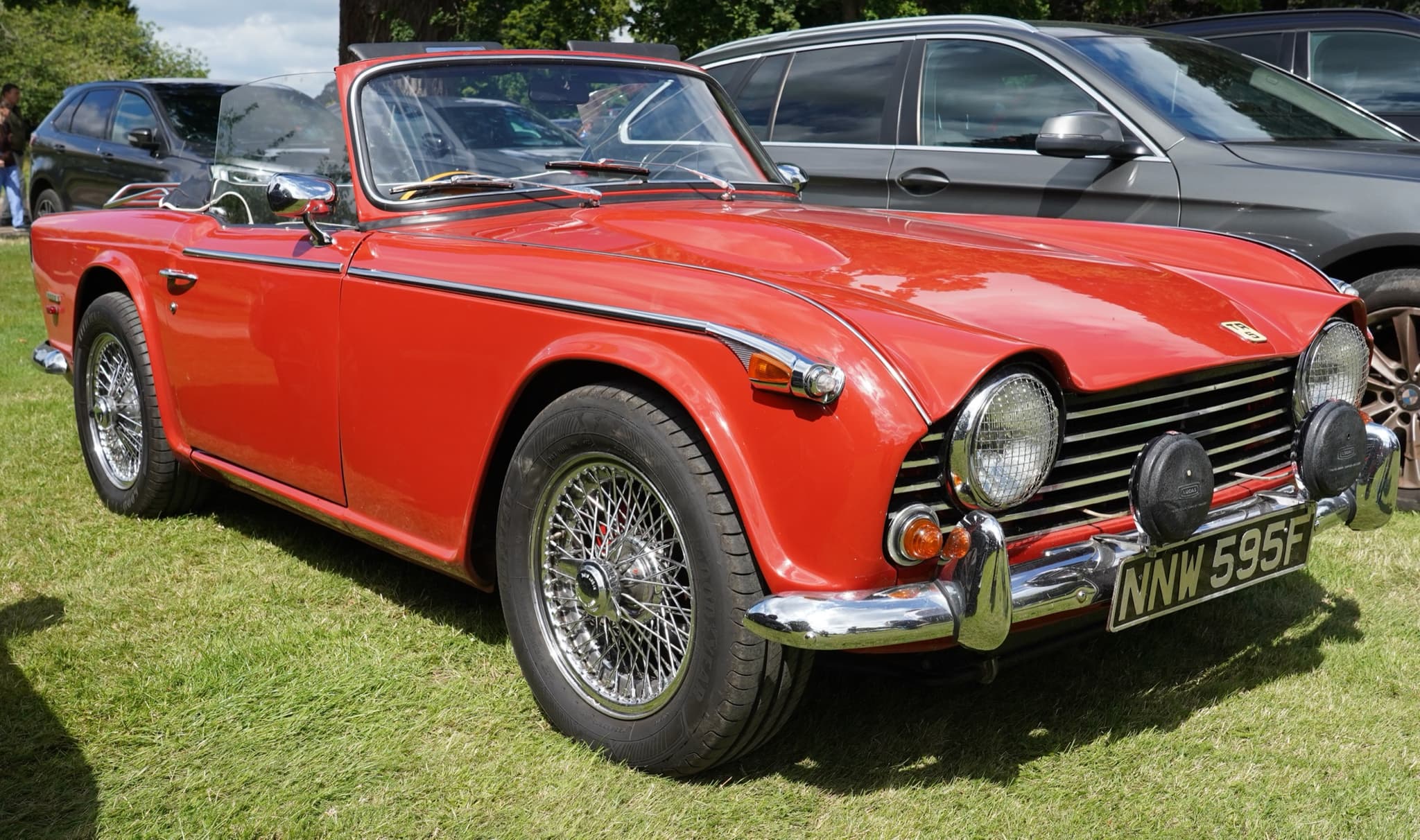
The press waited months for a TR5 to drive, and when the tests came, the engine won them over. Chris Harvey, looking back in 1983:
The 150-bhp fuel injection engine in the TR5 was welcomed with open arms by the testers.
They liked less the car around it, the body and frame of the TR4A with the new engine in front, and in America, where only the carburetted TR250 was sold, the reception was cooler still. Aaron Severson sums up the difference: "The TR5 PI met a better reception abroad".source 1source 2source 3
At launch, October 1967
Announced on 3 October 1967, the TR5 PI was shown that month at the London Motor Show, at Earls Court. Motor Sport's report gave Triumph's claims for speed, power and torque and listed the new hood (soft top), the stiffer rear suspension and the larger brakes. Its editor, Bill Boddy, set it against the MGC, and held back: "I will reserve judgment, however, until I have driven both these cars." The magazine's "Matters of Moment" column, looking at the show's advertising, asked who would not wish to go motoring in a TR5 with the long-haired blonde of Triumph's advertisement. Motor described the car on 7 October, and Car in its October issue under the title "Boots and All Take No Notice of the Pictures: The TR5 Is All Male", but neither piece has been read.
Then came a wait. Motor Sport had meant to test the TR5 against the MGC, and in March 1968 it explained why it could not:
Standard-Triumph's Press Office are not providing cars for road test until the new Triumph is properly in production, which only happened in the New Year although the car was unveiled as long ago as October, 1967.
The period tests: an index
Most of the period tests are known only from indexes, chiefly the list of sources at the end of Severson's history, which names the pages on which R. M. Clarke's Brooklands Books collection reprinted them. Their figures survive in Wikipedia's article but in no test that has been read.
| Date | Publication | What it was | Read here |
|---|---|---|---|
| October 1967 | Car | "Boots and All Take No Notice of the Pictures: The TR5 Is All Male" | No |
| 7 October 1967 | Motor | "1968 Cars – Injection TR", pp. 54–57 | No |
| November 1967 | Motor Sport | Earls Court show report, and its editor's column | Yes |
| December 1967 | Road & Track | "Triumph TR250", pp. 53–55 | No |
| 1968 | Road Test Annual | "Triumph TR250 Road Test" | No |
| March 1968 | Motor Sport | The MGC tested, and why no TR5 could be | Yes |
| 4 April 1968, by Harvey | Autocar | A TR5 test | No |
| April 1968 | Motor Trend | Bill Sanders, "Triumph 250: Six Cylinders for '68" | No |
| April 1968 | Car and Driver | Leon Mandel on the TR250K, not a road test | Yes, in part |
| 4 May 1968 | Motor | "Invigorating Injection", Road Test No. 19/68, pp. 17–22 | No |
| August 1968 | Motor Sport | D. C. N., "Road Test Report on a Sports Car" | Yes, in full |
| September 1968 | Cars & Car Conversions | "Triumph TR5 Petrol Injection" | No |
| October 1968 | Sports Car World (Australia) | "Enter, like a peal of thunder… Triumph's petrol injected TR5" | No |
| Date not found | Autosport | A TR5 test or report | No |
| Date not found | Car and Driver | A TR250 test | No |
| August 1969 | Road & Track | Robert A. Myers, "Owner Survey: Triumph TR4/4A/250" | No |
| August 1969 | Popular Science | "The $3,000 Roadsters", with a TR6, not a TR250 | Yes |
The Autocar test is known only from Chris Harvey, who dates it 4 April 1968 and records that Autocar was "very enthusiastic about the increase in performance". Two lines from Autosport and Car and Driver reach us through Moss Motoring in 2015, which quoted Autosport calling the TR5 "without doubt the best Triumph yet".source 3source 2source 1source 8source 9source 10
*Motor Sport*, August 1968, in detail
Motor Sport's is the one period test read here in full. Its test car, a soft-top TR5 PI in Valencia blue, arrived at the start of July 1968 for a fortnight, and its tester, D. C. N., covered 3,354 km (2,084 miles) in four days following the Gulf London Rally and then 1,252 km (778.1 miles) more.
He praised the hood, "one of the best of its type that I have seen … almost totally flap-free and extremely weather-proof", and the brakes, for which "moderate pedal pressure was all that was necessary for a most impressive stop". The engine was smooth, the Michelin XAS tyres held well in heavy rain, and the car was comfortable on long runs. The handling had an "inbuilt tendency towards understeer", though there was power enough to bring the tail round.
The rest he criticised. The dashboard was "a rather cheap-looking affair of dull-finished wood with a prominent join in the middle"; the dip switch was on the floor; the gearbox (transmission) seemed "stiff and notchy", though he allowed that "a difficult gearbox is half the fun"; the throttle was slightly sticky and the tickover failed; the poppers of the hood cover were brittle, the wipers missed a patch and lifted at speed, the horn and headlamp flasher gave trouble, grit got into the front brakes, and the boot (trunk) was small. Over the whole test the car returned 21.8 mpg (imperial). His verdict:
The TR5 has its imperfections, but is a vast improvement over the immediately preceding TR4A, and is a most desirable sports car, being one of the few real "man's cars" remaining, for it is very fast, quite heavy and a handful if it should break loose, but still sufficiently sophisticated to be well worth the £1,212 8s. 11d. asked for the soft-top version tested.
One tester's line on the ride survives in two books: Michael Richards and James Taylor both quote an unnamed test of the time, in which "the wheels tend to hop over any but the smoothest of surfaces".
The price D. C. N. gave in his verdict differs by tenpence from the one in the magazine's data panel, and the specifications give Triumph's prices. Within weeks the car was gone from the line, and at the London show that October Motor Sport asked: "Was it British Leyland policy which banished the sports Triumph TR5 to the "carriage work" section?" Its editor, Bill Boddy, reviewing his year in February 1969, had driven a TR5 only briefly: "I only covered a few miles in a Triumph TR5, on which a colleague commented fully and favourably."source 1source 11source 12source 13source 14
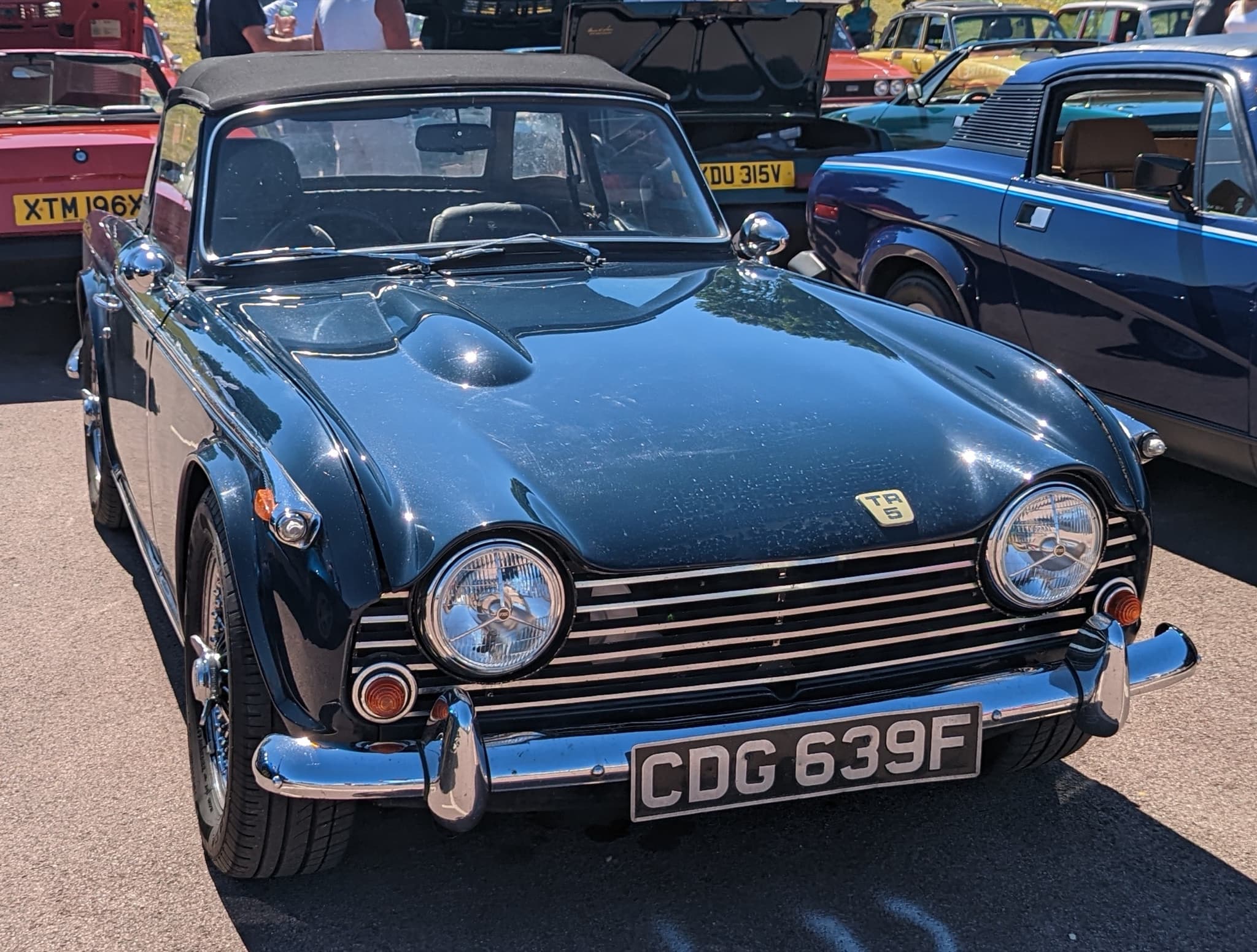
The TR250 in the American press
Americans saw a different car, and the press was unimpressed:
The American press was less than ecstatic about the TR250, having been presented for the third time in seven years with a new and more expensive TR that was no faster than its predecessor.
A few period reviews, Severson adds, found the TR250 slower than the TR4A, probably because the lower-geared axle option of the TR4 had gone, except to special order, and the testers grumbled at "the overly familiar styling, dated body structure, and a suspension that still didn't seem quite sorted". Harvey found one exception: Road & Track, reporting in December 1967, was "not too upset" that America did not get the injected engine. Moss Motoring, in 2015, quoted Road & Track finding that the engine "could hardly run more sweetly", and Car and Driver putting the case against: "to pay an extra $500 for a nearly identical but slower car doesn't make much sense". The owners had the last word; their survey and their complaints about the sealed carburettors are on the TR250 page.source 3source 2source 9
Sources
Sources are given as plain text; their addresses are on the sources page.
- Primarymade at the time, by the maker or by people who were there
- Referenceserious later work: clubs, specialists, magazines, books
- Doug Nye ("D. C. N."), "Road Test Report on a Sports Car: The Fuel-Injection Triumph TR5 PI", Motor Sport, Aug 1968, p. 26, p. 26, the verdict; p. 26, para. 1; p. 26; pp. 26–27. Primary
- Chris Harvey, TR for Triumph, Oxford Illustrated Press, 1983, ISBN 0-902280-94-5, full-text passages on the testers; full-text passage on Autocar; full-text passages on the American tests. Reference
- Aaron Severson, "Grandfather's Ax: The Many Evolutions of the Triumph TR4, Part 2: TR5, TR250, and TR6", Ate Up With Motor, 7 Nov 2012, "Triumph TR5 PI and TR250", the reception; notes on sources, Motor and Car; notes on sources, the period tests and the Brooklands reprints. Reference
- Motor Sport, "A selection of new models" (Earls Court show), Nov 1967, p. 39, p. 39, Triumph. Primary
- Bill Boddy, "The editor's annual showtime soliloquy", Motor Sport, Nov 1967, p. 24, p. 24. Primary
- Motor Sport, "Matters of Moment", Nov 1967, p. 15, p. 15, the show advertising. Primary
- Motor Sport, "New M.G.-C Sports Car", Mar 1968, p. 44, p. 44. Primary
- Leon Mandel, "TR-250K: Salvation of an Empire", Car and Driver, Apr 1968 (vol. 13 no. 10), pp. 2–4. Primary
- Moss Motoring, "Driven – 1968 Triumph TR250", 28 Aug 2015, the period quotations. Reference
- Jan P. Norbye and Jim Dunne, "The $3,000 Roadsters", Popular Science, vol. 195 no. 2, Aug 1969, pp. 96–101, pp. 96–101. Primary
- Michael Richards, Triumph TR4, 5, 6, Haynes, 1990, full-text passage, the ride. Reference
- James Taylor, Triumph TR, Windrow & Greene, Classics in Colour 9, 1994, full-text passage, the ride. Reference
- Motor Sport, "A Lighthearted Look at the London Show", Nov 1968, p. 18, p. 18. Primary
- Bill Boddy, "My Year's Motoring", Motor Sport, Feb 1969, p. 11, p. 11. Primary