Triumph TR5 Buyers Guide
What to check on a TR5 PI or TR250 before you buy: its identity first, then the frame's trailing-arm and differential mountings, rust in the body, the crankshaft thrust washers and, on a TR5, the injection, from the clubs' own guides.
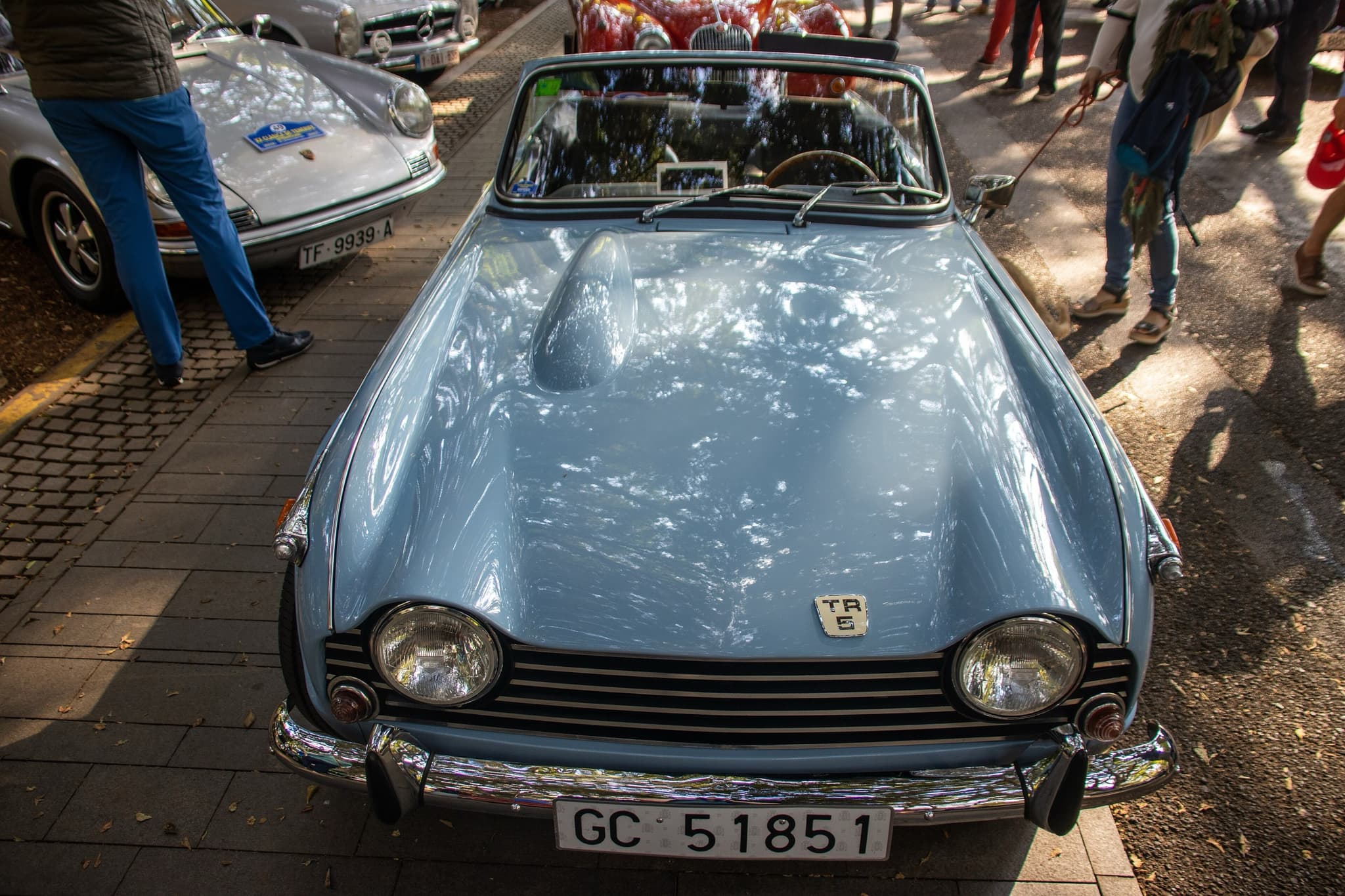
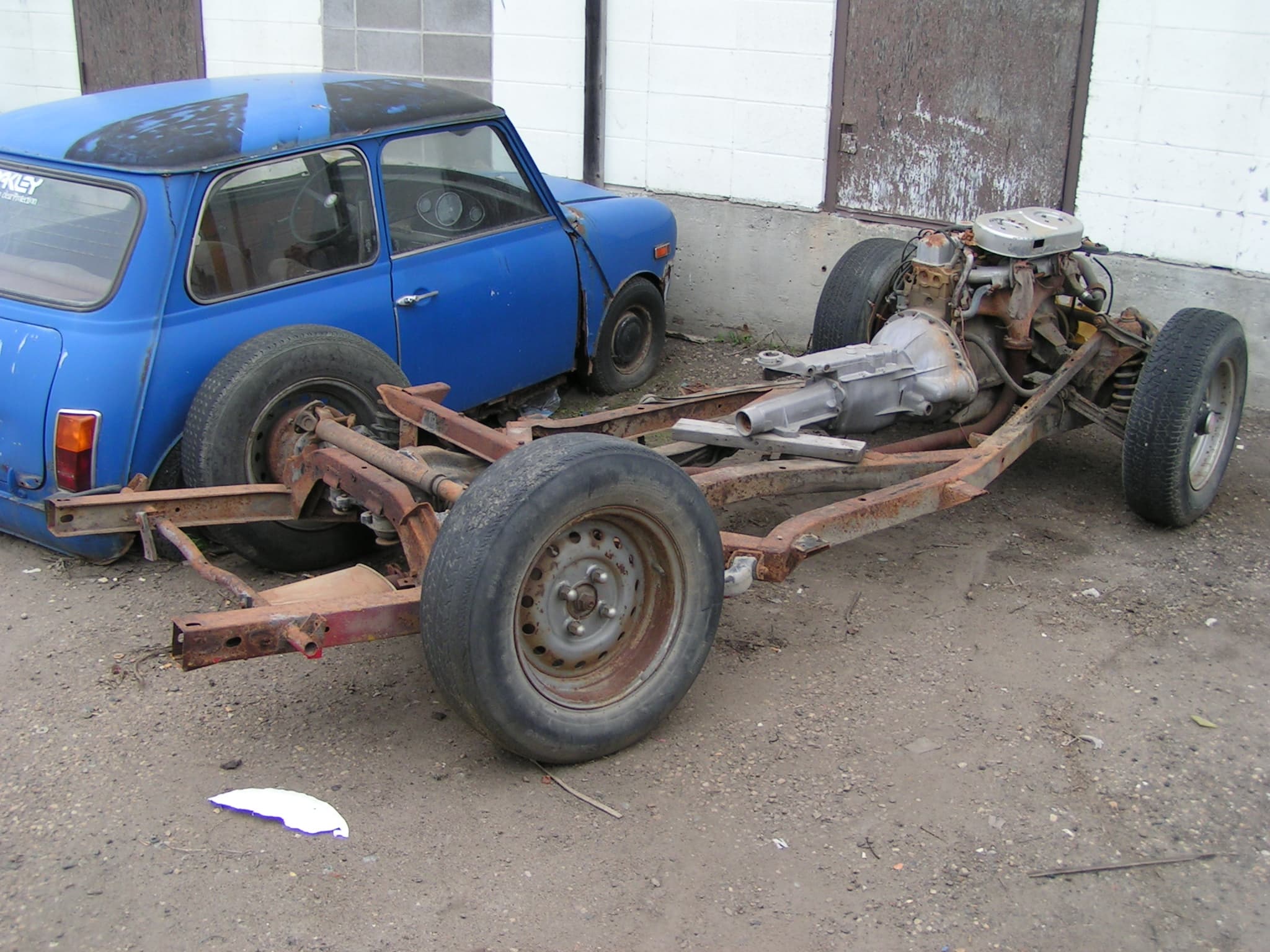
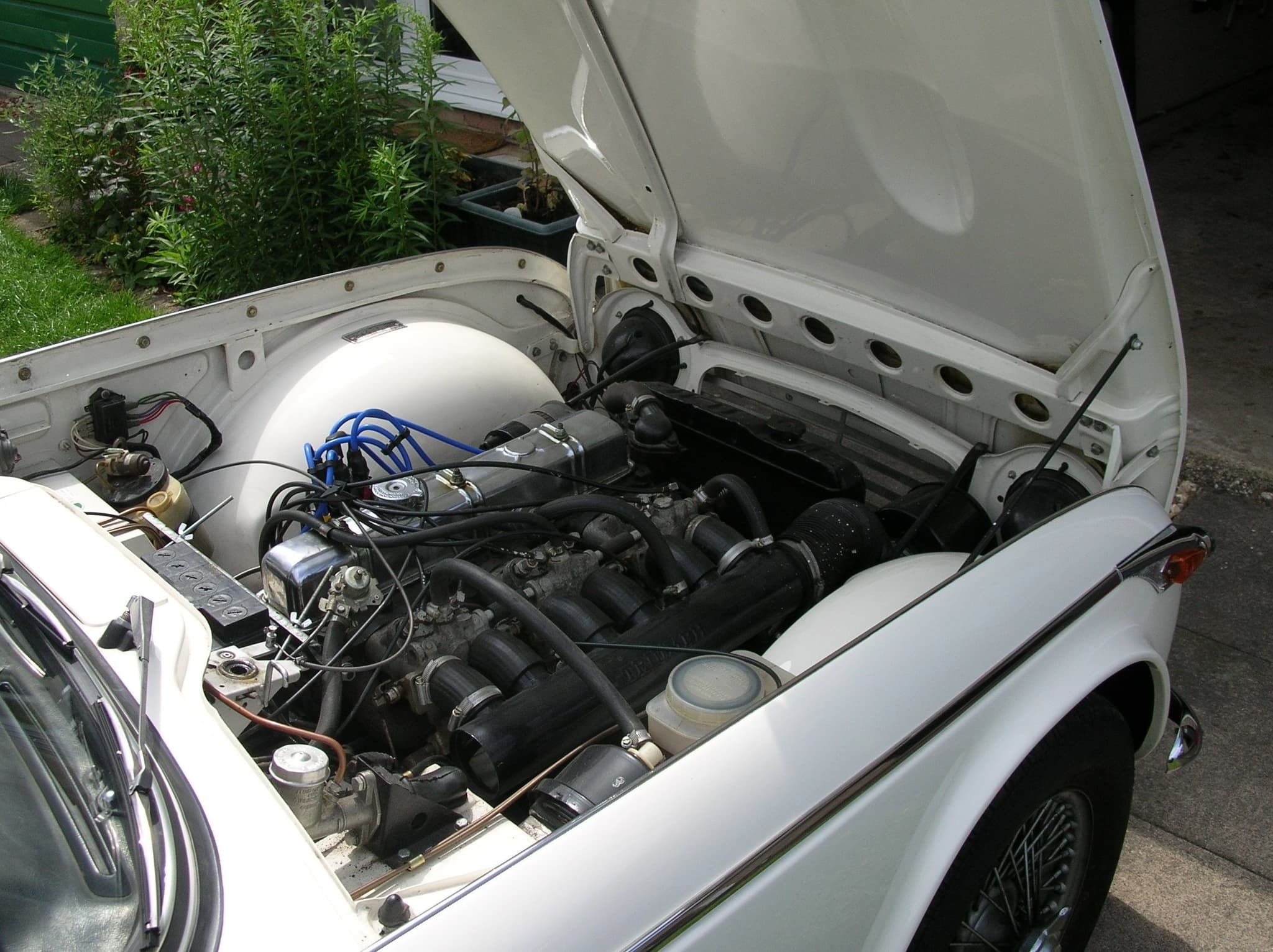
About the pictureA neglected car of the TR4A–TR250 body, its front of the TR4A pattern, standing in for a TR5 in need of work.

The clubs' guides to the TR5 and TR250 agree on the order: first make sure the car is what it claims to be, then look underneath at the frame, then at the body, and only then at the engine and, on a TR5, the injection. This guide follows the Vintage Triumph Register's (VTR's) guide for the TR5 and TR250, the German TR Register's, and the TR Register's general "Buyer Beware" sheet, with tr5passion.com on identity.source 1source 2source 3source 4
Before you look: is it a TR5?
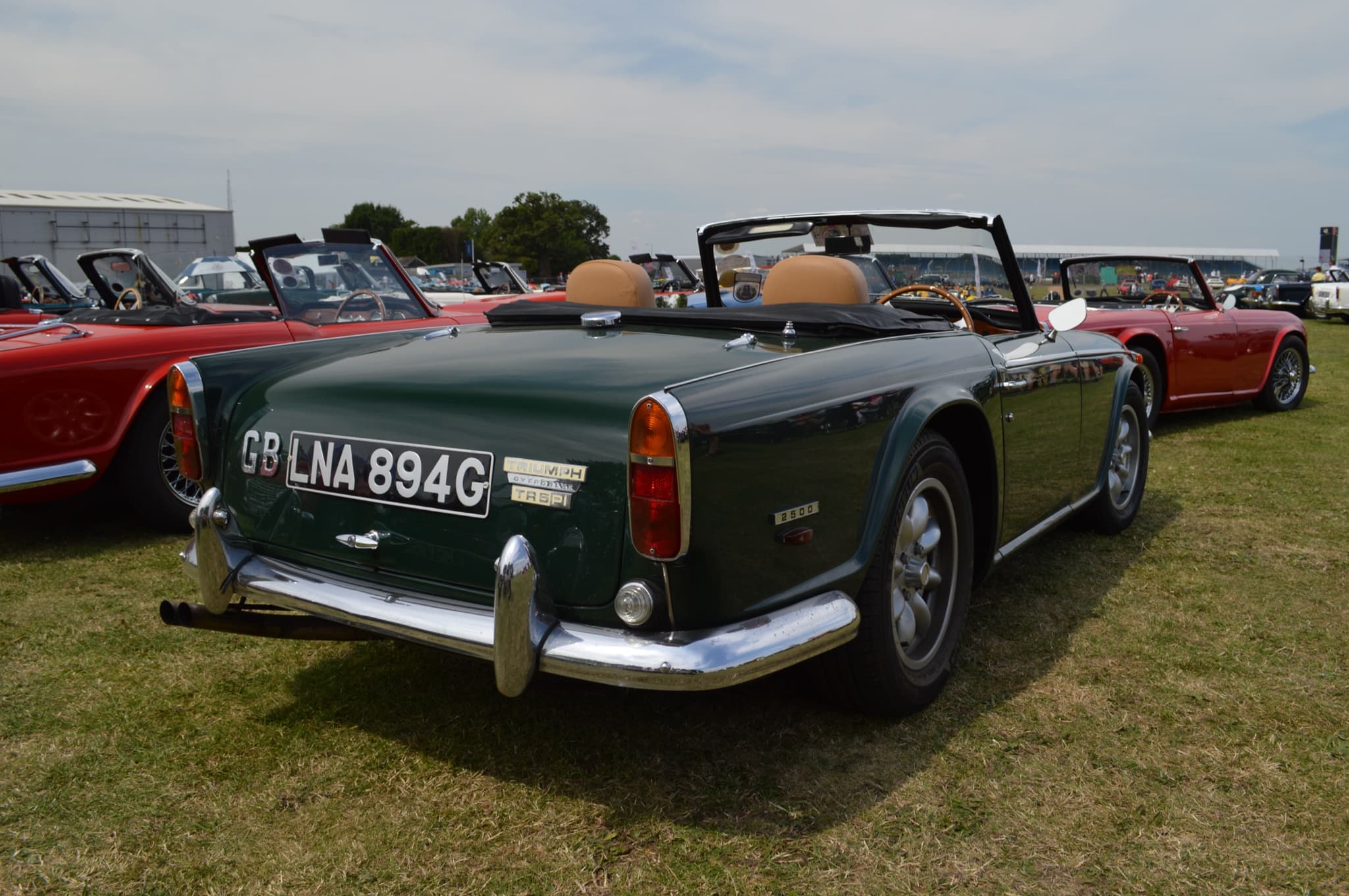
A TR5 PI's commission number begins CP, and a TR250's CD; the engine number should agree, CP…E for a TR5 and CC…E for a TR250. Then come the details, and for a car built at Canley a British Motor Museum Heritage Certificate. Converted cars are the trap. TR250s have been given injection, right-hand drive and new badges and sold as TR5s, and Motor Sport warned of the stripe as long ago as 1996:
If you come across a TR5 with racing stripes on the bonnet check to see if it is in fact the TR250 with Stomberg …
Identification explains the numbers, where they are and what a certificate shows. The TR Register adds two warnings: make sure the plate's number matches the registration document, and remember that every American car was built with left-hand drive, so a right-hand-drive car with an American past has been converted, well or badly.
The frame
Look at the frame before anything else. Its boxed members rot from the inside, the VTR's guide says, and show it first as blisters along the seams; the TR Register singles out the rear half, with the six-cylinder cars appearing to suffer more than the TR4A. Two places matter most, and both are under the car: the mountings of the rear suspension's semi-trailing arms, just behind the seats, and the mountings of the differential.
If there is rust on these pieces, get up, dust yourself off, and say 'Thanks, but no thanks'. (Unless you are looking for a donor car for a major project.)
The German guide explains why the differential's mountings tear: the differential hangs from two bridges by four bolts, too weak for the six's torque, and the tearing usually starts at the right front bolt. A clunk from the back, the VTR warns, can be torn mountings or worn universal joints, which sound alike. At the front the German guide asks a buyer to look for kinks in the frame's tips, from accidents and kerbs, cracks at the lower-wishbone brackets, tears at the welded seams of the steering-rack mountings, and damage to the diagonal struts that carry the spring towers. Sagging sills (rocker panels) and doors that stick, the VTR adds, are a warning about the frame as well as the body.
A hoist
The frame and its mountings can only be judged from underneath.
A magnet or a paint-thickness gauge
Filler hides where the steel has gone.
A mirror and a strong torch
For the differential's mountings, high up under the car.
A club specialist
The German guide's advice: take one along.source 1source 2source 3
The body
Rust in the body starts in the same places on every car, and the guides list them:
| Where | What to look for |
|---|---|
| Wing (fender) tops | Corrosion from beneath, along their whole length |
| Rear deck | The seams with the rear wings; bubbling paint means more within |
| Rear wings | The double-skinned edges behind the doors; the bolted upper edges |
| Front wings | Behind the wheels where they meet the bulkhead; around the headlamps |
| Sills | Below the front pillar, at the rear end, and the inner sills from below |
| Floors and footwells | Where they meet the sills and the bulkhead; under the pedals and the seat runners |
| Doors | The bottom edges, the front and rear edges, the corners of the window channels |
| Bonnet (hood) | A weak spot about 20 cm from its rear edge, where it rests on its stops |
| Boot (trunk) lid | Its lower edge |
| Battery box | Acid damage, there and under the master cylinders and the washer bottle |
| Tail | The tail-lamp area and the corners of the rear valance |
The inner panels should be in the body colour, the TR Register says, not black or underseal, and the German guide notes that glass-fibre panels are not original. Cars that have come back from America need the same care as any other:
Buyers should be aware that not all US cars spent their entire life in 'dry' States and that corrosion on US cars can be just as severe as found on any home market cars.
The engine
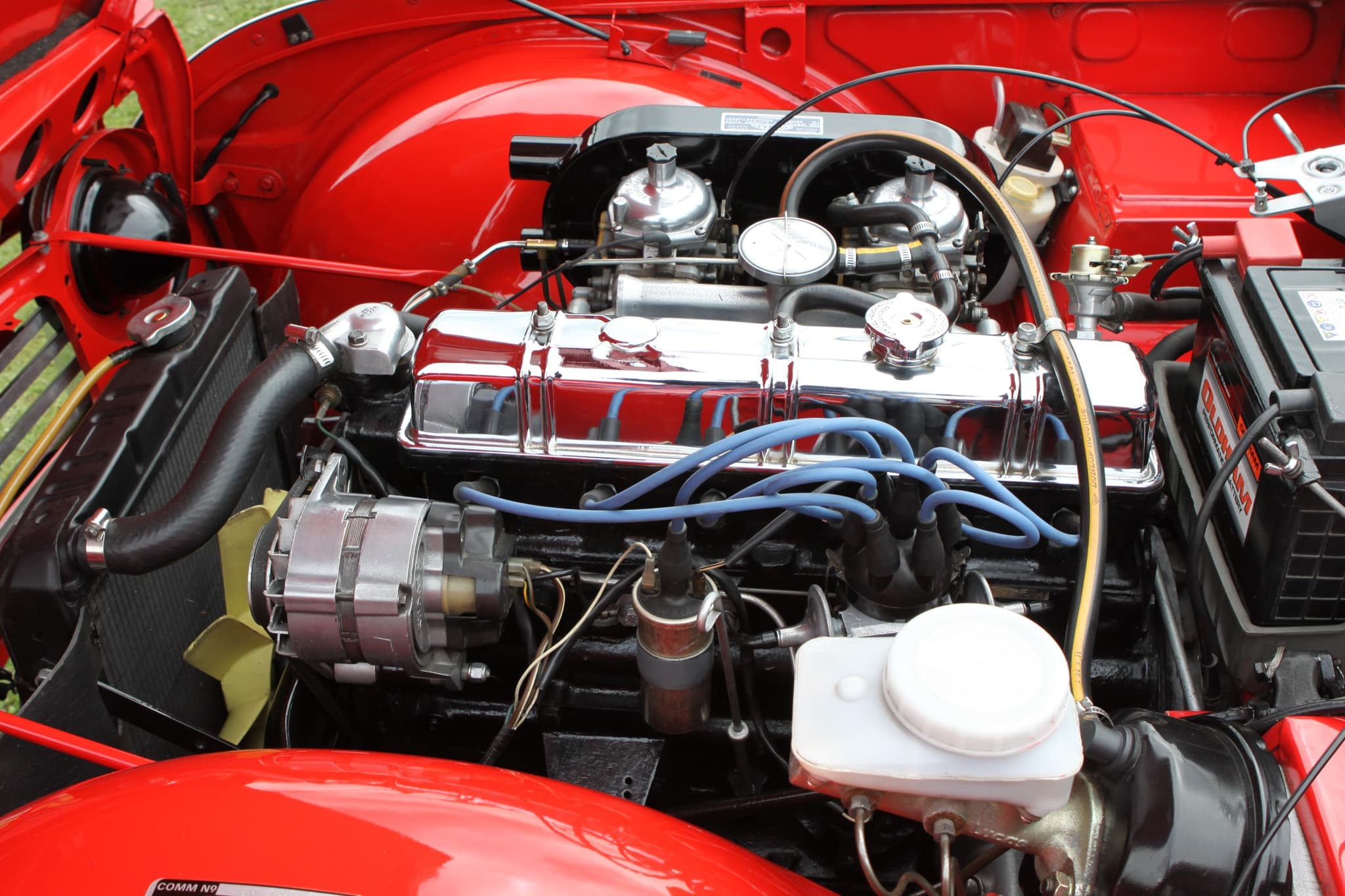
The six is strong, the VTR's guide says, and its weak point is the crankshaft's thrust washers: "These are the biggest failure point." The test needs a helper. Push the crankshaft pulley at the front of the engine towards the back, then have the helper press the clutch pedal, and feel whether the pulley moves forward. The guide allows between 0.18 and 0.33 mm (0.007 and 0.013 in) of end float; more than a fingernail's thickness means work soon, and near 3 mm (⅛ in) the washers may already be in the sump.
The German guide adds the rest. Test the compression and the leakage warm, and expect the oil pressure, also warm, to be above 3 bar (40 psi) at 3,000 on the rev counter; cold readings mean little. A rising level in a full, open radiator during the leakage test points to the head gasket, and so can brown foam under the oil filler cap, though short journeys cause that too. The temperature needle should settle in the middle within 5 km, the thermostat opening at 82 °C. For comparison, Motor Sport's new test car of 1968 showed about 4 bar (60 lb per sq in) at any steady speed over about 65 km/h (40 mph).source 1source 2source 9
The injection
The injection matters on a TR5, but it is one item among several, and the clubs' guides put it there. Motor Sport's advice in 1996 put it in its place, "When purchasing, watch out for rust in the chassis and check the engine running, as the fuel injection system can give trouble", and the checks are these:
The throttle spindles
Worn spindles in the three throttle bodies let in air.
A blip, warm
A quick blip of the throttle should bring no black smoke; black smoke means it is running rich.
The tank
A car that falters below a quarter of a tank has the TR5's known fault; the TR Drivers' Club says that more fuel seemed to cure it.
The pump
Vapour lock troubled the Lucas pump, by tr5passion.com's account, and some owners have fitted a Bosch-type pump in its place.
The metering unit
Its springs cannot be adjusted, and it is specialist work.
Running gear
The VTR's guide covers the transmission and the axle. Listen for noise in every gear and feel for slack in the change. The Laycock overdrive should engage and release promptly, the German guide adds, dropping the engine speed by about a fifth. The differential's bearings are ball bearings; a failed one is often cured by a new differential, and a rebuild needs special tools. The rear hubs' bearings cannot be greased: slack found early means a specialist rebuild, found late scrap, and the guide's advice is "Farm out hub rebuilding!" There are six universal joints, sealed for life at the factory, though replacements may have grease nipples.
At the front, the German guide finds that modern rubber bushes for the wishbones perish quickly, and that polyurethane bushes are common. The trunnions in the vertical links run in brass bushes and need liquid grease or gear oil, never hard grease; hardened grease and perished rubber boots mean worn threads. Check the upper ball joints' gaiters, play in the steering rack, and its rubber mountings, which make the steering vague; aluminium and other replacements are sold. On a TR250 the lower wishbones were fixed to the frame by a second stud, a cure, by the VTR's account, for a TR4A failure.source 1source 2source 12
Electrics, trim and originality
The VTR's guide finds no electrical trouble beyond the usual troubles of the period. Originality is harder on a TR250, whose striped hoses and carburettor vacuum valve the VTR finds scarce; no new harness carries the plug for its American hazard flasher. Parts in general are well supplied, and what interchanges with the TR4A, the TR6 and the 2.5 PI saloon (sedan) is on parts and specialists.source 1source 12source 2source 3
Sources
Sources are given as plain text; their addresses are on the sources page.
- Primarymade at the time, by the maker or by people who were there
- Referenceserious later work: clubs, specialists, magazines, books
- Steve Gronau with David Webb (buyer's guide), "TR5/250" (history; buyer's guide), Vintage Triumph Register, modified 12 Dec 2023, buyer's guide (Steve Gronau with David Webb); buyer's guide, the frame; buyer's guide, the body; buyer's guide, the engine; buyer's guide, transmission, axle and hubs; buyer's guide, electrics and originality. Reference
- Bruno Dwinger, "Geschichte, Typenkunde und Kaufberatung: Standard-Triumph TR4, TR5/TR250 – 'die Michelotti Autos'", TR-Register Deutschland, 2009, 13 pp. (PDF), Kaufberatung; Kaufberatung, the frame; Kaufberatung, the body; p. 11, the engine; Kaufberatung, the injection; Kaufberatung, overdrive, front suspension and steering; Kaufberatung, panels. Reference
- TR Register, "Buyer Beware: TR6" (2 pp. PDF leaflet), p. 2; p. 2, identity, US cars and conversions; p. 2, the frame; p. 2, the body and US cars; p. 2, inner panels. Reference
- Frédéric Reydellet (racing history), tr5passion.com (group): "En bref / Summary", "Identification", "Lucas injection", "Options", "Technical spec", "Colours", "TR5 Ginevra", "Racing history", TR5 Passion, Identification page (_r61); Lucas injection page (_r63). Reference
- Motor Sport, "A–Z of Classic Sporting Cars 1950–1975", Oct 1996, p. 80, p. 80, TR5. Reference
- TR Register, "Triumph TR5 / TR250" (facts sheet, under "Buyers Guide"), markets. Reference
- Moss Motoring, "Triumph in America", 1 Mar 2001, TR5 and TR250 lines. Reference
- Moss Motors, "Triumph TR250 & TR6 Vehicle Identification", engine numbers. Reference
- Doug Nye ("D. C. N."), "Road Test Report on a Sports Car: The Fuel-Injection Triumph TR5 PI", Motor Sport, Aug 1968, p. 26, p. 26, oil pressure. Primary
- TR Drivers Club, "The TR5/250", the low-tank fault. Reference
- Aaron Severson, "Grandfather's Ax: The Many Evolutions of the Triumph TR4, Part 2: TR5, TR250, and TR6", Ate Up With Motor, 7 Nov 2012, "Triumph TR5 PI and TR250", service. Reference
- Drew Holliday, "Triumph TR250 Production Information" (8 pp. PDF), Vintage Triumph Register, p. 3, the second stud; pp. 3–4, hoses, valve and flasher. Reference