Triumph TR5 Commission Numbers
Real TR5 or converted TR250? The commission number answers it: CP for a TR5 PI, CD for a TR250, with letters after the number for left-hand drive and overdrive. How to read the numbers, where to find them on the car, and what a Heritage Certificate can and cannot tell you.
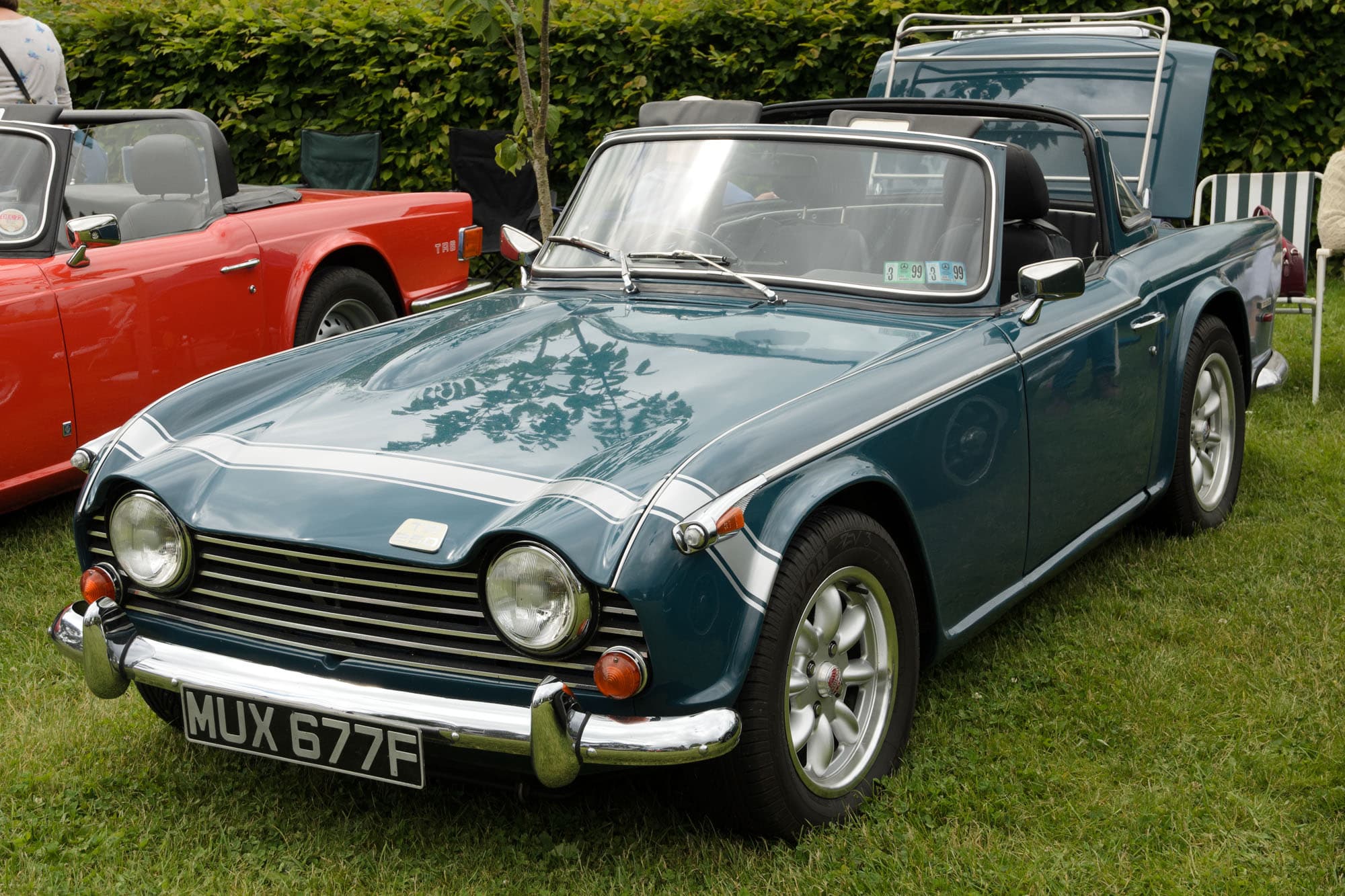
About the pictureThe TR5 PI's boot badges, standing in for a commission plate.
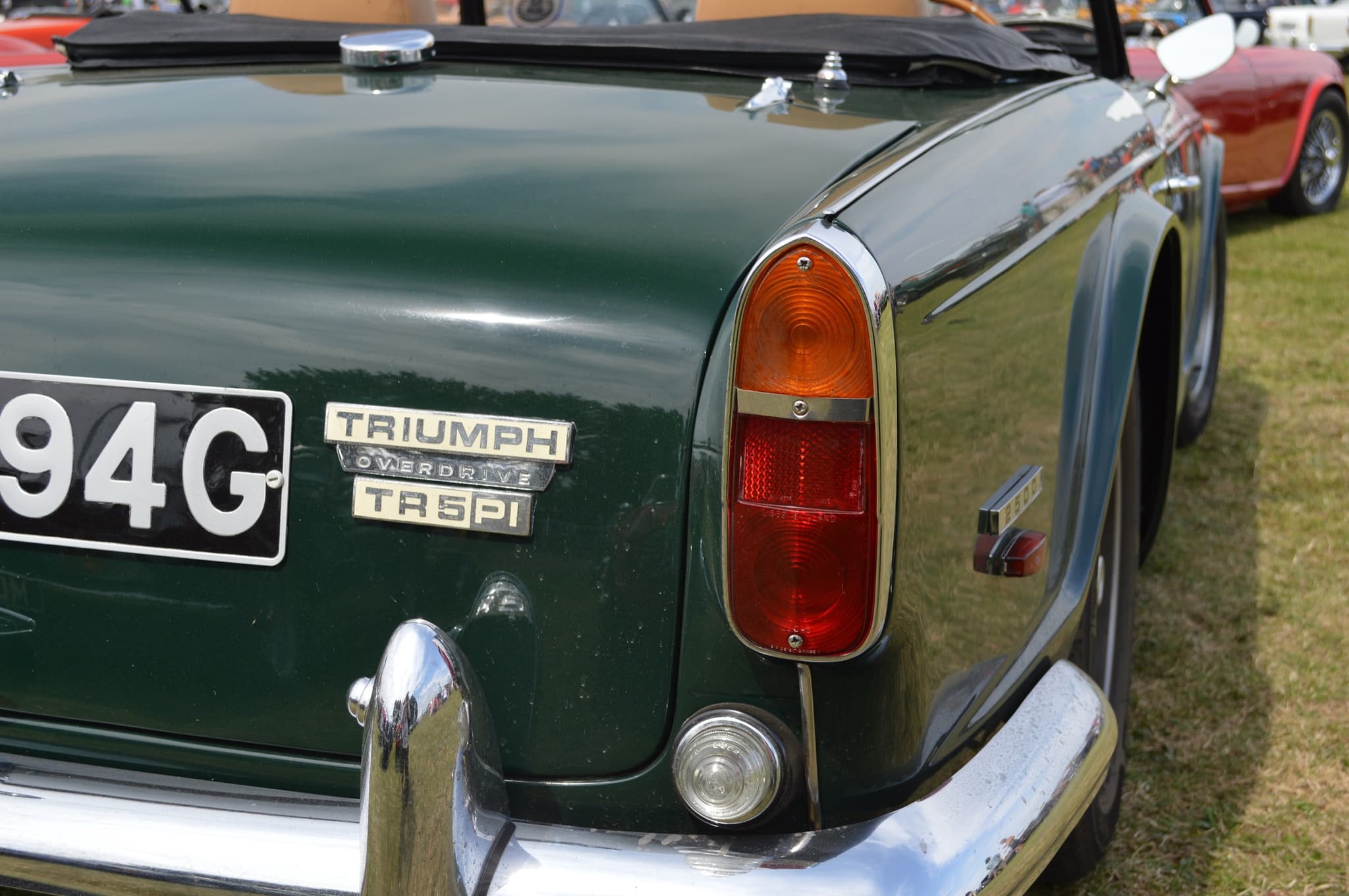
For every TR5, Canley built almost three TR250s. Nearly all of them went to North America, and the TR Register warns that many TRs have since come back, so that a car offered as a TR5 today may have been built as a TR250 and given injection, right-hand drive and new badges. The commission number, stamped on a plate when the car was built, is what tells them apart.source 1source 2source 3
Reading a commission number
CP opens a TR5 PI's number, CD a TR250's. After the serial number, L marks left-hand drive and O overdrive, so CP…LO is a left-hand-drive TR5 with overdrive, and a number with neither letter is a right-hand-drive car without it. Leather seats were meant to be marked too, with an H: the VTR says that several original leather cars carry no such mark, and tr5passion.com puts the letter before the trim code, H for leather and C for cloth, with none for Ambla. The plates of Canley-built cars also carry the paint and trim codes.
The TR5s assembled from kits in Belgium, at Malines (Mechelen) according to tr5passion.com, have numbers of their own: 1CP … LP, the 1 before the prefix and P after the L.source 2source 4source 3
CD8594L
- CDThe prefix: a TR250
- 8594The serial number
- LThe suffix: left-hand drive
The numbers year by year
| TR5 PI | TR250 | |
|---|---|---|
| First | CP1, a prototype; CP2, the first production car, 29 August 1967 | CD1, 11 July 1967 |
| First of 1968 | CP586, 1 January 1968 | CD2358, 1 January 1968, by the VTR's list (its text gives CD2685L) |
| Last | CP3101, 19 September 1968 | CD8594L, 19 September 1968 |
The numbers ran further than the cars. CP2 to CP3101 is 3,100 numbers, and CD1 to CD8594 is 8,594, more in each case than the cars the production readings below count. tr5passion.com admits that "We do not know where the gaps are in the numerical sequence", and the VTR offers an explanation:
The difference in actual production and commission numbers is attributed to rebadging and numbers being assigned to cars that were never built.
What was the last TR5's number?
Fact check
CP3101
the VTR, Rimmer's catalogue and tr5passion.com
CP3096
the German TR Register's guide
Our reading. CP3101, the last car built on 19 September 1968, which three sources give. Moss Motors' table prints the last number as "C93096", a misprint that may stand for CP3096; it is not a third reading.source 2source 4source 3source 7source 8
Where to look on the car
Engines and gearboxes (transmissions) can be changed; the commission plate stays with the body and frame, as Moss Motors puts it:
The commission number is the one which should live with your car forever.
Its place is described two ways: tr5passion.com puts it on the left-hand side of the bulkhead, and Moss Motors on the left-hand front wheel arch, for British cars of 1967 to 1974 and American cars of the 1968 and 1969 model years. No source read reconciles the two. On the Belgian cars, tr5passion.com says, the plate seems to have been riveted to the left of the battery, without the colour codes.
| Number | Where | What it reads |
|---|---|---|
| Engine | The left-hand side of the block | CP…E on a TR5; CC…E on a TR250, from CC1E |
| Body | A plate on the right-hand side of the bulkhead | The commission number reversed, its letters last |
| Gearbox | The left-hand side of the casing | A CD series, shared with the saloons (sedans) |
| Rear axle | The bottom of the differential casing | CP… on a TR5, by tr5passion.com |
| Chassis | Engraved at the front, near the mountings | tr5passion.com is not sure that every TR5's was numbered |
Real TR5 or converted TR250?
tr5passion.com puts the risk bluntly:
ATTENTION: The TR5 is a rare car and thus is much sought after. Some unscrupulous individuals transform TR250s into TR5 P1s!
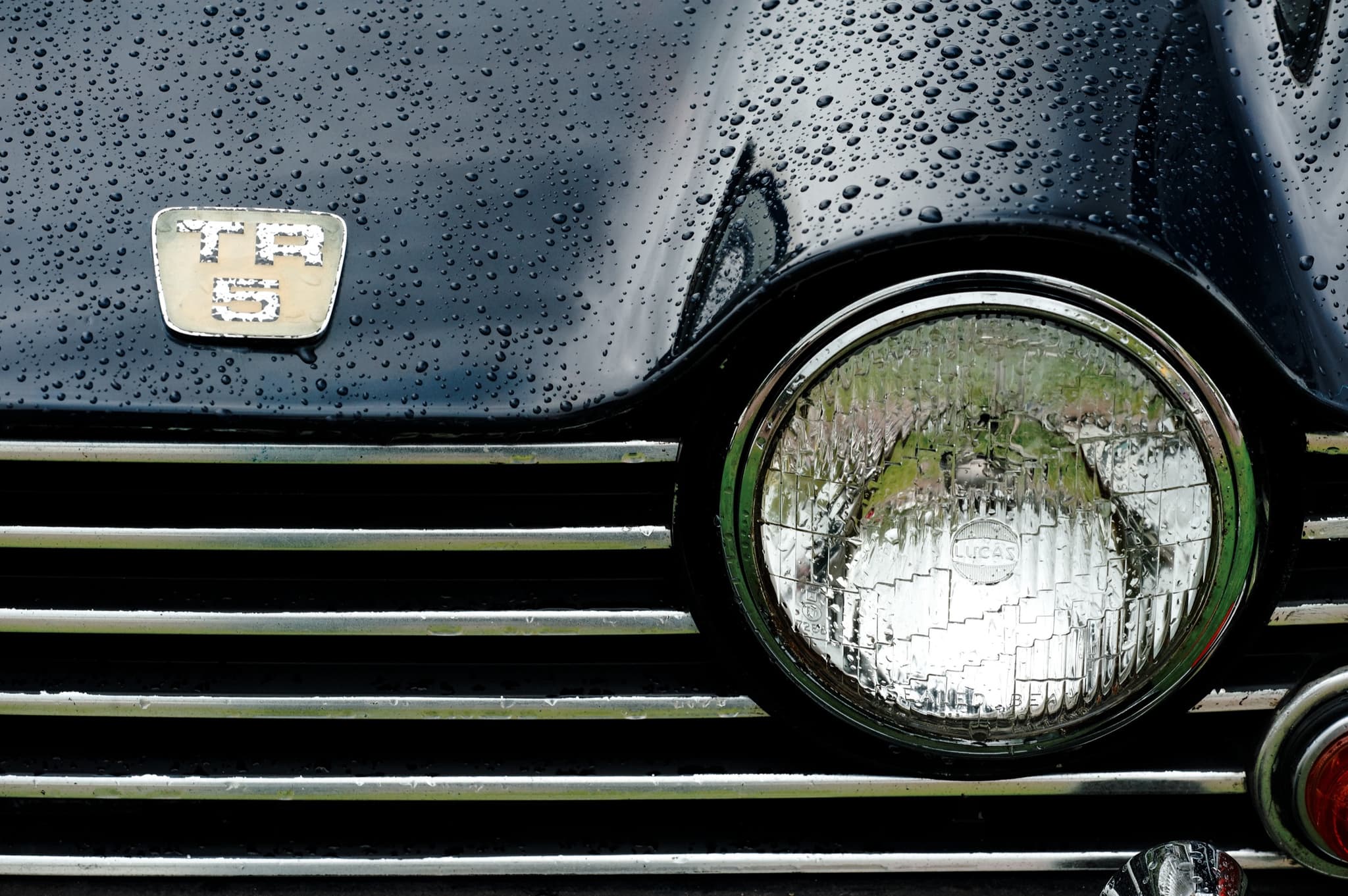
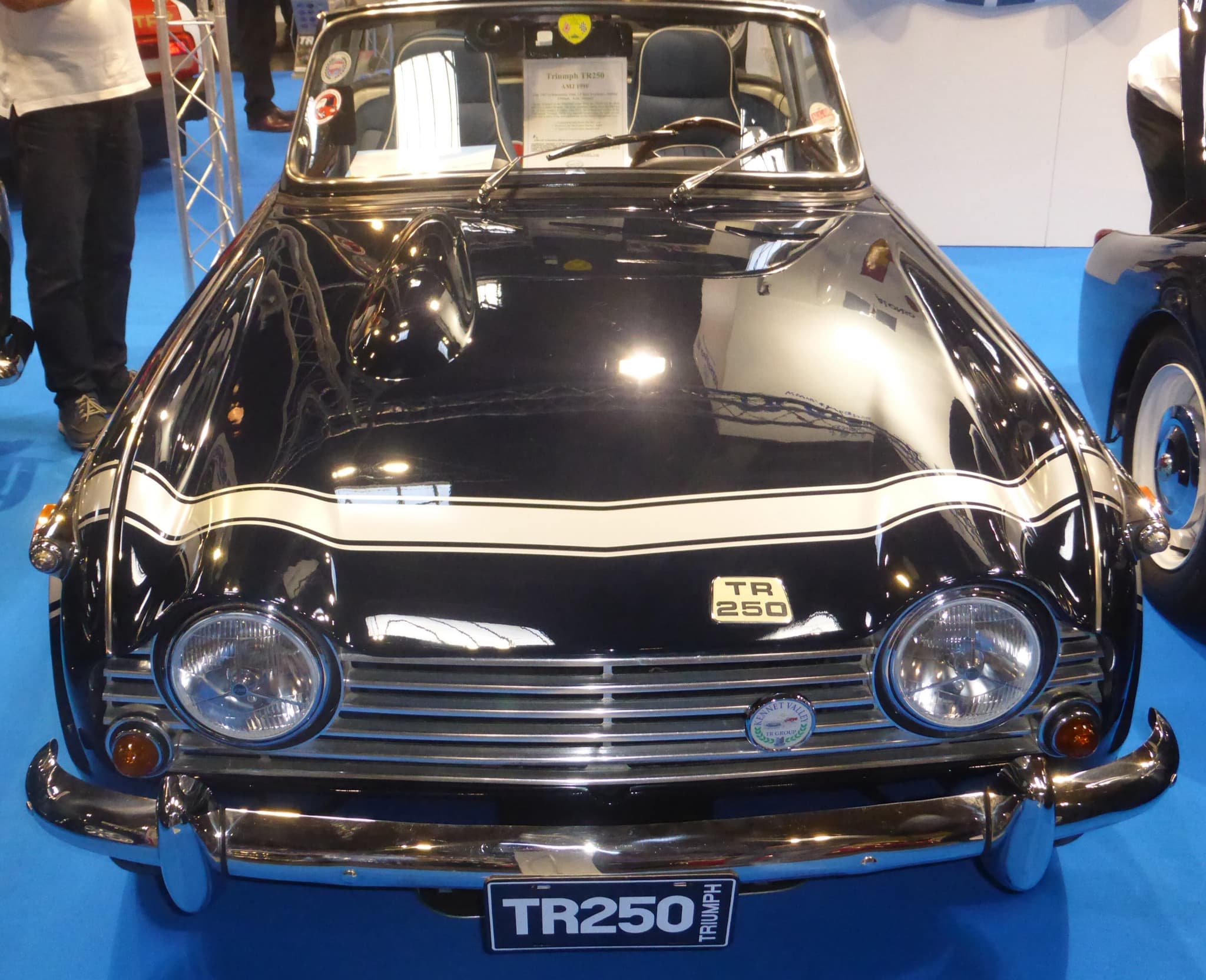
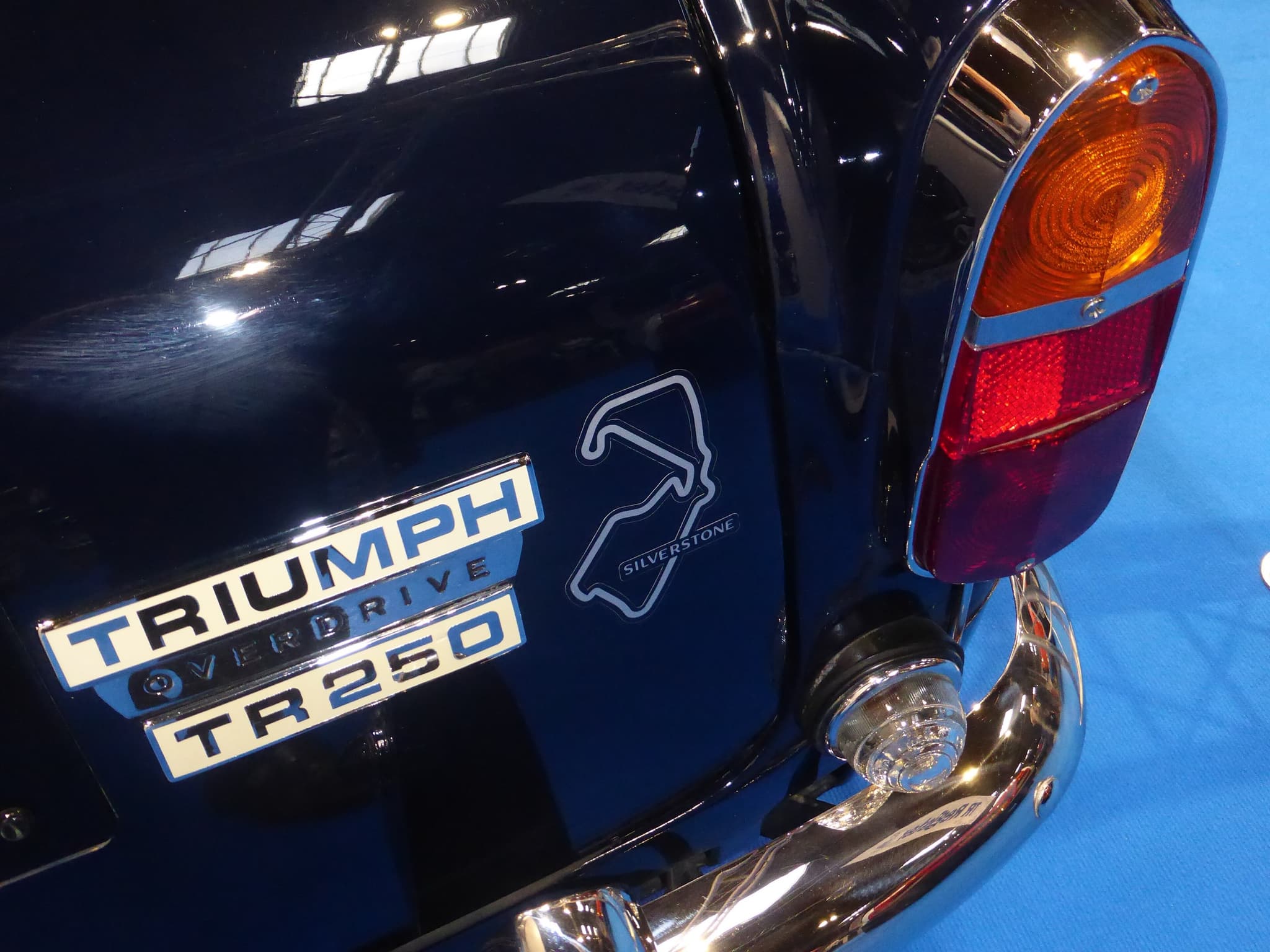
Motor Sport warned of the same in 1996. A conversion means injection, right-hand drive, since every car for the United States was built with left-hand drive, as the TR Register points out, and the stripe and badges removed or changed. What gives it away is the numbers: a CD prefix, an L on a car that now steers from the right, an engine numbered CC…E. Traces of a left-hand-drive past help too, such as the brake-failure lamp and hazard switch, which left-hand-drive TR5s also had. So do traces of the American specification: the side lamps and the striped hoses described on the TR250 page.
tr5passion.com's checks come in three stages, and the TR Register adds one of its own:
The plate
The prefix, CP or CD, and its suffixes, against the car in front of you.
The details
The TR5's own badges and fittings against a TR4's, as tr5passion.com sets them out.
The certificate
A British Motor Museum Heritage Certificate, for a car built at Canley.
The papers
The number on the plate against the registration document, and then the model's registrar at the TR Register.
A Heritage Certificate records how a Canley-built car left the factory, which tr5passion.com sums up as "the origins of your TR5 (colour and original options, agreement of numbers etc.)". It cannot help with a Belgian-assembled car: tr5passion.com advises that the British Motor Museum holds no record of them, so there is no point in asking for one.source 3source 9source 10source 1source 2source 11source 12source 6
Production
Production: how far the sources agree
- 2947, 1,161 home market + 1,786 export
- Good sources agree.
- 1,161 + 1,786, "TR5 Home" + "TR5 Export (not USA)"
- Good sources agree.
- 1,161 / 1,786 / 2,947, UK / export / total
- Good sources agree.
- 2945, TR5 (1967-68), as printed; the sidebar names no source for its figures
- One good source.
29471,161 home market + 1,786 export
TR Register, "Triumph TR5 / TR250" (facts sheet, under "Buyers Guide")source 12; Drew Holliday, "Triumph TR250 Production Information" (8 pp. PDF), Vintage Triumph Registersource 2; Frédéric Reydellet (racing history), tr5passion.com (group): "En bref / Summary", "Identification", "Lucas injection", "Options", "Technical spec", "Colours", "TR5 Ginevra", "Racing history", TR5 Passionsource 3
1,161 + 1,786"TR5 Home" + "TR5 Export (not USA)"
TR Drivers Club, "The TR5/250"source 13
1,161 / 1,786 / 2,947UK / export / total
Graham Robson (essay "15 Years of Evolution"), Triumph TR2 – TR3/3A, TR4/4A – TR5, TR250 1953–1968 Parts & Accessories Catalogue, Rimmer Bros, edn 2.1 (source code TR2512), Part 1source 4
2945TR5 (1967-68), as printed; the sidebar names no source for its figures
Fred M. H. Gregory, "TR8 V-8: A mighty Triumph" (road test), with the sidebar "A String of Triumphs", Motor Trend, Jun 1980source 14
Sources
Sources are given as plain text; their addresses are on the sources page.
- Primarymade at the time, by the maker or by people who were there
- Referenceserious later work: clubs, specialists, magazines, books
- TR Register, "Buyer Beware: TR6" (2 pp. PDF leaflet), p. 2, re-imports; p. 2, the plate; p. 2, US cars, conversions and the registration document. Reference
- Drew Holliday, "Triumph TR250 Production Information" (8 pp. PDF), Vintage Triumph Register, p. 1; pp. 1, 5, prefixes, suffixes and the leather mark; p. 1, span list and text; pp. 2–4, US equipment. Reference
- Frédéric Reydellet (racing history), tr5passion.com (group): "En bref / Summary", "Identification", "Lucas injection", "Options", "Technical spec", "Colours", "TR5 Ginevra", "Racing history", TR5 Passion, Identification page (_r61); Identification page (_r61), suffixes, trim codes and Belgian cars; Identification page (_r61); Summary page (_r58), years; Identification page (_r61), the conversions, the three checks and the certificate; Summary page (_r58). Reference
- Graham Robson (essay "15 Years of Evolution"), Triumph TR2 – TR3/3A, TR4/4A – TR5, TR250 1953–1968 Parts & Accessories Catalogue, Rimmer Bros, edn 2.1 (source code TR2512), Part 1, p. 7; pp. 6–7; p. 6, production table (read by the TR4 agent). Reference
- Motor Sport, "New M.G.-C Sports Car", Mar 1968, p. 44, p. 44. Primary
- Aaron Severson, "Grandfather's Ax: The Many Evolutions of the Triumph TR4, Part 2: TR5, TR250, and TR6", Ate Up With Motor, 7 Nov 2012, notes on sources, Sports Car World. Reference
- Bruno Dwinger, "Geschichte, Typenkunde und Kaufberatung: Standard-Triumph TR4, TR5/TR250 – 'die Michelotti Autos'", TR-Register Deutschland, 2009, 13 pp. (PDF), p. 4. Reference
- Moss Motors, "Triumph TR250 & TR6 Vehicle Identification", 1968 row; stamping positions. Reference
- Motor Sport, "A–Z of Classic Sporting Cars 1950–1975", Oct 1996, p. 80, p. 80, TR5. Reference
- Chris Harvey, TR for Triumph, Oxford Illustrated Press, 1983, ISBN 0-902280-94-5, full-text passage on the cylinder heads. Reference
- British Motor Museum (BMIHT), "Heritage Certificates". Primary
- TR Register, "Triumph TR5 / TR250" (facts sheet, under "Buyers Guide"), markets; facts sheet, production. Reference
- TR Drivers Club, "The TR5/250", TR5/250 page, production. Reference
- Fred M. H. Gregory, "TR8 V-8: A mighty Triumph" (road test), with the sidebar "A String of Triumphs", Motor Trend, Jun 1980, Jun 1980, sidebar "A String of Triumphs" (read by the TR8 agent). Primary