Triumph TR5 Parts
Parts for the TR5 PI and TR250 are well supplied, and much of the car is shared with the TR4A, the TR6 and Triumph's 2.5 PI saloon. What still turns up, what interchanges, how to order by number, and the clubs that keep the records.
About the pictureA TR250's engine bay, standing in for a TR5 under restoration.
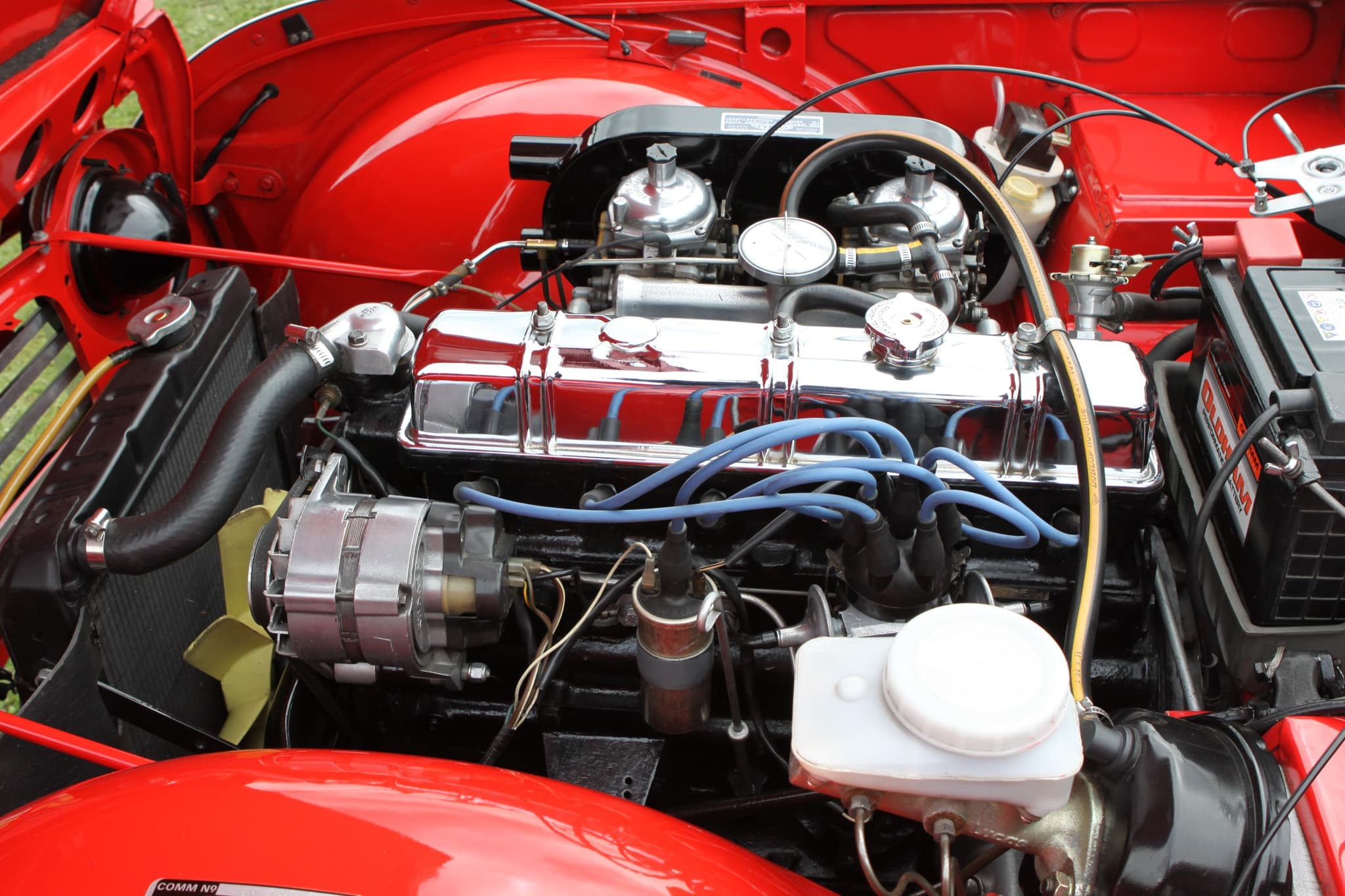
The TR5 was built for little more than a year, but it was never an orphan. Its body and frame were the TR4A's, its engine went on in the TR6 and in Triumph's 2.5 PI saloon (sedan), and the TR6 kept most of its structure, so that much of what a TR5 or TR250 needs was made for years after it, and still is.source 1source 2
What is easy to find, and what is not
The Vintage Triumph Register's (VTR's) buyer's guide is reassuring:
Parts availability for the TR5/250 are very good, with a number of major suppliers providing most parts for the TR5/250, ranging from tune up components and interior kits to replacement body panels.
Order by number, not by year. Moss Motors explains why: "Since many part changes were made during model years, the commission number, engine number and body number provide the only positive identification." Identification shows where to find them. Revington TR, which lists some of the changes between the TR4A, the TR5 and the TR250, warns that listing every change would be "a life's work" for the TR6 and, to a lesser extent, for the TR5 and TR250, and refers owners to the factory's parts books; Rimmer's TR2–TR250 parts catalogue prints a production table and the commission numbers beside its parts lists.
What is scarce is the TR250's American detail. The VTR names the yellow-and-black striped hoses and the vacuum control valve on the carburettor linkage as hard to find, and its production notes add the magnetic "Monza" fuel cap and the three-prong plug of the hazard flasher, which is not reproduced on new wiring harnesses. The German TR Register's guide lists the modern changes owners often make: polyurethane bushes in the suspension, replacement mountings for the steering rack, and plates to strengthen the brackets of the lower wishbones and the differential's mountings. On the injection, tr5passion.com records owners who have replaced the Lucas pump with one of Bosch type; how the system works and what it needs are on the TR5 PI page.source 1source 3source 4source 5source 6source 7source 8
What interchanges
| Part | Shared with | Note |
|---|---|---|
| Engine | The TR6 PI; the 2.5 PI saloon, in milder tune; the TR250's engine in the American TR6 | The same six throughout |
| Lucas injection | The TR6 PI; the 2.5 PI saloon | The same Mk II system |
| Cylinder head | The TR6 PI's; not the TR250's | Different ports on the TR250's, by Chris Harvey |
| Gearbox (transmission) | The TR4A; the Triumph 2000 and 2500 saloons; the TR6 | Gearbox numbers run in a CD series shared with the saloons; the TR6 kept the A-type overdrive |
| Frame | The TR4A; the TR6 | The German guide notes the TR6's added bracing for the wishbone brackets |
| Body | Largely the TR4's and TR4A's; the TR6 kept its centre section, doors, floors and bulkhead included | The German guide calls the TR4 to TR250 bodies largely identical |
| Dashboard | The TR250's is the TR5's | Matt wood, kept on the TR6 |
| Hardtop | The TR4's and TR4A's two-piece hardtop and Surrey top | The TR6's one-piece hardtop is different |
Clubs and registers
The clubs keep the cars' records and much of their know-how.
The TR Register, in Britain: model registrars for each TR, technical help, and buyers' sheets.
The TR Drivers' Club, in Britain.
The Vintage Triumph Register, in the United States: its TR5/250 pages, Drew Holliday's TR250 production notes and the archive of the American importer's newsletters.
TR-Register Deutschland, in Germany: Bruno Dwinger's guides to the TR4, TR5 and TR250.
tr5passion.com, in France: a site devoted to the TR5, with a registry of cars by country; it says it is not a club.
The British Motor Museum, at Gaydon: Heritage Certificates for cars built at Canley; tr5passion.com advises that the museum holds no record of the TR5s assembled in Belgium.source 14source 15source 16source 1source 5source 6source 17

Sources
Sources are given as plain text; their addresses are on the sources page.
- Primarymade at the time, by the maker or by people who were there
- Referenceserious later work: clubs, specialists, magazines, books
- Steve Gronau with David Webb (buyer's guide), "TR5/250" (history; buyer's guide), Vintage Triumph Register, modified 12 Dec 2023, buyer's guide, parts; buyer's guide, parts and originality; the club. Reference
- Aaron Severson, "Grandfather's Ax: The Many Evolutions of the Triumph TR4, Part 2: TR5, TR250, and TR6", Ate Up With Motor, 7 Nov 2012, "A new bottle: the Triumph TR6"; the 2.5 PI; "A new bottle: the Triumph TR6"; the 2.5 PI; the dash. Reference
- Moss Motors, "Triumph TR250 & TR6 Vehicle Identification", ordering by number; gearbox numbers. Reference
- Drew Holliday, "Triumph TR250 Production Information" (8 pp. PDF), Vintage Triumph Register, pp. 3–4, hoses, valve, fuel cap and flasher. Reference
- Bruno Dwinger, "Geschichte, Typenkunde und Kaufberatung: Standard-Triumph TR4, TR5/TR250 – 'die Michelotti Autos'", TR-Register Deutschland, 2009, 13 pp. (PDF), Kaufberatung, upgrades; pp. 5–6, the body; the wishbone brackets; the club. Reference
- Frédéric Reydellet (racing history), tr5passion.com (group): "En bref / Summary", "Identification", "Lucas injection", "Options", "Technical spec", "Colours", "TR5 Ginevra", "Racing history", TR5 Passion, Lucas injection page (_r63), the pump; Identification page (_r61), gearbox numbers; home page and registry. Reference
- Graham Robson (essay "15 Years of Evolution"), Triumph TR2 – TR3/3A, TR4/4A – TR5, TR250 1953–1968 Parts & Accessories Catalogue, Rimmer Bros, edn 2.1 (source code TR2512), Part 1, pp. 5–7. Reference
- Revington TR, "TR250/5 Technical Specification Change Points", the parts books; the TR250/5 changes. Reference
- Bill Boddy, "Road Impressions of: The Triumph 2.5 PI", Motor Sport, Apr 1969, p. 54, p. 54. Primary
- Chris Harvey, TR for Triumph, Oxford Illustrated Press, 1983, ISBN 0-902280-94-5, full-text passages on the cylinder heads and the TR6 wheels. Reference
- Vintage Triumph Register, "TR6" (history, year-by-year changes, US production table, buyer's guide), the overdrive. Reference
- Revington TR, "Technical Specification Change Points" (TR6), what the TR6 kept. Reference
- Bruno Dwinger, "Geschichte, Typenkunde und Kaufberatung: British Leyland Triumph TR 6PI und TR 6 (Vergaser) – Die Karmann Autos", TR-Register Deutschland, c. 2010, 13 pp. (PDF), the TR6 PI. Reference
- TR Register, "Triumph TR5 / TR250" (facts sheet, under "Buyers Guide"), the club. Reference
- TR Register, "Buyer Beware: TR6" (2 pp. PDF leaflet), p. 2, the registrars. Reference
- TR Drivers Club, "The TR5/250", the club. Reference
- British Motor Museum (BMIHT), "Heritage Certificates". Primary