Triumph TR5 PI
PI stands for petrol injection, fuel injection in American usage. The TR5 PI was the injected TR, built in 1967–68 for every market except North America, and its Lucas system, descended from racing, made it fast and gave it a reputation that period tests and club guides let us check.
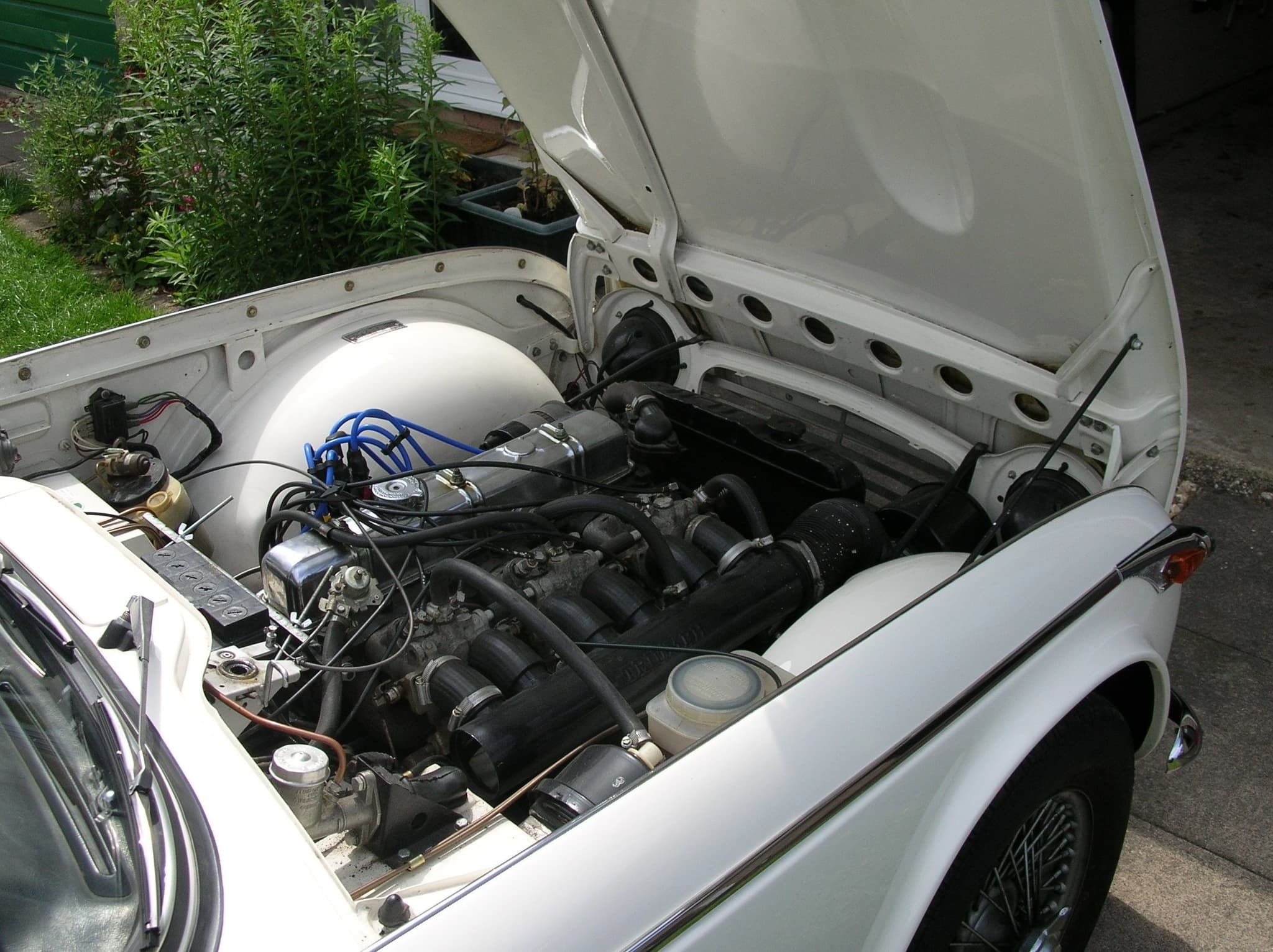
The TR5 PI's production ran from CP2, built on 29 August 1967, to CP3101, on 19 September 1968; tr5passion.com lists CP1, before them, as a prototype. It went to Britain with right-hand drive and to every export market but North America with whichever side its buyers drove on, and fewer were built than of any other TR from the TR2 to the TR6 (identification gives the count). America had its carburetted twin, the TR250, and the story of both is on history.
What made it new was under the bonnet, and Triumph's Italian brochure of October 1967 claimed a first for it in one sentence:
La Triumph TR5 è la prima vettura sportiva inglese di serie con sistema de iniezione di benzina.
In our translation: the Triumph TR5 is the first British series-production sports car with a petrol-injection system. What that first did and did not mean is answered below.source 1source 2source 3source 4source 5source 6
How the Mk II system works
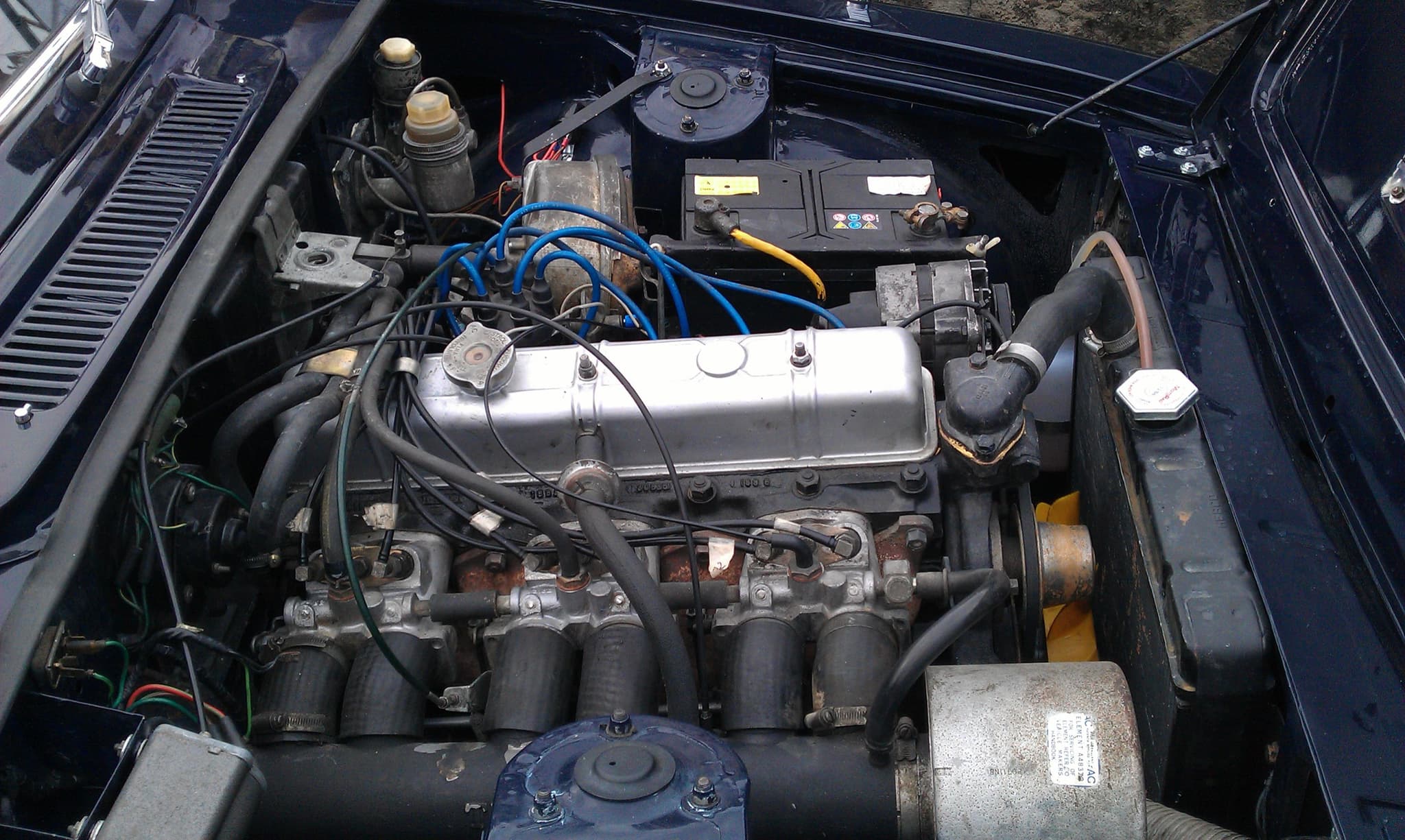
The system was Lucas's Mk II, a mechanical injection, and Motor Sport's road test of 1968 described it part by part. An electric pump drew fuel from the tank through a filter and delivered it at about 6.9 bar (100 lb per sq in) to a metering distributor, mounted low on the left of the engine and driven at half engine speed, which sent it to an injector at each inlet port. Fuel the engine did not need went back to the tank. How much it needed was decided, in the magazine's words, by "a mixture-control device which is operated by manifold pressure", and each cylinder had its own inlet tract and its own throttle butterfly.
The metering was also its weakness. Aaron Severson explains that, unlike Lucas's racing system, the road version measured fuel by the vacuum behind the six butterflies, not through a mechanical linkage from the throttle, so that its metering off idle "was less than ideal". The German TR Register's guide adds that the six butterflies sat on three throttle spindles. A knob on the console, which Motor Sport called the "choke", worked the cold-start arrangement.
The factory's brochure printed a diagram of the system, its parts numbered in Italian:
| No. | The brochure's label | In English |
|---|---|---|
| 1 | Filtro | Filter |
| 2 | Pompa comandata dal motore | Motor-driven pump |
| 3 | Valvola a sfoga di pressione | Pressure-relief valve |
| 4 | Eccesso carburante | Surplus fuel, returning |
| 5 | Comando del rotore | Rotor drive |
| 6 | Gruppo comando distributore dosatore | Metering distributor |
| 7 | Collegamento al collettore | Connection to the manifold |
| 8 | Agli iniettore | To the injectors |
The same brochure promised each cylinder a precisely measured charge whatever the conditions, a more efficient and economical fuel system, and an instant answer to the throttle. tr5passion.com, explaining why Lucas built a mechanical system, says that its pressures were beyond the electronic systems of the day. The same injection, which Bill Boddy's road impressions of 1969 gave as Lucas Mk II, went into the Triumph 2.5 PI saloon from late 1968.source 7source 5source 6source 8source 9source 3source 10
Origins: from racing to the TR5
According to Motor Sport, writing in 2000, Lucas's injection began in the air and then went racing:
Originally developed late in the war for use on the Rolls-Royce Merlin, it had been experimented with on the Jaguar XK120C Le Mans car (along with an SU competitor) and eventually saw ill-fated use in the works Jaguar D-type of 1956.
The magazine follows it into Formula 1 from 1962 on the BRM V8, and later on the Coventry-Climax V8 and the Cosworth DFV. tr5passion.com dates a Lucas research programme on a 3-litre six for a sports-racing car to 1953, and says that Lucas then widened the racing system into the Mark 2, for road engines of four, six, eight and twelve cylinders. Severson describes the road system as an adaptation of the racing Mk 1 by Lucas's injection laboratory, with a similar constant-pressure pump and a metering rotor driven from the distributor.
Triumph had already tried it on its rally cars. In Severson's account, tests in the works rally team's 2000 saloons showed that with injection, its long inlet tracts and its better distribution of fuel, the six was far more drivable on a wilder camshaft than with carburettors. Graham Robson, in his memoir of Harry Webster, put the decision plainly: "Triumph, too, was the first in the UK to take a brave pill and use Lucas fuel injection."

The engine it fed
The engine was the Triumph six, lengthened in stroke for the TR, with a cast-iron block and head, four main bearings and pushrod-operated valves. For the injected car it had higher compression than the TR250 and a hotter camshaft, of 280° against the TR250's 256° by the German TR Register's figures. The power and torque Triumph quoted for it are in the specifications, which also explains why their basis is not known.
tr5passion.com gives its firing order as 1-5-3-6-2-4, with a Lucas HA12 coil and Champion N9Y plugs, and the German guide its thermostat's opening at 82 °C. Chris Harvey adds a point for anyone who meets a converted car: the two cars' cylinder heads are ported differently, which identification takes further.
After the TR5 the injected six served the TR6 PI until early 1975, and, with a milder camshaft, the 2.5 PI saloon.source 7source 8source 6source 3source 5source 13source 10source 14
What went wrong, and the cures
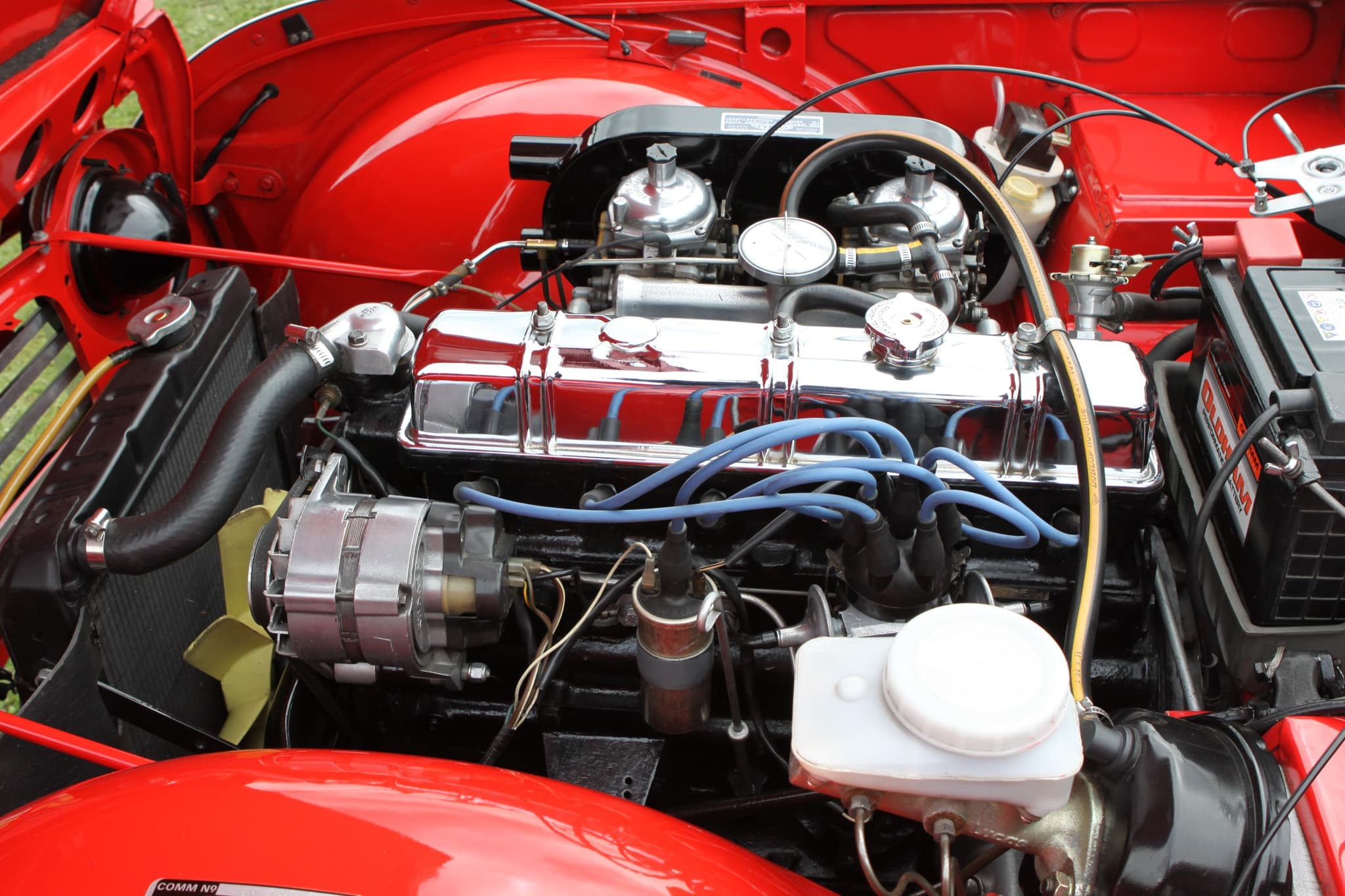
Motor Sport's test car of 1968 had its peculiarities. Its throttle was slightly sticky, so that for a while power "seemed to be either on or off, with no shades of grey in-between", and its tickover "was at first lumpy and then failed altogether", so that the driver had to heel and toe to keep the engine running at rest. It needed the best fuel, 5-star in Britain, which Severson gives as super-premium of 100–101 octane. He adds a rough idle and a thirst well beyond the four-cylinder car's.
The best-known fault came with an empty tank:
A curious feature of the TR5/Lucas petrol injection system was the very frequent occurrence of an intermittent power failure when the fuel tank was no more than a quarter full.
The club explains that the pump then drew in aerated fuel, which went round the return line until the engine faltered, and that adding as little as 4.5 litres (an imperial gallon) seemed to cure it. Severson writes that owners were well advised not to let the level fall so low that hard cornering uncovered the pump's pickup. In service, he writes, the metering unit's diaphragm springs were matched to each unit and could not be adjusted, and Triumph preferred to replace a unit rather than repair it; the filter was due every 19,000 km (12,000 miles), and the pump's seals could give trouble. Even Lucas's own engineers, he adds, "thought the use of six separate butterflies was a mistake", and the American organisation's worry about the warranty cost of the system was borne out.
The cures are on record too. tr5passion.com, which says that "At the time, this injection system that was deemed to be unreliable, gave some garage owners a lot of work", says that opinions are divided: some keep the Lucas parts, some fit a Bosch-type pump, which "seems to have solved the recurrent vapour lock problem", and some return to carburettors. For a buyer, the German guide's checks are worn throttle spindles, which let in air, and black smoke on a quick blip of the throttle when the engine is warm, a sign that it is running rich. No source read describes the rebuilding of a metering unit.
Sources
Sources are given as plain text; their addresses are on the sources page.
- Primarymade at the time, by the maker or by people who were there
- Referenceserious later work: clubs, specialists, magazines, books
- Drew Holliday, "Triumph TR250 Production Information" (8 pp. PDF), Vintage Triumph Register, p. 1, CP2 and CP3101. Reference
- Graham Robson (essay "15 Years of Evolution"), Triumph TR2 – TR3/3A, TR4/4A – TR5, TR250 1953–1968 Parts & Accessories Catalogue, Rimmer Bros, edn 2.1 (source code TR2512), Part 1, pp. 6–7. Reference
- Frédéric Reydellet (racing history), tr5passion.com (group): "En bref / Summary", "Identification", "Lucas injection", "Options", "Technical spec", "Colours", "TR5 Ginevra", "Racing history", TR5 Passion, Identification page (_r61), CP1; Lucas injection page (_r63); Technical specification page (_r65). Reference
- TR Register, "Triumph TR5 / TR250" (facts sheet, under "Buyers Guide"), markets. Reference
- Aaron Severson, "Grandfather's Ax: The Many Evolutions of the Triumph TR4, Part 2: TR5, TR250, and TR6", Ate Up With Motor, 7 Nov 2012, "Triumph TR5 PI and TR250"; "Wasp: six into TR4", the injection; "Wasp: six into TR4"; "Wasp: six into TR4"; the 2.5 PI; "Triumph TR5 PI and TR250", service and faults. Reference
- Standard-Triumph, Nuova Triumph TR5 PI (fold-out sales brochure), Italy, Oct 1967, ref. 387/1067/IT, engine page, body text; page images, the injection diagram; cover line; data panel. Primary
- Doug Nye ("D. C. N."), "Road Test Report on a Sports Car: The Fuel-Injection Triumph TR5 PI", Motor Sport, Aug 1968, p. 26, p. 26, the specification paragraph; p. 26, the induction system; p. 26, the throttle, tickover and fuel. Primary
- Bruno Dwinger, "Geschichte, Typenkunde und Kaufberatung: Standard-Triumph TR4, TR5/TR250 – 'die Michelotti Autos'", TR-Register Deutschland, 2009, 13 pp. (PDF), p. 5, throttle spindles; p. 5, main bearings, camshafts and thermostat; Kaufberatung, the injection. Reference
- Motor Sport, "Lucas fuel injection", Dec 2000, p. 39, p. 39, the shuttle; p. 39, history. Reference
- Bill Boddy, "Road Impressions of: The Triumph 2.5 PI", Motor Sport, Apr 1969, p. 54, p. 54, the 2.5 PI's injection; p. 54. Primary
- Graham Robson, "Harry Webster – My Technical Mentor", Moss Motoring (Moss Motors), 12 Jun 2019, the TR5 lines. Reference
- Motor Sport, "A–Z of Classic Sporting Cars 1950–1975", Oct 1996, p. 80, p. 80, TR5 and 300SL. Reference
- Chris Harvey, TR for Triumph, Oxford Illustrated Press, 1983, ISBN 0-902280-94-5, full-text passage on the cylinder heads. Reference
- Bruno Dwinger, "Geschichte, Typenkunde und Kaufberatung: British Leyland Triumph TR 6PI und TR 6 (Vergaser) – Die Karmann Autos", TR-Register Deutschland, c. 2010, 13 pp. (PDF), the TR6 PI. Reference
- TR Drivers Club, "The TR5/250", the low-tank fault. Reference
- Steve Gronau with David Webb (buyer's guide), "TR5/250" (history; buyer's guide), Vintage Triumph Register, modified 12 Dec 2023, buyer's guide. Reference
- TR Register, "Buyer Beware: TR6" (2 pp. PDF leaflet), p. 2. Reference