Triumph TR250K
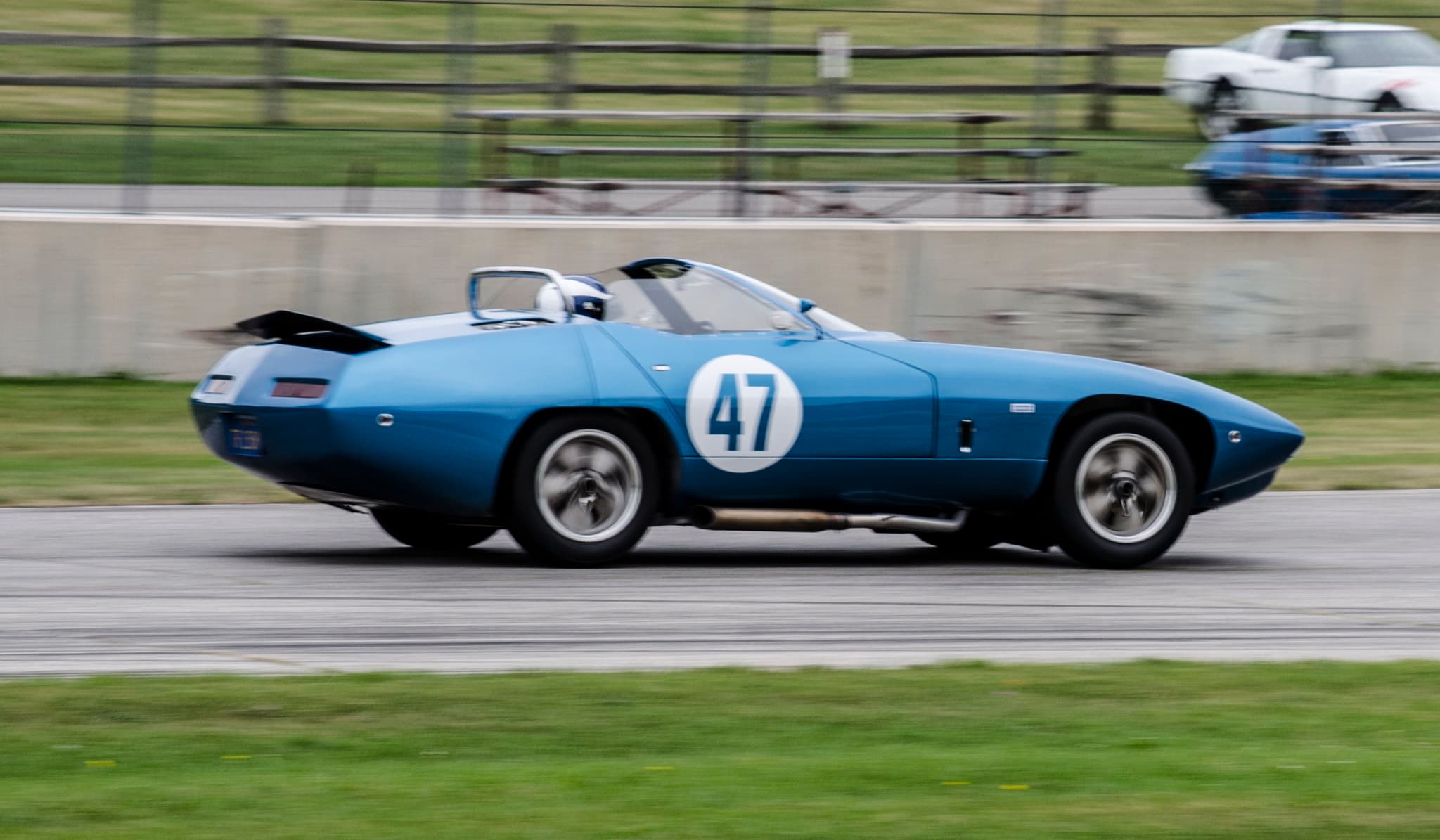
Kas Kastner and Peter Brock's one-off for the Sebring 12 Hours of 1968: the TR250's six under an aluminium body Brock drew, built in California to show Leyland what the next TR could be. It retired with a broken wheel, and Leyland never took it up.
Car and Driver put it on its cover in April 1968, and inside its editor, Leon Mandel, wrote:
Listen to this: the car is built on a production chassis but it weighs only 1550 pounds; it conforms to every safety standard in the books—and then some
The magazine's subtitle put it more briefly: "A TR-250 in an aluminum suit; Triumph bones under a beautiful skin."source 1source 2source 3
What it was
Sources for Triumph TR250K
Triumph Sports Owners Association, Triumph Sports Owners Association Newsletter, February 1968, Feb 1968 (vol. 14 no. 2)source 2; Triumph Sports Owners Association, Triumph Sports Owners Association Newsletter, April 1968, Apr 1968 (vol. 14 no. 4)source 4; Leon Mandel, "TR-250K: Salvation of an Empire", Car and Driver, Apr 1968 (vol. 13 no. 10)source 1; Peter Brock, "The Triumph That Could Have Been", Moss Motoring, 17 Jan 2020source 3; Aaron Severson, "Grandfather's Ax: The Many Evolutions of the Triumph TR4, Part 2: TR5, TR250, and TR6", Ate Up With Motor, 7 Nov 2012source 5; racingsportscars.com, Sebring 12 Hours 1968, resultssource 6
The TR250K was Kas Kastner's and Peter Brock's. Kastner ran Triumph's competition department in the United States, at Gardena in California, and Brock was the designer of the Daytona Cobra coupés. Kastner told Mandel how it began:
Pete and I have been talking a couple of years about doing a car on the TR4A chassis. It's bullet-proof, that's what Pete calls it.
The importer's newsletter called it the Triumph 250-K, Car and Driver the TR-250K, and Brock, recalling it in 2020, the K-car.
On the TR4A frame Brock put a long, low open body, panelled in aluminium, and the TR250's six, moved back. The newsletter's preview listed what else it had: the standard suspension units modified with metal bushes and anti-roll bars, Firestone tyres on magnesium wheels, square Cibié headlamps, a roll bar built into the styling, foam-filled fuel tanks and a boot (trunk) a fifth bigger than a TR250's. Its first track tests, the newsletter said, pointed to a potential of nearly 250 km/h (155 mph) and 0–60 mph in under 6 seconds. Car and Driver added that it was "all ready and waiting for a 3.5 liter V-8".
How it was paid for is told three ways, and the three fit together. Kastner, in 1968: "we were trying to figure out how to do it on his few bucks and my few bucks". Aaron Severson writes that Bruce McWilliams, Leyland's marketing chief in America, authorised the single prototype. And Peter Brock recalled in 2020 that Kastner obtained a few thousand pounds from British Leyland.source 2source 1source 3source 5
Sebring, 23 March 1968
Jim Dittemore and Bob Tullius drove it at Sebring, and its race lasted 49 laps; its entry is in the result below. The importer's newsletter reported the next month that in practice the car had been "easily faster than the MGC and a number of the more exotic entries", and that in the race a fuel line broke after 55 minutes and was repaired. Of the end it wrote:
The effort was finally halted just before three hours when Dittemore felt the rear end sway and went off the course with a broken wheel, damaging the suspension so badly that Kastner decided to retire the car.
The wheels were of a type, the newsletter said, used "on Chapparals" for several years. Peter Brock, writing 52 years later, remembered that a magnesium wheel failed, "ripping away part of the car's braking system"; the race report of the time, and the results, give the suspension. Had it finished, the newsletter thought, the TR250K would have been in the top ten, and it quoted Kastner: "If they'd re-start this race in two weeks we'd win!" Brock recalled that in the first couple of hours it lapped faster than "most of the works-backed Porsche team cars".
Kastner, Brock and the car since
Car and Driver called the TR250K "the biggest gamble Kas Kastner, Leyland Triumph's U.S. competitions director, and Peter Brock, the last of the real car designers, have ever taken", and Kastner offered Mandel a forfeit if it failed:
If we're wrong about this car, look out the window when you drive through Kansas. You're liable to see an eight-foot scarecrow out in the fields. That'll be me.
It was meant as the basis of a production TR. Severson writes that Kastner pressed George Turnbull, Standard-Triumph's chairman, to adopt it, in vain, Kastner believing that the factory dismissed it because it was not its own idea, and McWilliams holding that it could not have been built "without being hopelessly watered down". Brock later believed, Severson reports, that the TR7 "owed a lot to the TR250K".
The car survives: it was with a private owner in the United States when Brock wrote in 2020, and its later outings are set out below.source 1source 3source 5
Where it has been
- 1968
Announced as Triumph's entry for the Sebring 12 Hours
February 1968. The US importer's newsletter previewed "the Triumph 250-K": a body by Peter Brock on a production chassis (on what Kas Kastner called the TR4A chassis), six inches longer and eight inches lower than a stock TR250, with its engine 9½ inches further back, the TR250's six at 11.6:1 with three 45 mm Webers, 202 hp on the dynamometer and 12-inch Airheart discs all round. Brock recalled in 2020 that California Metal Shaping formed its aluminium panels
Triumph Sports Owners Association, Triumph Sports Owners Association Newsletter, February 1968, Feb 1968 (vol. 14 no. 2)source 2; Leon Mandel, "TR-250K: Salvation of an Empire", Car and Driver, Apr 1968 (vol. 13 no. 10)source 1; Peter Brock, "The Triumph That Could Have Been", Moss Motoring, 17 Jan 2020source 3
- 1968
Cover story in Car and Driver
April 1968. Leon Mandel's "TR-250K: Salvation of an Empire", which gave its weight as 1,550 lb
Leon Mandel, "TR-250K: Salvation of an Empire", Car and Driver, Apr 1968 (vol. 13 no. 10)source 1
- 1968
Not taken up for production
Aaron Severson, "Grandfather's Ax: The Many Evolutions of the Triumph TR4, Part 2: TR5, TR250, and TR6", Ate Up With Motor, 7 Nov 2012source 5
- 2008
Pictured at Watkins Glen
Ate Up With Motor says it has been repainted several times and is once again in its original colour "or a close approximation"
Aaron Severson, "Grandfather's Ax: The Many Evolutions of the Triumph TR4, Part 2: TR5, TR250, and TR6", Ate Up With Motor, 7 Nov 2012source 5
- 2019
Ran in the Kastner Cup at Buttonwillow
As Peter Brock recalled in 2020
Peter Brock, "The Triumph That Could Have Been", Moss Motoring, 17 Jan 2020source 3
Results
- 1968
Sources
Sources are given as plain text; their addresses are on the sources page.
- Primarymade at the time, by the maker or by people who were there
- Referenceserious later work: clubs, specialists, magazines, books
- Databaseresults and listings, entry by entry
- Leon Mandel, "TR-250K: Salvation of an Empire", Car and Driver, Apr 1968 (vol. 13 no. 10), pp. 2–4. Primary
- Triumph Sports Owners Association, Triumph Sports Owners Association Newsletter, February 1968, Feb 1968 (vol. 14 no. 2), pp. 1–2. Primary
- Peter Brock, "The Triumph That Could Have Been", Moss Motoring, 17 Jan 2020. Reference
- Triumph Sports Owners Association, Triumph Sports Owners Association Newsletter, April 1968, Apr 1968 (vol. 14 no. 4), p. 1; pp. 1–2. Primary
- Aaron Severson, "Grandfather's Ax: The Many Evolutions of the Triumph TR4, Part 2: TR5, TR250, and TR6", Ate Up With Motor, 7 Nov 2012, Sidebar: The Triumph TR250K. Reference
- racingsportscars.com, Sebring 12 Hours 1968, results, No. 47; DNF table, No. 47. Database
- racingsportscars.com, Race pages, 1968 (group): American Road Race of Champions, Riverside, 24 Nov 1968 (results); Sebring 12 Hours, 23 Mar 1968 (results); Cumberland, Kent, Virginia and Phoenix (summaries), ARRC, Riverside, 24 Nov 1968, C Production. Database